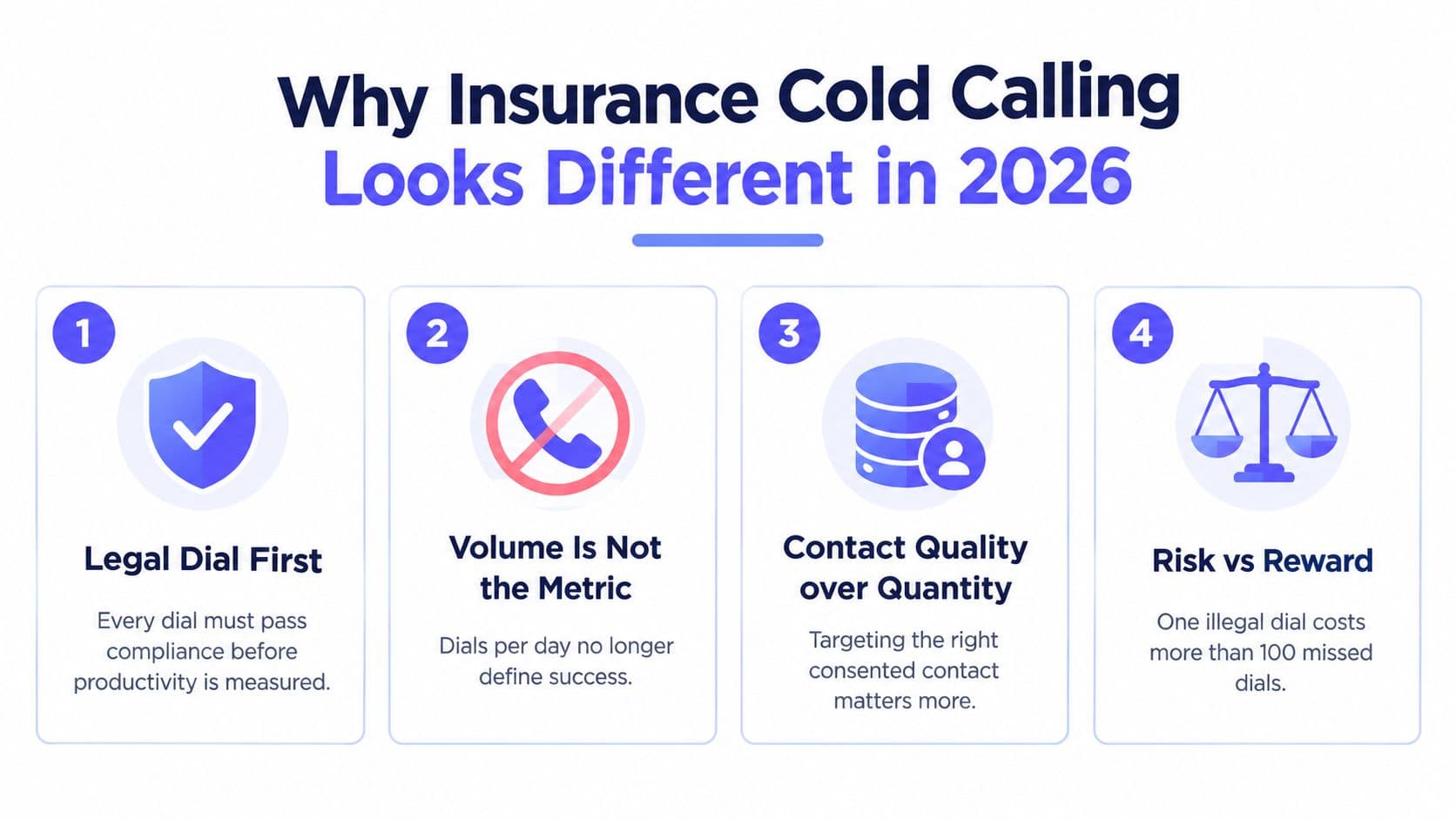
Most advice on cold calling for insurance still starts with the wrong obsession. It tells reps to “dial more” and hand harder, when the real gate in 2026 is whether the number is legally dialable, whether the prospect is actually reachable, and whether the first few seconds survive a buyer who's already screening hard and doing homework before they answer.
That shift isn't theoretical. Insurance cold calling got boxed in for years after the TCPA was enacted in 1991 and implemented in 1992, then tightened again by the FTC's Telemarketing Sales Rule in 1995 and the National Do Not Call Registry in 2003, which launched with about 30 million numbers and later grew to more than 110 million numbers, covering over 60% of U.S. households by the mid-2000s (Society of Actuaries newsletter background). If you're still measuring success by raw dials alone, you're optimizing the easiest thing to count, not the thing that decides revenue.
Why Insurance Cold Calling Looks Different in 2026
The old playbook assumed that more dials would wash out weak lists, weak timing, and weak scripts. In insurance, that mindset now creates the exact problems it claims to solve, because the front end of the funnel is constrained by compliance, callability, and trust before a rep ever gets to pitch. Modern benchmarks show cold-call conversion in insurance is typically around 1% to 2%, with broader insurance-sales summaries landing around 2% to 4%, and average answer rates near 28% (insurance cold calling benchmarks).
That's why the bottleneck isn't “how many calls can one rep make.” It's whether the list is clean, whether the contact is permitted, and whether the rep gets a real conversation instead of a dead-end answer or voicemail. One operational summary puts the average connect challenge even more bluntly, noting that some teams need about 18 attempts to connect with a single prospect in 2025, which is exactly why trust and list quality matter more than brute force (insurance outbound statistics).
What changed for outbound teams
Commercial buyers screen harder, personal buyers ignore more unknown numbers, and both groups have learned to do more research before they respond. At the same time, the legal safe zone has narrowed, especially for autodialed, prerecorded, and AI-voice outreach to cell phones, which recent guidance ties to prior express written consent and stricter consent specificity after FCC Report and Order FCC 24-15 took effect in January 2025 (TCPA consent safeguards overview).
Practical rule: treat every connected call as scarce inventory. If a number isn't clean, legal, and likely to connect, it doesn't belong in the dialer yet.
The teams that still chase volume without fixing compliance and data hygiene usually end up with low connect-to-meeting ratios, inflated voicemail activity, and burned-out agents who sound tired by the third hour. The better model is triage. Protect dialable inventory first, sharpen targeting second, then measure the call like a scarce sales event rather than a commodity.
The Compliance Gate That Runs Before Every Dial
A real insurance outbound process starts long before the ring. The first pass is suppression, because a number that should never be called can't be rescued by a good opener. Best-practice outbound hygiene includes scrubbing against the National Do Not Call Registry, checking applicable state DNC lists, maintaining an internal DNC list, and synchronizing that suppression data across systems, with one insurance compliance guide recommending fresh DNC data at least every 31 days and timestamping each scrub (DNC compliance checklist for insurance).
For personal lines, the compliance burden is heavier because consumer rules apply. For commercial lines, the federal DNC framework is narrower, but that does not mean “free to call.” TCPA rules, local calling windows, state telemarketing laws, licensing requirements, and opt-out handling still shape what's safe to dial and when. That's why I prefer a gate, not a loose checklist.
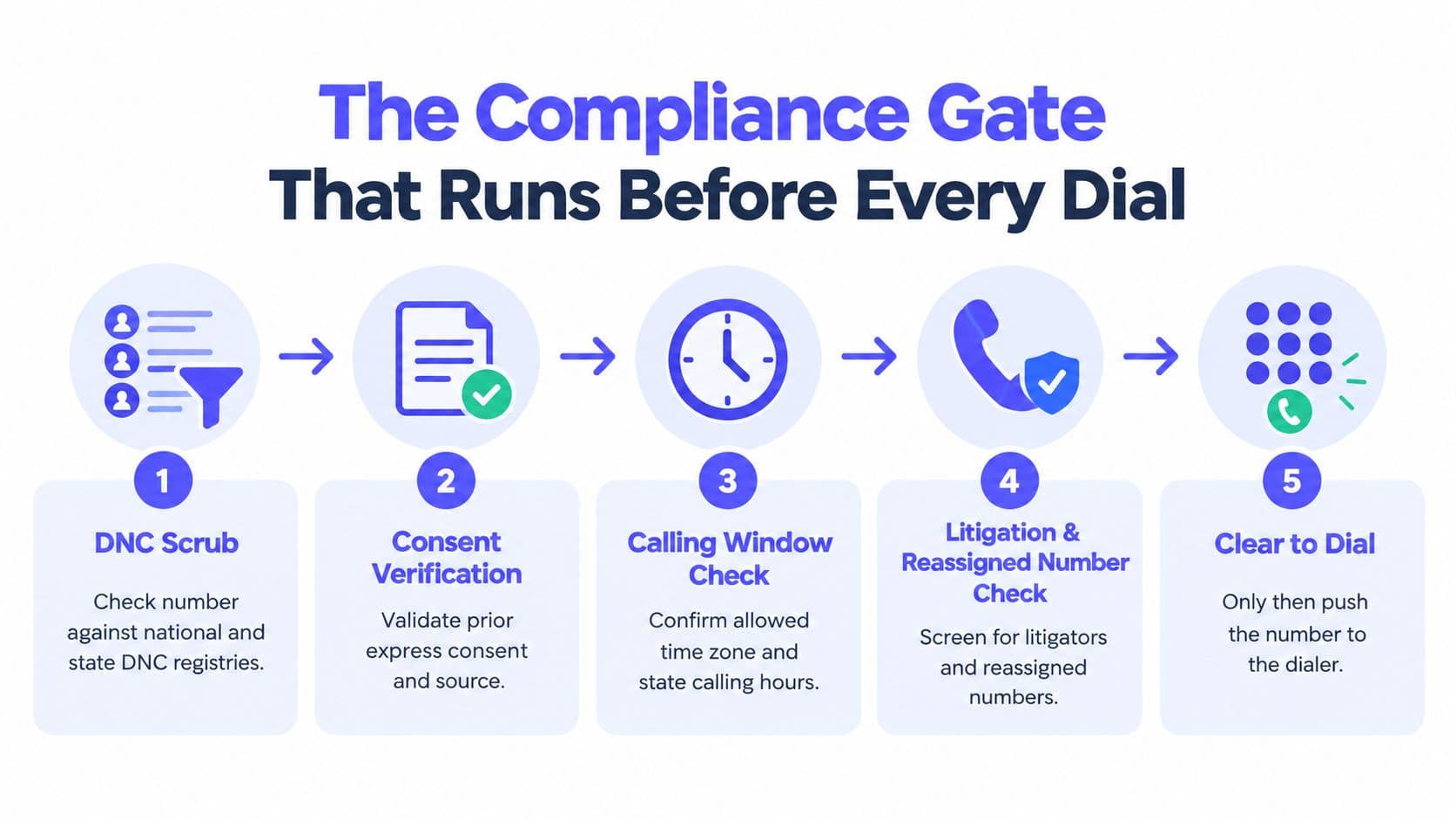
The sequence that belongs in front of the dialer
A clean workflow starts with a DNC scrub, then verifies consent provenance, then checks the calling window in the prospect's local time, then screens for suppression and litigator risk, and only then clears the record for dialing. The point is simple, if a caller can't prove the lead was callable, the campaign is already exposed.
Compliance is not a list-hygiene task you finish once. The suppression layer has to run before every campaign step, because calling windows and opt-outs change.
A practical build also needs auditability. The internal record should hold the consent source, suppression batch, call disposition, and opt-out event so a regulator-ready export can be assembled fast when someone asks for it. If the team can't explain why a number was dialed, the process isn't mature yet.
For a deeper workflow reference, the operational structure mirrors the same logic used in a dedicated DNC compliance feature set, where the point is to stop the wrong call before it starts. Here's the part most teams miss. Compliance isn't just about avoiding fines, it's also how you keep the list honest enough for performance reporting to mean anything.
Building Dial-Ready Territory Lists
Good territory lists don't start in a purchased CSV. They start with a geography, a market, and a reason the prospect should talk to you now. For insurance teams, that usually means turning a county, zip code, or drive-time radius into a queue that's already segmented by business type, role, and call priority before it ever lands in the dialer.
The sources that matter
Google Maps is useful because it surfaces local agencies, brokerages, and licensed businesses fast, and a territory scrape can be expanded with Secretary of State filings, licensing board rosters, and chamber directories. That mix gives you more than just names, it gives you the context needed to tell a relevant story on the first ring.
| Source | Best For | Typical Cost | Compliance Notes |
|---|---|---|---|
| Google Maps | Local business discovery and territory coverage | Varies by tool | Must still verify callability before upload |
| Secretary of State filings | Entity names and legal structure | Usually low-cost to access | Good for validation, not consent |
| Licensing board rosters | Licensed professionals and firm records | Usually publicly available | Helpful for role matching, not automatic permission |
| Chamber directories | Local business depth and category signals | Often member-based or public | Useful for enrichment, still needs scrubbing |
The expensive mistake is treating the first scrape as “ready.” It isn't. Names need to be split from roles, duplicate records need to be collapsed, and direct lines should only be appended where you can defend the source and the suppression status. A clean list is really a data pipeline, not a spreadsheet.
How the list becomes a queue
Territory splitting should follow agent capacity and travel logic, not just city boundaries. If one rep owns a region, drive-time polygons help avoid handoffs that scatter activity, while daily refreshes keep stale records from piling up. A territory can rot quickly when a business closes, changes numbers, or gets acquired, and insurance calling punishes stale data more than many realize.
The last step is field mapping. The cleaned CSV should carry timezone, lead source, last-touch, and assignment fields so reporting stays honest down funnel. If the dialer can't tell which list a record came from or when it was last touched, the manager ends up coaching activity that doesn't map to outcomes.
For teams that want the sourcing step embedded in the same workspace, Google Maps lead scraping is one example of how a territory can move from map to queue without unnecessary exports. That matters because every manual handoff creates room for errors, and errors in insurance outbound usually become either wasted dials or compliance exceptions.
Scripts and Call Arcs That Actually Convert
The worst insurance scripts sound like they were written to avoid rejection, not to earn attention. Good call arcs do the opposite. They lead with the trigger, establish why the call is relevant, and move fast enough that the prospect understands the point before skepticism takes over.
The four call types reps actually run
A new-business homeowner call should start with a clear purchase or shopping trigger, not a generic pitch. If someone just bought a home or recently moved, the opener should sound like a reasoned check-in, not a random interrupt. The bridge is simple, the rep references the event, then asks a narrow question about current coverage or shopping history.
A commercial lines cold call works differently because the trigger is usually a business event. Hiring, expansion, or a new location gives the rep a real reason to call, and the cleanest bridge is one sentence that ties the event to coverage risk. If the prospect responds with a short confirmation, that's the signal to move from opener to meeting request instead of continuing to explain.
A cross-sell call to an existing book should sound like account stewardship. You're not hunting a stranger, you're identifying a likely gap in the relationship, such as life or umbrella coverage sitting outside the current policy set. When the customer says they already have someone for that line, that's the cue to ask who reviewed the coverage last, then ask for the appointment.
A renewal save call is the most urgent of the four because the prospect already has another quote in hand. Here, the opener has to acknowledge the competitive quote without sounding defensive, then pivot into a concise comparison discussion. If the buyer says they're just comparing, that's engagement, and the next step is to ask for the meeting, not to keep selling over the phone.
Practical rule: the first 10 seconds should explain the trigger, not the product. If the buyer has to ask why you called, you've already lost one turn of attention.
Tone matters as much as wording. Reading a script verbatim makes the call sound manufactured, especially in insurance where buyers are already expecting a pitch. The better reps use the structure, then speak naturally enough that the line feels like a conversation with a purpose.
Following Up When the Call Goes to Voicemail
A missed call is not a dead lead. It's a multi-touch sequence that just started late. One rep can turn a voicemail into a useful path forward by keeping the message short, tying it to the trigger event, and carrying the same context into SMS and email without sounding repetitive.
The voicemail itself should stay under 20 seconds. Say the reason for the call, leave the callback number twice, and skip the pitch entirely. If the number is legal to text, a short SMS 15 minutes later can add the same callback number and one line of value, while the same-day email should stay brief, use a subject line tied to the trigger, and keep the body under 120 words.
For the follow-up stack, a shared messaging layer can help keep the same context across channels, which is why teams often want calling, SMS, and email in one place rather than stitched together across tools. A platform like GrowOutly combines those pieces with a CRM and booking workflow, which is useful when a missed call needs to become a tracked sequence instead of a forgotten note.
A workable cadence
Day one is voicemail, SMS, and email. Day two gets a second call attempt with a different opener. Day three adds a LinkedIn connect if the prospect is reachable there. Day seven gets the breakup email that asks directly whether the timing is wrong.
The discipline is in the logging. Every touch belongs in the CRM so the next rep inherits context, not a blank record. That matters more than most managers admit, because a prospect who's already heard the story once will punish a second rep for sounding clueless.
A voicemail that doesn't create context is just a lost minute. A voicemail that feeds the next touch still has value, even when nobody calls back.
Metrics That Reveal Where Your Funnel Leaks
Most insurance teams look at one number and miss the leak. They celebrate dials, complain about low answer rates, and then argue about script quality without separating where the funnel is breaking. The useful view is staged, because each stage answers a different operational question.
The first stage is dial-to-connect, which measures how often a dial reaches a live person. The second is connect-to-appointment, which shows whether the opener and qualification flow are converting a conversation into a meeting. The third is appointment-to-bind, which tells you whether the follow-through, quote quality, and sales process are turning meetings into business.
| Stage | Input | Output | Healthy Benchmark |
|---|---|---|---|
| Dial-to-connect | Total dials | Live conversations | Scrubbed-list connect rate above 8% |
| Connect-to-appointment | Live conversations | Booked meetings | Appointment rate above 4% of connects |
| Appointment-to-bind | Qualified appointments | Bound business | Bind rate above 35% of qualified appointments |
A weak dial-to-connect rate with a decent connect-to-appointment rate usually points to list quality or calling window problems. The opposite pattern suggests the prospect is picking up, but the opener or handoff isn't doing enough work. That's the difference between a sourcing issue and a script issue, and managers need to coach them separately.
The metric most teams miss is time to second touch after a voicemail. Insurance pipelines stall fast when follow-up slips past a day, because the prospect no longer links the call, the text, and the email as one sequence. The fix isn't more pressure, it's tighter response choreography and cleaner logging.
Your Pre-Launch Checklist and Weekly Review
A pre-launch checklist keeps the program from starting in a bad state. Every list should carry a timestamped suppression export, every script should include a written TCPA disclosure, and the dialer should enforce state-specific calling windows instead of trusting reps to remember them. Opt-out keyword handling, call recording consent language, and a documented dispute process for consumer complaints also need to be in place before volume starts.
The weekly review should stay small enough that someone runs it. Pull DNC scrub frequency, opt-out capture rate, connect-to-conversation ratio, conversation-to-meeting rate, and meeting-to-bind rate, then look for drift before it becomes either a complaint pattern or a quota miss.
| Metric | Weekly Target | Red Flag |
|---|---|---|
| DNC scrub frequency | Fresh and timestamped before launch and on a recurring cadence | Old suppression data or missing scrub records |
| Opt-out capture rate | Immediate logging of every request | Verbal opt-outs that never reach the CRM |
| Connect-to-conversation ratio | Stable and trending with clean lists | Calls answered but no real conversation |
| Conversation-to-meeting rate | Consistent enough to forecast | Good connects, weak handoff to calendar |
| Meeting-to-bind rate | Healthy follow-through after qualified meetings | Meetings happen, but quotes don't convert |
A manager who reviews those five numbers weekly can see compliance drift and funnel leaks before they turn expensive. That's the primary advantage of treating cold calling for insurance like an operating system instead of a motivational exercise.
If you want a dialing workflow that keeps compliance, calling, SMS, email, and booking in one place, GrowOutly is built for outbound teams that need the list, the dialer, and the follow-up trail to stay connected. For insurance teams, that means fewer handoffs, cleaner audit logs, and a simpler path from first call to booked meeting.
Enhanced by the Outrank tool