Most advice about how to close sales still treats the close like a magic line you deliver at the end of a pitch. That's lazy thinking, and it's why so many reps confuse pressure with progress. In outbound, the close is usually a sequence of small agreements, timed follow-ups, and a final handoff that keeps the buyer moving when the conversation gets messy.
The math backs that up. Average B2B close rates sit around 20 to 21%, only about 2% of sales close on the first meeting, and roughly 80% of deals need at least five follow-up touchpoints before a decision happens, while 44% of reps stop after one follow-up, which leaves a lot of pipeline sitting dead Thunderbit's sales closing benchmark compilation. If you want a practical workflow for outbound calling, you need a system that builds momentum, not a script that hopes for a sudden yes.
Rethinking the Sales Close in Outbound Environments
The biggest mistake in outbound is assuming the close starts after discovery ends. In reality, the rep is closing from the first useful question onward by confirming pain, testing urgency, and getting the buyer to agree on what success looks like. If that work is sloppy, no amount of polished phrasing at the end will rescue the deal.
That's why the myth of a single “magic closing line” falls apart fast in high-volume environments. Benchmark data shows the close is usually a sequence of interactions, not one dramatic moment, and teams that build systematic follow-up into their process tend to outperform reps who end the call without a next step Thunderbit. The practical lesson is simple, finish the call with movement, even if that movement is just a calendar hold, a stakeholder intro, or a clear reason to reconnect.
Practical rule: if the buyer leaves the conversation without a date, a task, or a decision owner, you probably didn't close anything yet.
That mindset shift matters because outbound buyers rarely decide on the spot. They compare, defer, loop in other people, and wait for proof that your offer solves a real problem. A consultative posture keeps pressure low and credibility high, which is exactly what you want when the prospect is still forming the internal case.
The cleanest way to think about close sales techniques is as a progression, not a performance. You're not trying to win a courtroom argument. You're trying to guide a buyer from interest to commitment without creating friction they don't need.
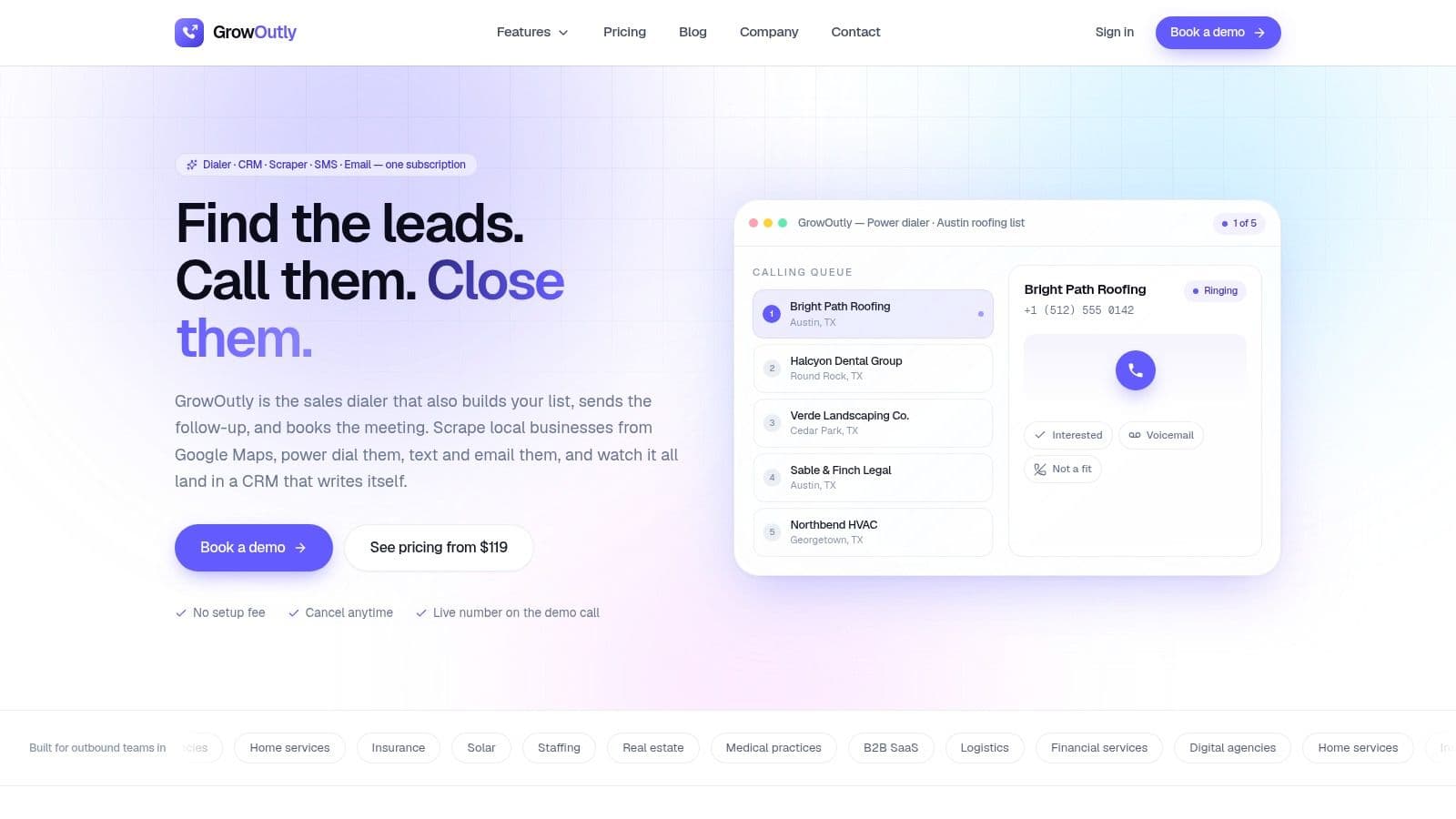
One reason this matters operationally is that your team needs a repeatable motion, not heroics from the rep who happens to be smooth on the phone. If your outbound stack can support outgoing calls, follow-up triggers, and booked meetings in one place, the rep spends less time stitching the process together and more time advancing the deal. A platform like GrowOutly's outgoing calls workflow fits that kind of motion because it keeps the call, the next step, and the follow-up path connected.
What the real close looks like
- Confirm the problem. The buyer has to recognize the pain in their own words.
- Restate the impact. Tie the problem to something the prospect already cares about.
- Offer one next step. Keep it low-friction and specific.
- Lock the calendar action. A vague promise to reconnect is not enough.
That sequence is what makes closing feel earned. It replaces force with structure, and structure is what keeps outbound from turning into random acts of persistence.
Proven Closing Techniques for High-Volume Teams
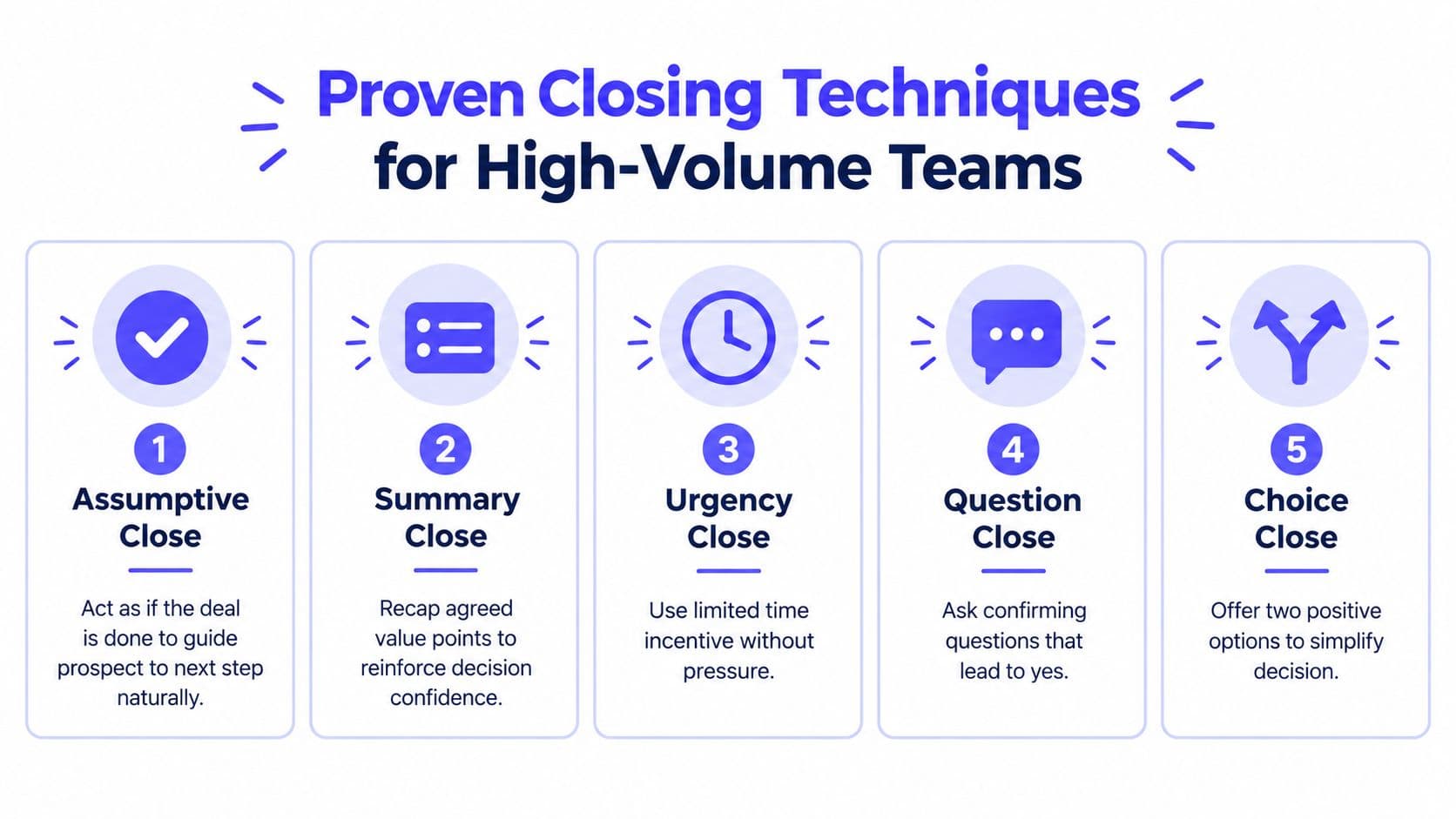
High-volume teams don't need more pressure. They need closing moves that make it easy for the buyer to say yes to the next step. The strongest close sales techniques work because they reduce friction, narrow the choice, and keep the conversation anchored to value the buyer already accepted.
Assumptive close
Use this when the buyer has signaled interest and the remaining issue is logistics. Don't ask, “Do you want to move forward?” Ask like the deal is already in motion, then give the buyer two clear scheduling options.
A clean line sounds like this, “Based on what we mapped out, the next step is to get time on the calendar. Does Tuesday morning or Thursday afternoon work better?” The value of this approach is that it keeps the buyer focused on action instead of reopening the whole case.
Summary close
Use this when the conversation is longer, the value proposition is complex, or the buyer has been juggling competing priorities. Re-state the agreed points in one tight recap, then ask for the commitment.
A useful script is, “You said the main priorities were lowering manual follow-up, shortening response time, and keeping the team in one system. If those are still the right goals, I'd like to send the agreement and line up the kickoff.” The summary close works because it reminds the buyer why the deal made sense before doubt had room to grow.
Alternative choice close
Use this when the buyer is hesitant but not opposed. Present two positive options, both of which move the deal forward. The point isn't to corner them, it's to simplify the decision.
Try, “Would you rather start with the lighter rollout and expand after the first month, or get the full setup in place now and book onboarding this week?” That's a much better conversation than a blunt yes or no, because it gives the buyer control without letting the deal stall.
The best close usually feels like scheduling, not selling.
The wrong move is to pile on intensity right when the buyer is trying to think clearly. If the conversation already produced agreement on pain, impact, and next steps, the ask should sound like a natural continuation of that logic. If it doesn't, you're probably closing too hard.
For teams running repeatable outbound motions, the right software matters because the ask has to connect cleanly to the rest of the workflow. GrowOutly's outbound call center software is relevant here because it supports the mechanics around the call, the follow-up, and the booking step without forcing reps to bounce between tools.
Handling Objections Without Losing Momentum
Objections aren't the end of the conversation. They're the moment the buyer stops hiding behind politeness and tells you what's blocking the deal. A good rep doesn't get defensive, they isolate the issue and keep the tone collaborative.
Take the classic “send me an email.” In most cases, that's not a request for more email, it's a request to escape a decision they don't yet feel ready to make. The clean response is to acknowledge the ask and then get specific about what the email needs to accomplish. “Happy to send something over. Before I do, what would be most useful to see in it, the pricing summary, the implementation steps, or the comparison against your current process?”
LAER in a real call
The LAER model works well here because it keeps the rep from talking over the objection.
- Listen. Let the buyer finish without jumping in.
- Acknowledge. Show you heard the concern.
- Explore. Ask what's underneath it.
- Respond. Give a direct answer tied to the blocker.
A prospect says, “We already have a vendor.” The weak response is to attack the current vendor. The stronger response is, “That makes sense. What's working well today, and where are you still having friction?” That question changes the tone from combat to diagnosis.
Or take, “Call me next quarter.” If you accept that at face value, you've probably lost the deal. Instead, probe for timing. “I can do that. What changes between now and next quarter that would make this a better fit then?” If they can't explain a real trigger, you've got a stalled deal, not a scheduled one.
What to do when the answer is still vague
Ask one more question before you respond. Most weak closes happen because the rep answers the surface objection instead of the real one.
That matters in complex B2B buying groups, where the person on the phone may not be the final decision-maker. The objection you hear may be cover for someone else's concern, or a polite delay while they gather internal consensus. You don't need to win the argument in the moment, you need to keep the thread alive long enough to get to the actual blocker.
The practical difference between strong and weak objection handling is tempo. Strong reps stay calm, ask one targeted follow-up, and move the call back toward a decision point. Weak reps defend the offer, over-explain the product, and make the prospect feel like they have to escape.
Structuring the Multi-Touch Follow-Up Sequence
Closing usually fails in the gap between interest and decision. That gap gets wider when reps stop after one or two touches, even though multiple industry summaries note that 80% of successful sales require 5+ follow-ups and 93% of converted leads are reached by the sixth call WorldMetrics' follow-up sales statistics. Persistence works when it's structured, timely, and varied. It fails when it becomes a lazy “just checking in” loop.
A follow-up sequence that keeps momentum
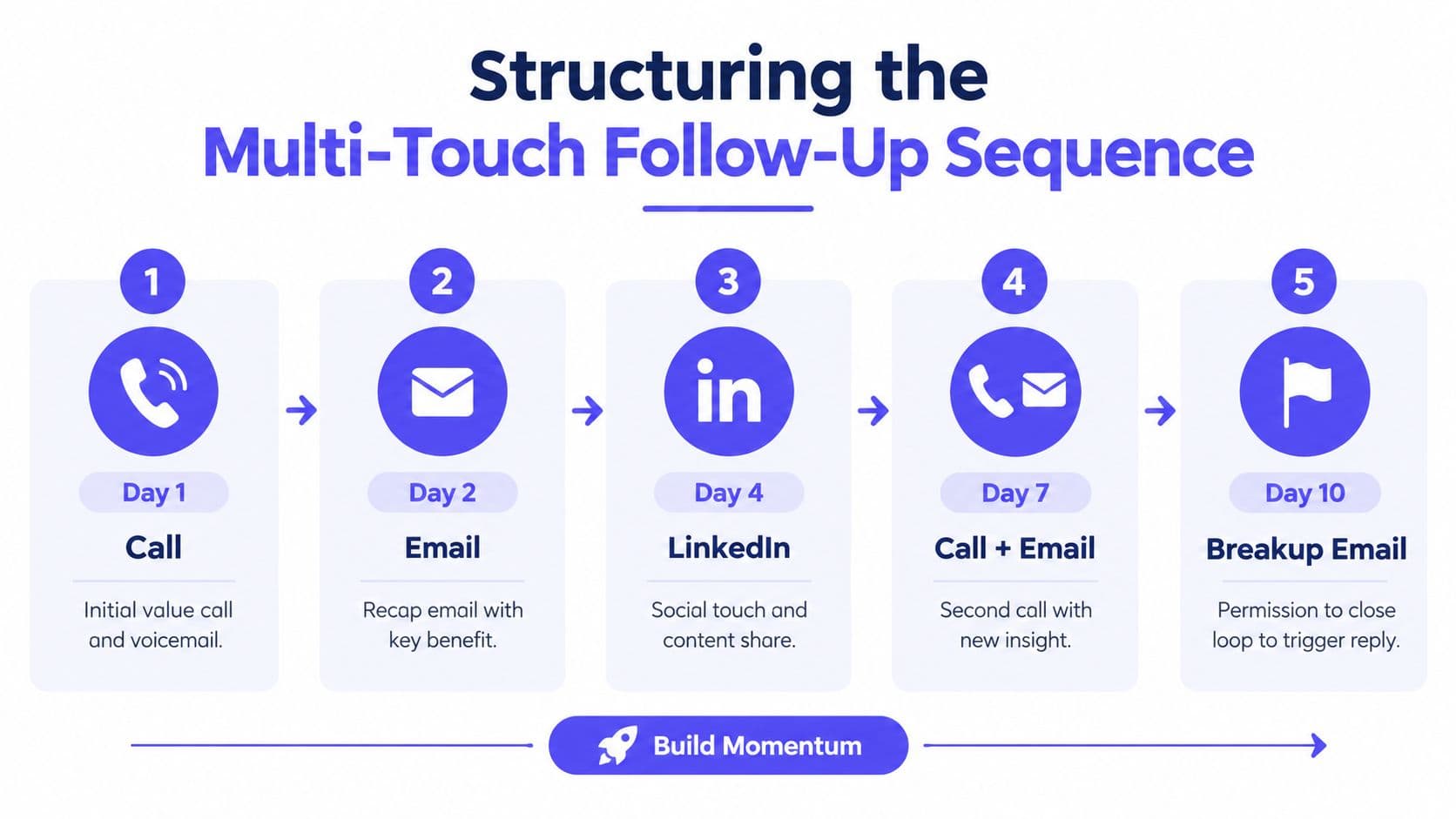
A practical sequence looks like this:
- Day 1, call plus voicemail. Reaffirm the value discussed on the live conversation and state the next step.
- Day 2, email recap. Summarize the problem, the agreed value, and the action needed.
- Day 4, LinkedIn touch. Share a relevant insight or article that adds context.
- Day 7, second call plus email. Bring a new angle, not the same message again.
- Day 10, breakup email. Give permission to close the loop and trigger a response.
That sequence works because it changes the medium while keeping the thread intact. If you only call twice and stop, you're behaving like the rep who quits before the buyer has finished thinking.
The content of each touch matters as much as the timing. A follow-up should add new information, not repeat the original pitch in a different font. Reference the last conversation, name the blocker if you know it, and make the next step easy to accept.
Compliance can't be an afterthought
The follow-up system also has to stay clean from a TCPA and DNC standpoint. Guidance in the results says businesses should scrub calling lists against the National Do Not Call Registry every 31 days, call between 8 a.m. and 9 p.m. in the recipient's local time zone, and honor internal opt-out requests indefinitely TeleVista Lead Generation's TCPA compliance guide. Another compliance summary notes that violations can carry penalties of up to $50,120 per call, and that prerecorded messages or autodialers need prior express consent, with written consent required in some cases PossibleNow's compliance summary.
That's why the best outbound teams use automation gates before every dial or SMS. They also keep records of call times, scripts, consent, and opt-outs so there's an audit trail if a dispute comes up. If your process can't show that discipline, it's not a process, it's a liability.
For teams that want the close and the follow-up to live in the same motion, a tool with built-in CRM and follow-up automation helps reduce handoff errors. GrowOutly's CRM is one option for keeping notes, dispositions, and follow-up actions tied to the same account record.
Coaching and Role-Play Workflows for Sales Reps
Scripts don't fail because the wording is bad. They fail because the rep can't deliver them under pressure, in front of a skeptical buyer, after three objection pivots and a scheduling question. Managers who want better closes need a coaching system that isolates the exact moment where the rep loses control.
Run role-play like a live deal
Role-play should sound like the calls your team gets. Don't practice generic “closing” in a vacuum. Give the rep a pain point, a timeline, a stakeholder wrinkle, and one objection to overcome. Then make the rep ask for the next step out loud.
A strong session has three parts:
- Live scenario. One manager plays the buyer and throws in realistic resistance.
- Immediate replay. The rep repeats the same close with one correction.
- Scored feedback. The manager marks exactly where the rep lost clarity or momentum.
That last part matters. “Be more confident” isn't feedback, it's noise. “You asked for the signature before confirming the stakeholder” is useful because it gives the rep a fix they can apply on the next call.
Score the call, not the personality
Use call recordings to identify patterns, not to punish people for sounding awkward. The point is to hear whether the rep:
- Asked for a specific next step
- Handled the objection directly
- Kept the tone consultative
- Confirmed the calendar action before ending
A rep who gets stuck after “send me info” usually doesn't need more enthusiasm. They need a better transition line and a stronger habit of asking what the email should contain. Another rep may be fine on discovery but rush the close too early, which means coaching should focus on timing instead of phrasing.
Manager rule: coach one behavior per rep per week, or the feedback gets diluted and nobody changes anything.
A good scorecard also helps reps self-correct. Once they know what strong execution looks like, they stop treating the close like a personality trait and start treating it like a skill set.
Build repetition into the calendar
The best teams don't wait for onboarding to teach closing. They build ongoing practice into the week. Short, frequent reps beat occasional long workshops because the language stays fresh and the edge cases stay visible. That's how closing turns from something reps hope they can do into something they've rehearsed enough to trust.
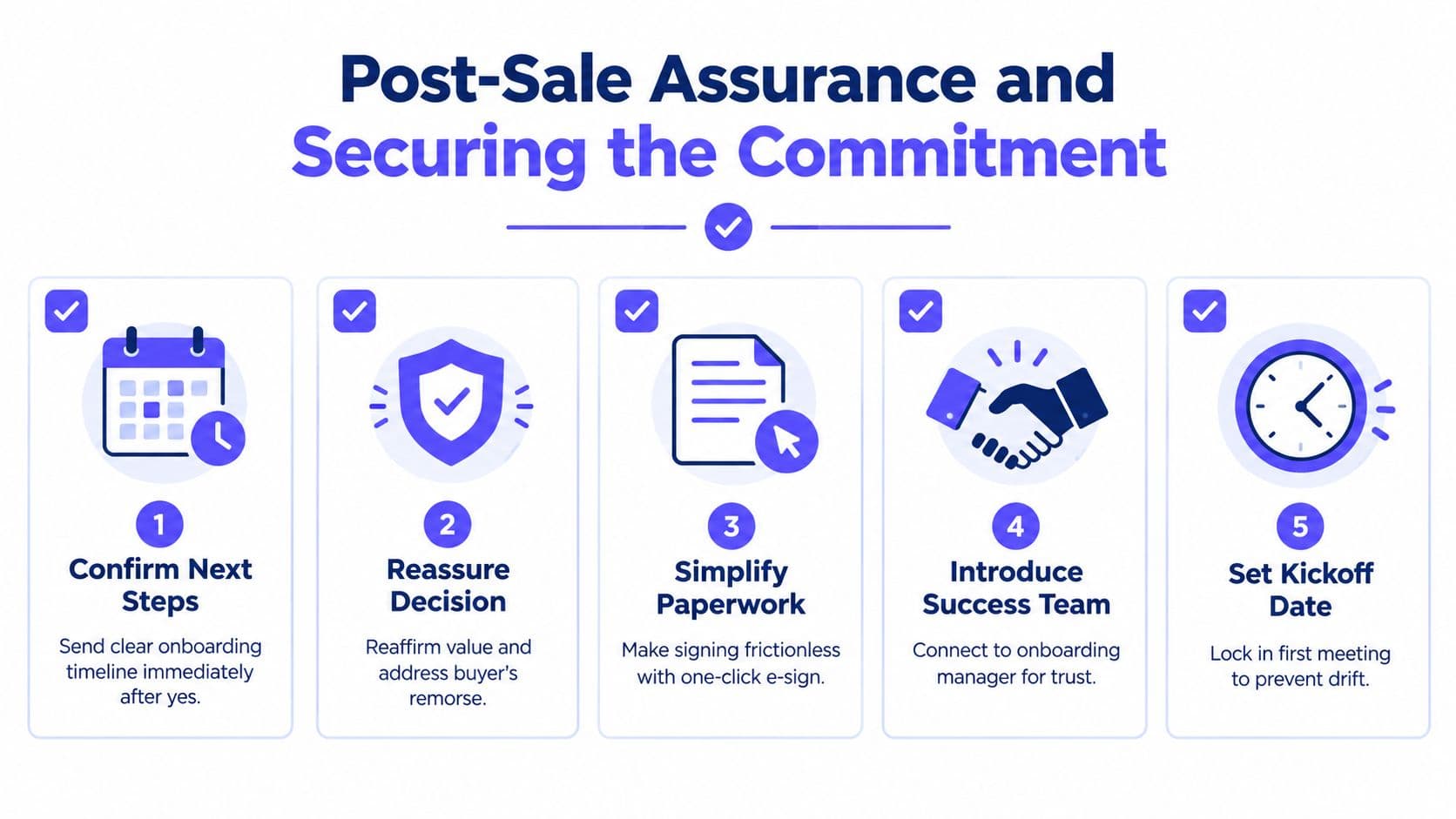
Post-Sale Assurance and Securing the Commitment
A verbal yes is progress, not closure. Complex deals still drift after the buyer agrees in principle because the paperwork is slow, internal alignment breaks down, or buyer's remorse sneaks in once the excitement fades. The overlooked part of the process is post-sale assurance, and newer research frames closing as three phases, closing preamble, closing moment, and post-sale assurance, rather than a single line or tactic Baylor's Keller Center paper on rethinking the close.
Lock the commitment before the paperwork slows everything down
The first move after the yes is to confirm the next milestone in plain language. “I'm sending the agreement now, and I've booked the kickoff for Tuesday so we don't lose momentum.” That keeps the buyer focused on motion, not on second-guessing.
Then make the administrative path painless. If the buyer has to hunt for the contract, wonder who signs next, or figure out where onboarding starts, momentum leaks out of the deal. The handoff should be simple, visible, and immediate.
Reassurance matters after agreement
This is the moment to reinforce the value without reopening the sale. Reiterate the problem they're solving, the outcome they wanted, and the fact that the next step is already set. That kind of steady follow-through helps reduce the kind of hesitation that appears after the room goes quiet.
The final handoff also needs internal clarity. The buyer should know who owns onboarding, what happens first, and when the first live interaction is happening. Calendar booking and reminders reduce the back-and-forth that lets closed-won deals drift back into “almost there.”
The cleanest closes don't end with excitement, they end with certainty. The rep leaves no ambiguity about what happens next, the buyer has no reason to stall, and the transition to customer success feels like a continuation instead of a restart.
If you want a cleaner outbound close, better follow-up discipline, and fewer deals lost to silence after the first yes, build the process into the workspace your team already uses. GrowOutly gives outbound teams calling, messaging, CRM, and booking in one flow, which makes it easier to turn live conversations into scheduled next steps.
Created with Outrank