Most advice on skills based call routing starts in the wrong place. Teams are told to add more skill tags, tighten the IVR, and let the system sort things out, but a longer skill list can just as easily create more misroutes, more repetition, and slower service when the taxonomy gets too rigid or stale.
The better framing is operational. Routing is a live policy that balances caller intent, agent capability, queue pressure, and fallback behavior in real time, not a static directory of who knows what. That shift matters because the work is deciding how precise the match should be before the queue starts to harm the experience.
Rethinking Skills Based Call Routing
A lot of contact centers still treat routing like a labeling exercise. They build a skill spreadsheet, assign a few tags, and assume the right call will land with the right person if the taxonomy is detailed enough. That's not how the queue behaves under pressure, especially when caller intent is messy and agent availability changes by the minute.
The more useful view is dynamic operational policy. Skills based call routing should take the caller's reason for contact, current demand, and real agent capacity into account, then make a staged decision rather than a one-shot assignment. That's why inbound call routing software is most effective when it can combine intent, skill, and availability instead of relying on a single static rule. That comparison covers which platforms do it; our inbound call routing buyer's guide covers how to evaluate them. This guide is about configuring the policy once you have one.
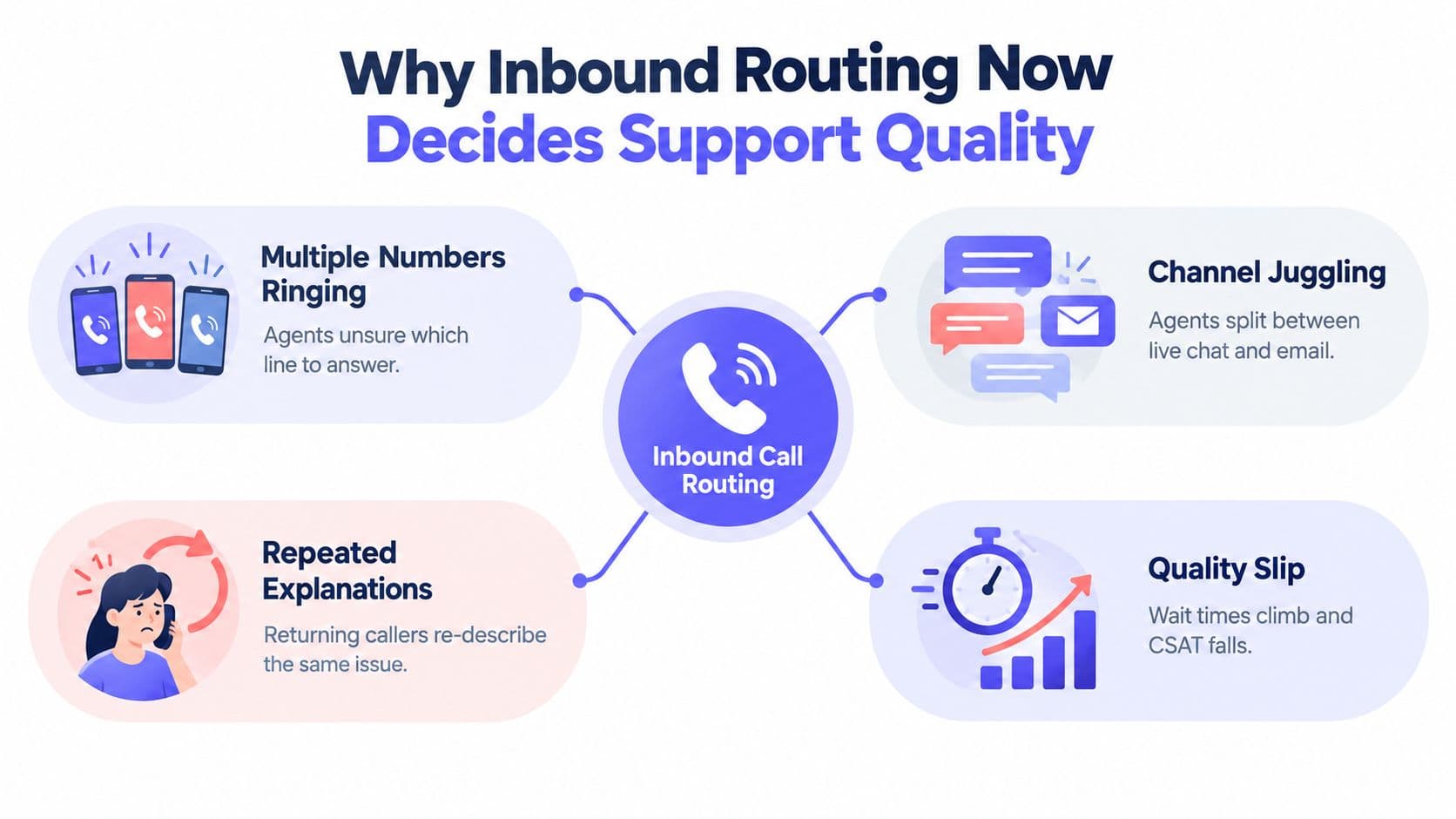
A rigid skill tree can hurt the experience in two directions at once. It can over-direct callers into narrow paths that don't quite fit, and it can strand them when the “perfect” agent isn't available. In practice, that means more transfers, more repetition, and more time spent waiting for a specialist who's tied up on another queue.
Practical rule: define routing around the customer's problem, not the department chart.
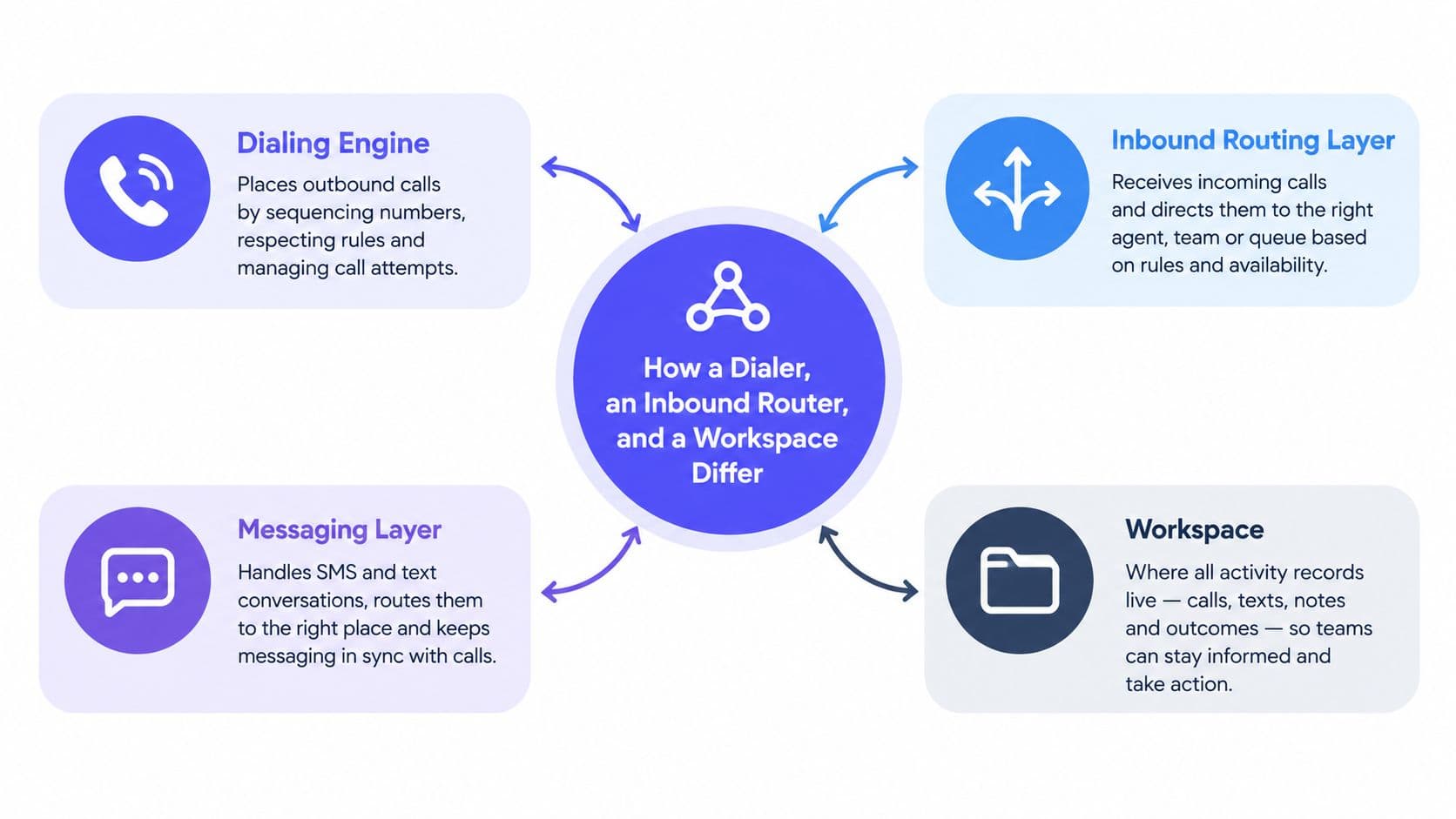
The capacity side of this is staffing math rather than taxonomy work, and our call center dialer software buyer's guide covers where the dialing engine ends and the routing layer begins, which matters when the same agents handle both.
The best operators keep the taxonomy small enough to stay current and broad enough to avoid dead ends. They also treat every routing rule as something to test against abandonment, transfer behavior, and resolution quality, not just agent utilization.
The Mechanics of Staged Matching Algorithms
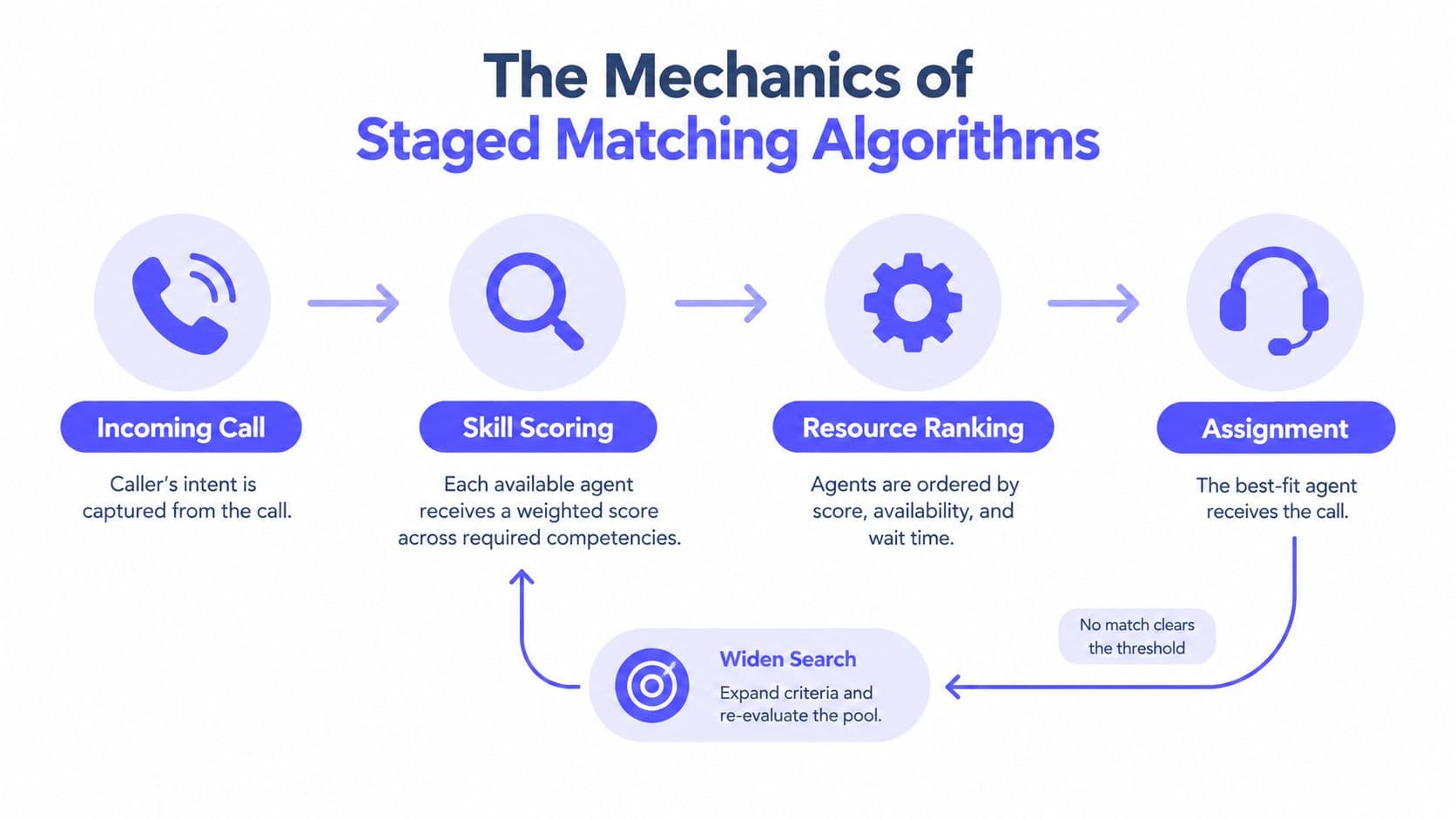
A good ACD doesn't just ask, “Who's free?” It asks which agent is both qualified and available, then decides how long to hold that standard before widening the search. That staged approach is where skills based call routing becomes more than a telephony feature.
The underlying logic is resource pooling. Columbia's contact-center staffing research shows that limited cross-training can deliver much of the capacity benefit of a fully cross-trained workforce, and that agents with only two well-chosen skills can perform nearly as well as fully cross-trained agents in simulation, while assigning at least two skills produced significant gains in almost all tested scenarios (Columbia University research). The point isn't to make everyone an expert in everything, it's to design skill combinations that let capacity flex when one queue spikes.
How staged matching works in practice
The routing engine first translates the inbound interaction into required skills. That might come from IVR input, language choice, account context, or CRM history. It then ranks agents by skill match, proficiency, availability, and queue pressure, and only then assigns the call.
A sensible setup usually follows this sequence:
- Primary skill match. Offer the call to agents who hold the highest-priority skill set.
- Timed expansion. If no one answers within a defined interval, widen eligibility to secondary skills or lower proficiency bands.
- Tie-breaking logic. Use longest available time, lowest occupancy, or highest proficiency to resolve collisions.
- Overflow behavior. Route to a broader queue, offer a callback, or escalate to a human fallback path.
That structure is cleaner than permanently throwing everything to the nearest generalist. It preserves first-contact resolution when the queue is healthy and protects service levels when it isn't.
GrowOutly's incoming calls feature fits this model because the routing decision can respect context without flattening every interaction into a generic queue. The practical lesson is simple, the system should widen gracefully, not panic.
Building a Caller-Centric Queue Taxonomy
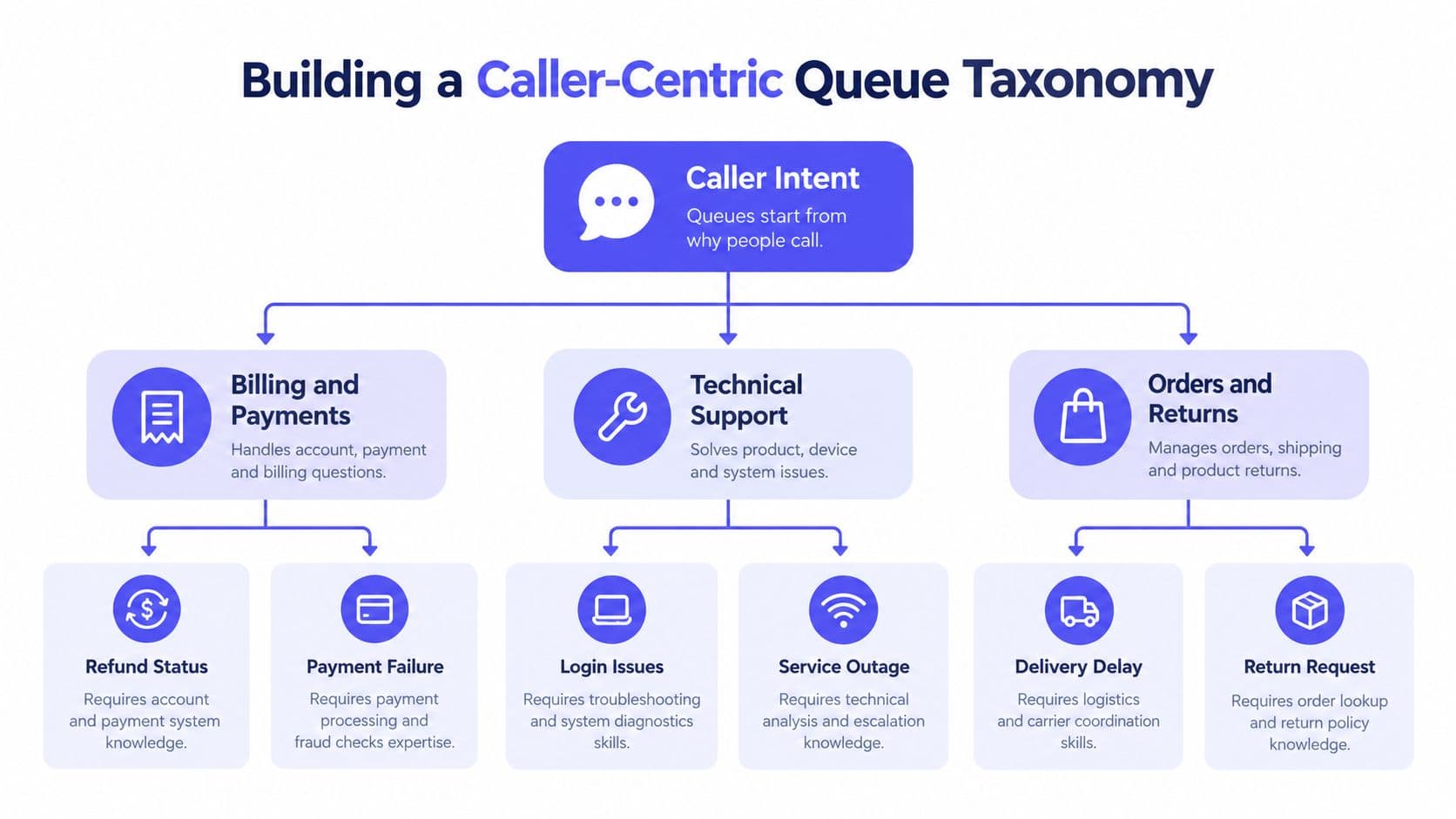
Queue design works best when it starts with what customers say, not what your org chart says. A billing team, for example, may need separate flows for payment disputes, invoice questions, and subscription changes because those are different intents with different handling needs. The routing model gets more stable when each queue maps to a real caller reason.
A practical build sequence
Start with call log review, then group interactions by language, product, urgency, and issue type. If a category is too narrow to justify its own queue, fold it into a broader one and use proficiency rules to sort the calls inside that queue. The goal is to keep the taxonomy auditable, not impressive.
Then define proficiency with observed work, not stale CRM fields. A simple three-tier model works well for nearly every team.
- Learning. The agent can take the call with support, coaching, or lighter complexity.
- Competent. The agent can resolve the call independently in normal conditions.
- Advanced. The agent handles the most complex or high-risk versions of that intent.
A skill record should expire or be reviewed if it's no longer backed by current performance.
That matters because routing based on outdated fields creates hidden misroutes. A person can remain tagged as qualified long after their performance has shifted, and the queue will believe a bad record before it believes the caller.
The final piece is threshold behavior. Every queue needs a rule for what happens when demand exceeds specialist supply. A callback offer, overflow to another qualified queue, or a handoff to a generalist pool is better than letting callers sit inside a fantasy of perfect matching.
Integrating SMS Outreach and Compliance Keywords
Voice routing and text outreach seem different, yet they depend on the same operational skill, reading intent fast and acting without extra friction. In SMS, that usually means spotting a consent withdrawal before the next campaign send goes out. If your intent layer can classify why someone contacted you, it should also recognize when they are telling you to stop.
Common SMS opt-out keywords include STOP, END, CANCEL, UNSUBSCRIBE, QUIT, and phrases such as OPT OUT. Replies that contain those terms should immediately stop campaign messaging and may receive only a single non-promotional confirmation. Reasonable requests like “please don't contact me” should also be treated as opt-out intent rather than forcing the customer to use one exact word or form. For the compliance side of that workflow, see our guide to TCPA compliance, the TCPA compliance checklist for outbound teams for running opt-outs through a single gate, and the Infobip SMS compliance guidance.
| Keyword / Phrase | Required System Action | CRM Logging Requirement |
|---|---|---|
| STOP | Suppress future campaign messages immediately | Log the keyword, timestamp, and channel |
| END | Suppress future campaign messages immediately | Record the opt-out event in the contact timeline |
| CANCEL | Suppress future campaign messages immediately | Mark the number as opted out for future sends |
| UNSUBSCRIBE | Suppress future campaign messages immediately | Save the exact phrase used by the recipient |
| QUIT | Suppress future campaign messages immediately | Store the suppression reason in CRM |
| OPT OUT | Suppress future campaign messages immediately | Log the request as compliance-related intent |
| Please don't contact me | Suppress future campaign messages immediately | Capture the conversational request in notes and suppression fields |
That logic belongs in the same intent-detection layer that powers routing. If the system can classify a caller's reason for contact, it can also recognize a permission withdrawal, then route that event into suppression instead of outreach.
The harder governance question is AI participation across voice and messaging. The FCC proposed safeguards in May 2025 for AI-generated calls and robotexts, including disclosure and affirmative consumer consent, while also acknowledging accessibility benefits for people with disabilities (FCC consumer policy issues). The practical takeaway is straightforward: keep low-risk decision support, such as queue recommendations, separate from higher-risk automated speech. Log routing rationale, preserve opt-out status, disclose automation where required, support accessible alternatives, and keep a human handoff available.
Measuring Operational Health Beyond Speed to Answer
Speed to answer can flatter a weak routing design. A caller who reaches the wrong specialist quickly still has to explain the issue again, and a fast answer means little if the queue is bleeding into transfers or abandonment. The measurement set is broader.
Independent contact-center material in the provided research links specialized agents to 5% to 15% higher first-call resolution than generalists on the same call types, and also connects better matching with shorter handle time and lower cost of resolution (SQM Group summary as cited in the USFCA study). Another contact-center guide notes that a 1% improvement in FCR is associated with a 1% improvement in customer satisfaction and a 1% reduction in operating cost (Aircall guide). Those numbers aren't universal benchmarks, but they do show why routing quality matters more than raw answer speed.
What to watch on the dashboard
Cisco's contact-center documentation says the service-level timer for a skill group starts when the call is queued to that skill group, which means teams need a consistent definition for where timing begins if they want fair comparisons (Cisco service-level documentation). If one team measures from IVR entry and another from skill-group entry, the dashboard becomes theater.
Use a skill-level scorecard built around these measures:
- FCR by skill queue. If resolution drops in one queue, the routing definition or proficiency model is probably off.
- Transfer rate. A rising transfer rate usually means the call reached the wrong skill group or the queue is too narrow.
- Abandonment. If callers leave one queue more often than others, that queue is underpowered or over-restricted.
- Occupancy by skill group. Overloading your strongest agents creates a new bottleneck even when routing is technically accurate.
The best routing policy isn't the one that matches most tightly. It's the one that resolves more calls without creating a new queue somewhere else.
Capacity-aware policies such as “Least Active” or “Most Available” help here, because they keep the best agents from becoming the only agents the system ever calls on. That balance matters more than cosmetic routing precision.
Designing Fallback Paths for Complex Scenarios
A large insurance support team I worked with had a clean skill matrix, a disciplined IVR, and still saw bad experiences whenever one specialist queue got slammed. The issue wasn't the classifier, it was the absence of a graceful fallback when confidence was low and the specialist pool was already full.
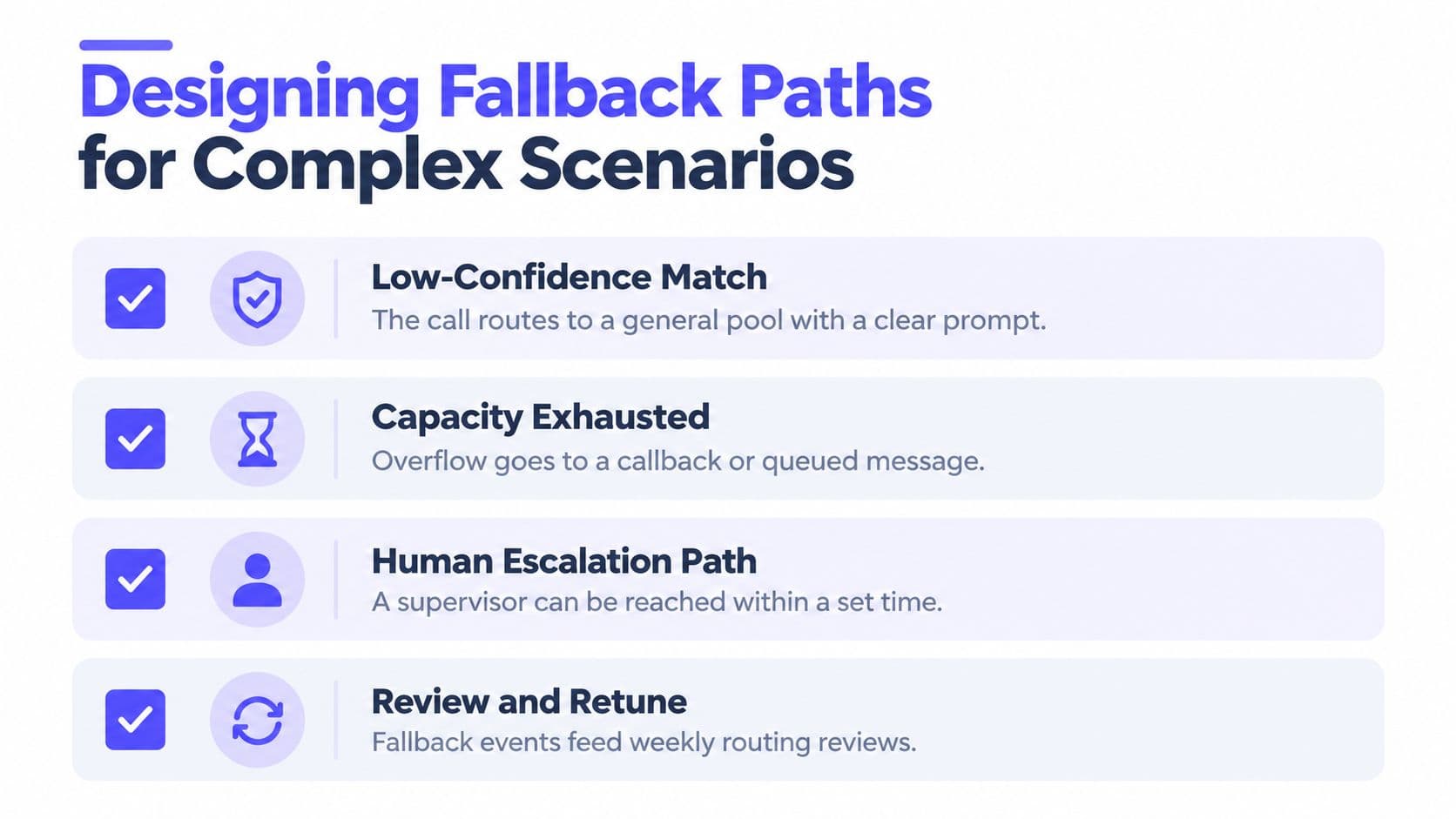
The fix started with a low-confidence escape route. If the system couldn't confidently identify the intent, it stopped forcing the caller through narrow branches and sent the interaction to a general pool with a clear human path. That change cut down on repeated IVR loops and made the queue feel less brittle, even before any staffing changes landed.
Next came capacity exhaustion behavior. When the specialist queue filled, the system moved callers to callback or a broader qualified queue instead of leaving them to wait indefinitely. The point wasn't to degrade routing, it was to acknowledge reality faster than the customer had to.
A weekly review loop
The routing team then reviewed fallback events by intent, language, and repeat-transfer rate. Any queue that kept triggering overflow got a threshold adjustment, and any skill that stayed overloaded got re-examined for scope, staffing, or proficiency width. That rhythm kept the routing model from drifting into a static configuration that only looked good in the admin console.
A strong fallback policy usually includes:
- Low-confidence match. Send the call to a general pool with a clear prompt when the system isn't sure.
- Capacity exhausted. Offer callback or overflow when no qualified agent is free.
- Human escalation path. Let a supervisor step in within a defined time window.
- Review and retune. Feed fallback events into weekly routing review and threshold tuning.
Whatever the routing decides, the context has to survive the assignment, which is the same write-back problem power dialer CRM describes on the outbound side.
GrowOutly supports this kind of operational setup by keeping inbound routing, CRM context, messaging, and compliance checks in one workspace, which helps teams keep the handoff visible instead of scattered across tools. If you're redesigning routing policy rather than just re-tagging agents, visit GrowOutly and evaluate how a single system can tie call routing, SMS handling, and compliance-aware workflows together.