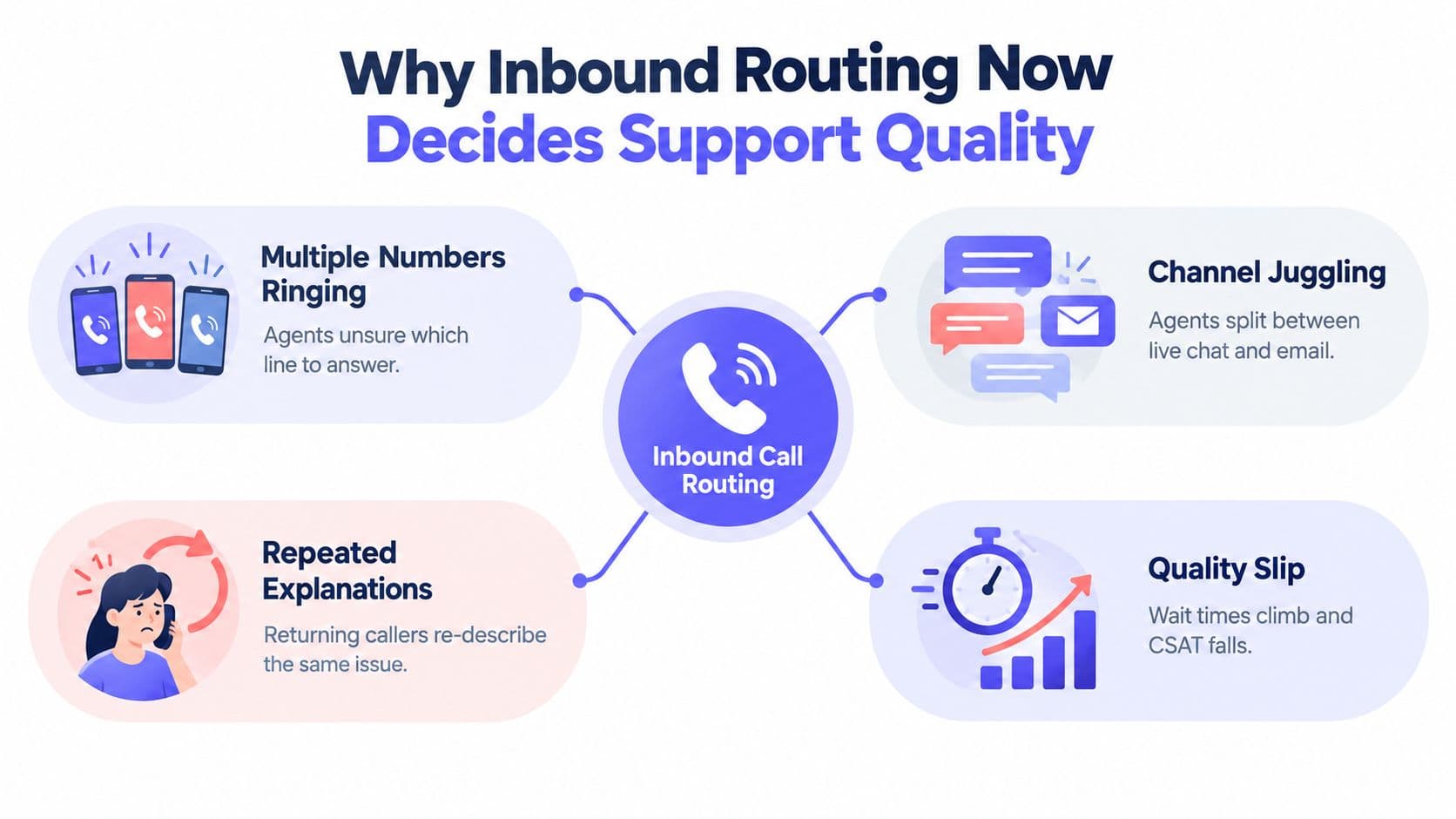
Monday morning exposes bad routing fast. Phones light up on every line, a returning customer gets bounced between agents, the queue swells, and someone on your team is trying to answer chat while checking email and whispering to a caller who has already repeated the issue twice. If your inbound call routing software can't protect context, enforce priority, and keep the right people on the right calls, it's not a support system, it's a bottleneck with a dashboard.
This guide is about the criteria rather than the candidates. When you are ready to name products, our comparison of 10 inbound call routing software options scores ten platforms, from GrowOutly and Aircall through to Genesys, NICE CXone, and Twilio Flex, against exactly these questions.
| Criterion | What to look for | Why it matters for support and marketing teams |
|---|---|---|
| Routing intelligence | Skills, weights, overflow, business-hours routing, and context-based assignment | Stops misroutes, reduces rework, and keeps specialized queues usable |
| Queueing and analytics | Offered, answered, abandon, threshold compliance, and queue time by queue and rule | Shows where callers are really getting stuck, not just the average |
| IVR depth without bloat | Self-service that ends cleanly and escalates cleanly | Cuts unnecessary agent load without trapping callers in a maze |
| Integration | CRM, messaging, scheduling, and on-screen context | Lets the next person see who is calling, why they called, and what happened before |
Why Inbound Routing Now Decides Support Quality
A caller reaches the right number, but the wrong queue picks up. The agent who answers lacks the full history. The customer repeats the problem, then repeats it again. That is how support quality slips, even when the phone is technically being answered.
Intelligent call routing fixes that by deciding where a call goes before it connects, based on caller identity, skill, time, geography, and business priority. U.S. Digital Government guidance defines an ACD as a computerized telephony system that analyzes incoming calls and distributes them according to predefined instructions, and it lists routing models such as IVR or recorded-message routing, next-available-agent routing, skills-based routing, time-based routing, area-based routing, and dynamic network routing (Digital.gov contact center guidance).
Routing software is also an operations tool. The same guidance says ACD platforms track incoming-call volume, calls waiting in queue, abandoned calls, and talk time while problems are happening, not just after the fact. A support lead can use that to spot a queue failure before customers start bailing out.
What separates a usable setup from a checkbox feature is context. The platform should check the line the caller dialed, the rules you set, and the record in your CRM, then place the call where it belongs. That matters for geographically distributed teams, after-hours coverage, and specialized queues, because those are the places where bad routing shows up fastest.
Accessibility matters too. A caller who cannot get to the right person without re-explaining the issue is dealing with a broken service path, not a finished support experience.
For teams using SMS alongside voice, keep keyword handling tight. If a routing flow sends outbound texts, every opt-in, opt-out, and help keyword needs to work cleanly, because sloppy routing and sloppy SMS compliance usually fail in the same places.
Core Routing Models Every Buyer Must Understand
Start with IVR-driven routing. That's the phone menu layer, and it earns its place when the caller can self-select cleanly and the tree stays short. A three-agent team does not need a five-deep maze with every option hidden behind another prompt.
Next-available-agent routing is the simplest live-assignment model. It's fine when the team is small, the issue types are similar, and speed matters more than specialization. It breaks down fast when every call is treated the same and no one owns the hard cases.
Skills and availability are the real divider
Skills-based routing matches callers to agents by language, product, territory, tier, or other labels. Availability-aware routing adds presence and time-of-day rules, so the system knows who can take the call right now and whether business hours make sense for the caller. The point is not complexity for its own sake, it's getting the right person on the first try.
If the platform can't explain why a call went to a specific queue, the routing rules are too opaque to trust.
Queueing language matters too. Offered calls are the calls presented to the system, answered calls are the ones picked up, and abandonment is what happens when callers give up before help arrives. Average handle time by itself can flatter a bad setup, because a fast transfer that forces a repeat explanation is still a bad call.
For a buyer, the comparison question is simple. Does the system let you define a clean path for common calls, then route edge cases to a capable human without making the caller start over? If it does, it's solving routing. If it doesn't, it's just a menu with a billing cycle.
See how one platform presents incoming calls and routing features when you're evaluating the shape of the workflow.
Comparing Inbound Routing Solutions on What Actually Matters
The market is crowded with platforms that all claim to “route intelligently.” Most of them are not comparable on the same axis. One has decent IVR but weak context. Another has a slick dashboard but no real overflow logic. A third looks enterprise-ready and still makes you stitch together five tools to answer a basic call.
Routing intelligence, queueing, and context
For routing intelligence, look for more than a next-available toggle. You want skills, weights, overflow, business-hours routing, and ring order or backup-queue behavior that reflects how your team really works. Home services offices need territory awareness. B2B teams need contract tier and language handling. Support teams need a way to move urgent calls without dumping them into the first open slot.
For queueing and real-time analytics, demand views by queue and by rule. The FTC-style compliance checks matter in outbound flows, but inside routing, the daily operational question is still whether offered calls, answered calls, abandons, threshold compliance, and queue time are visible where managers can act on them. A pretty total average doesn't help if one queue is breaking every afternoon.
IVR depth and integrations without theater
For IVR depth, the buyer trap is adding one more menu every time a team asks for one more category. That's how a clean front door turns into IVR bloat. Good IVR should contain easy work and escalate the rest with context intact.
For integration, the test is whether the caller's context follows the call into CRM, messaging, and scheduling. If the agent still has to search, copy, and paste while the caller waits, the platform is creating work, not removing it. That's especially true in teams where inbound calls trigger outbound follow-ups later.
| Criterion | What to look for | Why it matters for support and marketing teams |
|---|---|---|
| Routing intelligence | Skills, weights, overflow, business-hours routing, and caller context | Routes the call to the right person without manual triage |
| Queueing and analytics | Offered, answered, abandons, threshold compliance, queue time by queue and rule | Exposes service failures before they become churn |
| IVR depth | Containment plus clean escalation | Avoids menu bloat and reduces repeat explanations |
| Integration | CRM, messaging, scheduling, shared timelines | Keeps the next interaction connected to the last one |
See how these ideas show up in business calling software built for teams that share callers and follow-ups.
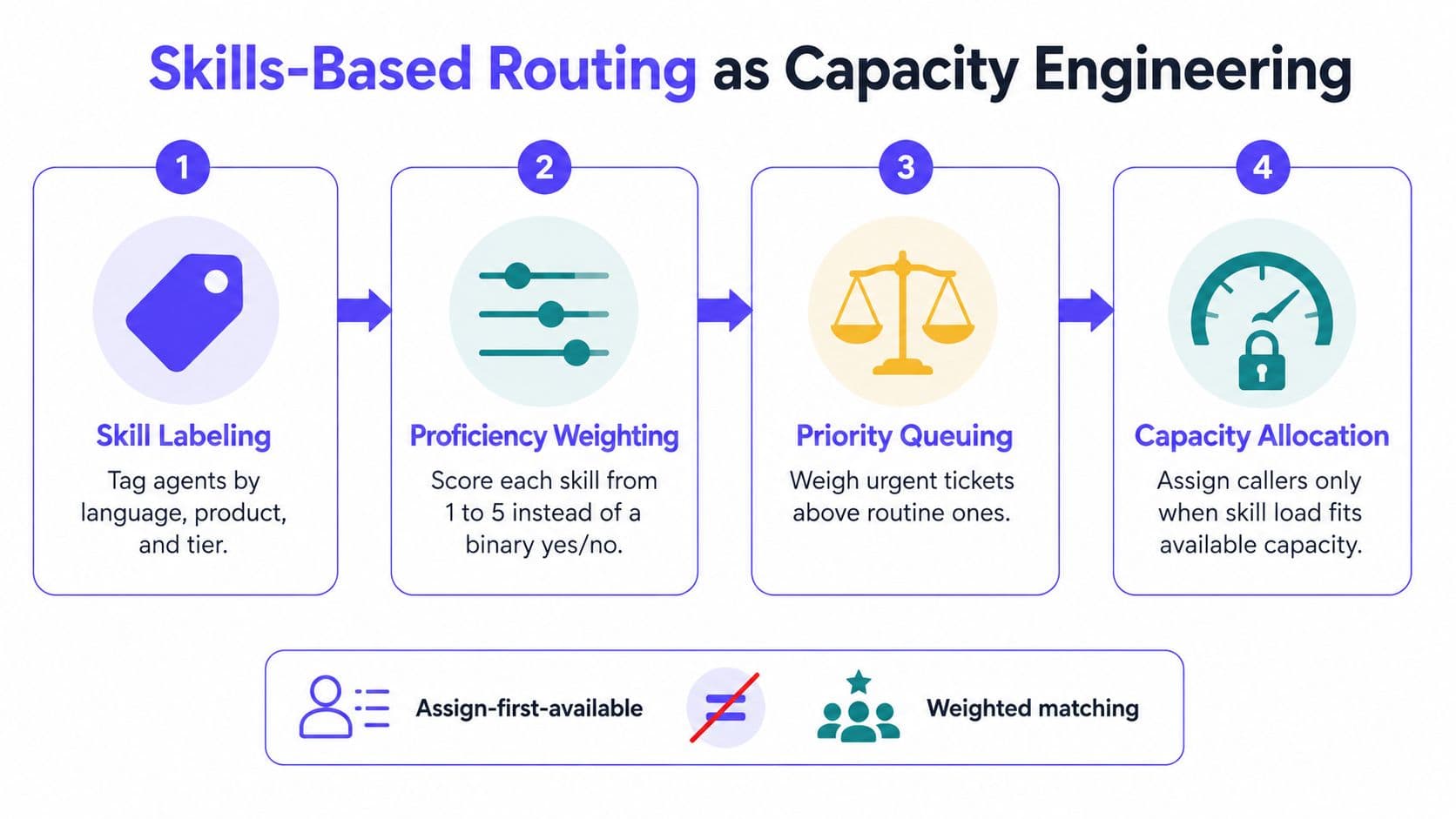
Skills-Based Routing as Capacity Engineering
Treat skills-based routing like staffing math, not a checkbox. The job is to spread limited capacity across competing queues without starving specialized work or forcing every caller through the same path.
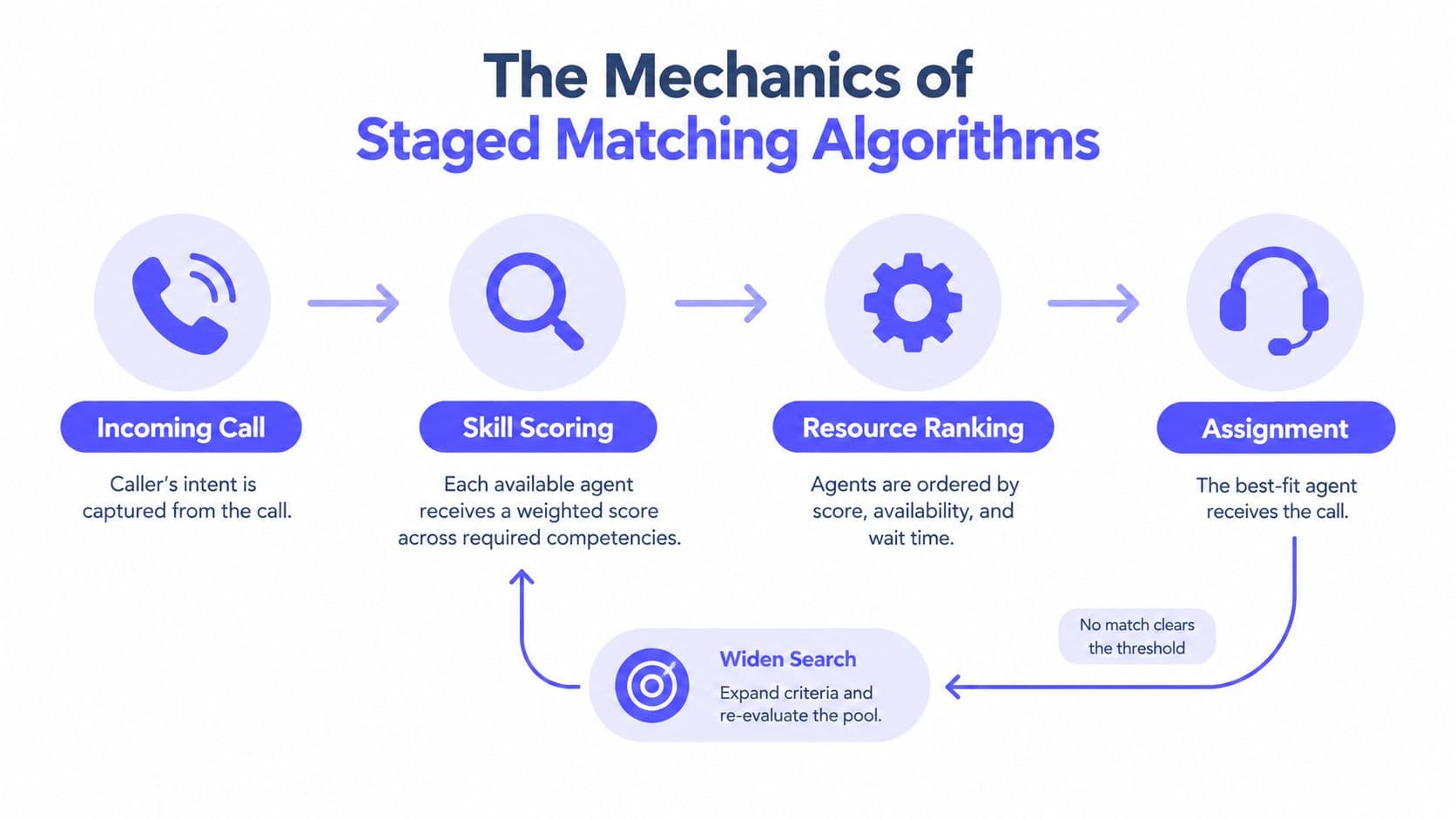
The Columbia University operations model is useful because it frames the goal as minimizing staff and telephone lines while still meeting an SLA such as P(delay ≤ 30 seconds) ≥ 0.80 and keeping blocking probability below 0.005 (Columbia skill-based routing lecture). That is the right model for small and mid-market teams. You do not need everyone to know everything. You need a clean mix of coverage, overflow, and priority rules. Once the platform is chosen, our skills based call routing setup guide covers the configuration itself: staged matching that relaxes precision as a call ages, a queue taxonomy you can keep current, and fallback paths for the calls that fit no skill.
Build the queue like a real capacity plan
Start with explicit skill labels. Language, product line, tier, territory, and availability belong there. Then assign proficiency or priority weights instead of a crude yes or no flag, because a lightly trained agent should not be treated the same as your strongest closer.
Overflow is a pressure valve, not a failure. A small cross-trained group can approach the performance of a fully cross-trained pool when routing rules are tight and queue-specific service targets are realistic. That is the practical point from the Columbia model, and it holds up in real support teams. Cross-training does not have to be universal to be useful.
Operational rule: If a queue cannot tell you its delay probability, transfer rate, abandonment, and first-contact resolution by call type, the routing design is too vague to manage.
Use dashboards segmented by call type, not just team totals. If sales, support, territory, and language calls collapse into one reporting bucket, you hide the exact imbalance you paid routing software to fix.
Designing Routing for Escalation, Not Just Containment
Support teams still talk about routing as if the goal is to keep callers away from people. That thinking breaks service. The actual job is to get the caller to the right human quickly once automation has done its part and stopped helping.
Voice AI acceptance data makes the handoff problem obvious. In the cited survey, 35.8% of respondents accepted voice AI if it solved the problem, 27.2% accepted it if they could transfer to a human without friction, and 18.9% accepted it when either condition applied. Separate 2025 research found that 78% of consumers considered switching to a human important, while only 15% experienced a handoff they regarded as smooth (8x8 voice AI insights). That gap is what routing has to fix.
Escalate on purpose
Route to a person when authentication keeps failing, when the caller is frustrated, when the issue is high value or regulated, or when intent detection is uncertain. Those are the moments when pushing harder on containment makes the experience worse.
The handoff has to carry context. The next agent should get caller identity, intent, transcript, authentication status, prior attempts, and the next step already promised. Without that payload, the transfer restarts the interaction and makes the caller repeat themselves.
A fast transfer with context beats a brittle automation loop.
Accessibility belongs in routing, not in a separate policy
Voice still dominates service journeys, so routing choices affect speech-impaired callers, multilingual households, older users, and relay-service callers. Accessibility is part of call handling quality. If the system assumes every caller can move through touch-tone prompts quickly, it is already failing part of the queue.
A better platform supports keypad, speech, callback, SMS, relay, and live-agent paths, with timeout rules that do not punish slower speakers. It should also log where callers get stuck, because aggregate answer rates hide who is being excluded.
SMS outreach needs the same discipline. If routing triggers a text follow-up, keyword handling should be consistent, because opt-out, help, and consent flows are part of the customer record, not an afterthought.
Compliance, Local Time, and SMS Keyword Discipline
If your inbound stack triggers outbound follow-ups, compliance has to happen before the call or text leaves the system. Otherwise routing turns into legal risk.
The FTC's Telemarketing Sales Rule generally prohibits telemarketing calls to a person's home before 8:00 a.m. or after 9:00 p.m. in the recipient's local time, unless prior consent allows otherwise. It also requires direct do-not-call requests to be honored, even if an established business relationship or prior inquiry might otherwise allow contact (FTC Telemarketing Sales Rule guidance).
The compliance gate should block before assignment
The National Do Not Call Registry is not a one-time upload. U.S. telemarketers and sellers must access it at least once every 31 days and remove registered numbers from calling lists, subject to exceptions that still disappear if the consumer directly asks not to be called (FTC DNC registry business guidance). Operationally, that means separate records for registry status, consent basis, relationship age, and company-specific opt-outs.
SMS needs the same discipline. CTIA guidance identifies STOP as the standard opt-out instruction and lists END, CANCEL, QUIT, and UNSUBSCRIBE as equivalent keywords, with HELP for assistance (CTIA Short Code Monitoring Handbook). Opt-outs must work across both SMS and MMS, a final confirmation should follow, and no further messages should go out after that confirmation. For teams running both calling and texting from the same workspace, the platform proves its value at that handoff.
Emergency and location context need correction paths
When emergency-service handling is involved, caller location can't be guessed. NENA guidance says the telecommunicator must verify all location information conveyed about an emergency to obtain the most accurate dispatchable location, and if displayed wireline or static VoIP location is inaccurate, the telecommunicator must complete and forward a correction report (NENA 911 call standard). Verified data should stay distinct from inferred data at answer.
One platform that puts this into practice is GrowOutly, which combines inbound routing with outbound dialing, messaging, CRM, and compliance checks in one workspace. The name matters less than the control point. The call should not leave the system until the compliance gate has already passed.
See the TCPA compliance checklist before you let follow-up workflows go live.
Matching Platforms to Real Support Scenarios
A three-to-eight-person team should care more about clean configuration and full context than about feature sprawl. If the platform can't keep IVR, skills-based routing, support queues, and on-screen context in one place, the extra bells don't matter.
Teams that also run outbound from the same stack should read this alongside the outbound sales software buyer's guide, which covers data readiness and CRM integrity on the other side of the same workspace.
Mid-market B2B support needs a different standard. Skill weights, queue-specific service levels, and analytics segmented by call type matter more than generic “AI” claims. If contract tier and language are part of the routing logic, the vendor should show it plainly in the workflow and in the reports.
High-volume inbound with outbound follow-ups is a compliance-first problem. If your team handles insurance, solar, or home services, the deciding factors are local-time rules, DNC refresh cadence, and SMS keyword handling from the same numbers used for calling. The cold calling playbook for insurance shows that gate running in front of a regulated motion, and what TCPA compliance is covers the federal rules underneath it. A routing platform that can't handle that sequence reliably will create cleanup work later.
Buyer Questions to Close the Loop
Start by watching offered calls, answered calls, abandons, threshold compliance, and queue time by rule in the first week after go-live. Don't settle for one blended average.
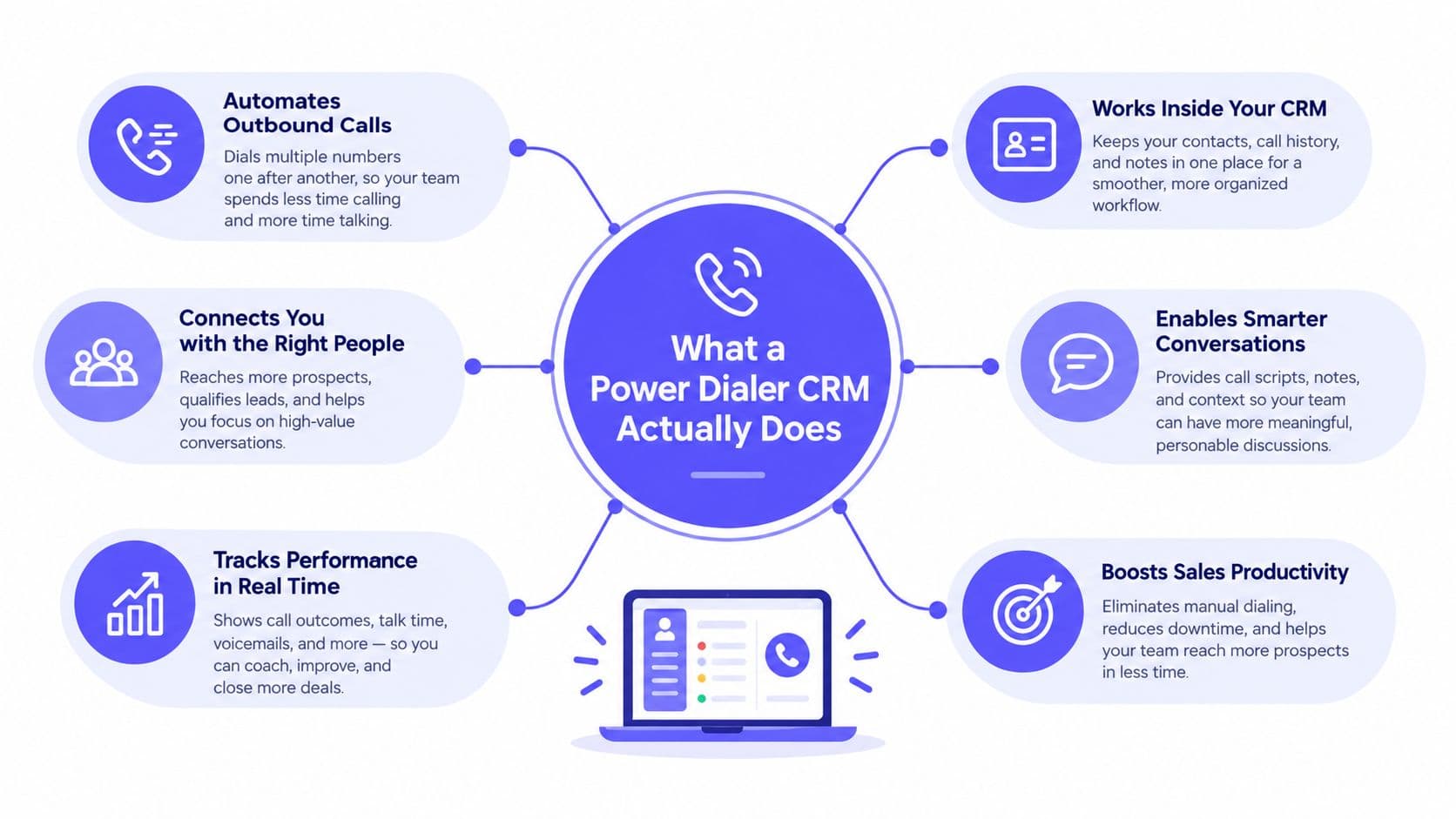
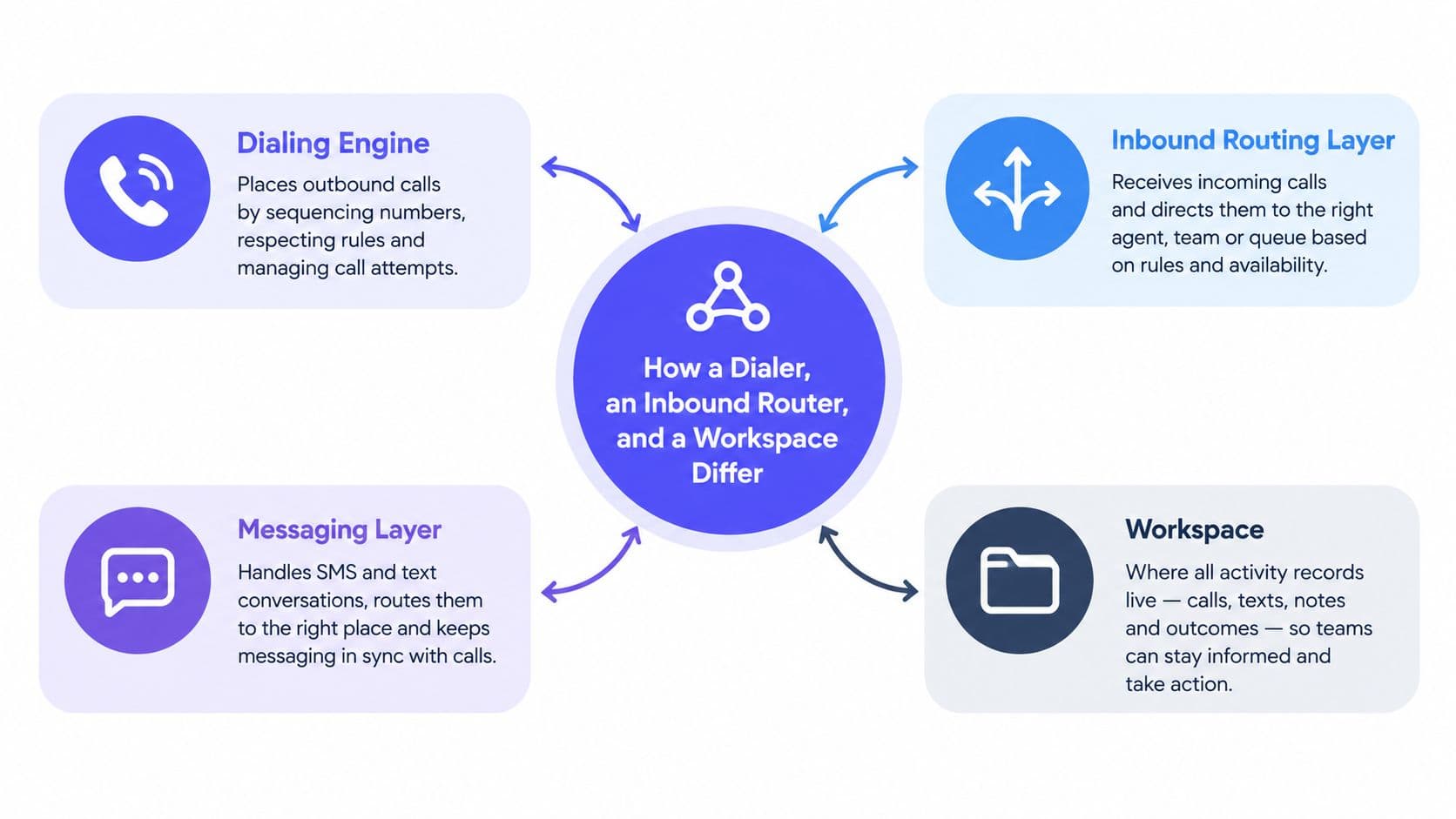
If inbound and outbound share one workspace, integration should be measured by whether context survives the handoff, not by how many apps are nominally connected. That write-back is the same loop power dialer CRM describes on the outbound side, and our call center dialer software buyer's guide covers where the dialing engine ends and the router begins. SMS keywords must work across SMS and MMS from the same numbers used for calling, and a caller's local time always controls outbound timing when curfew rules apply.
GrowOutly brings inbound routing, outbound dialing, SMS, CRM, and compliance checks into one workspace, so your team doesn't lose context between the first call and the follow-up. If you're comparing inbound call routing software for a support or revenue team, visit GrowOutly and see how one system handles routing, compliance, and follow-through together.