More than 258 million active registrations were on the National Do Not Call Registry at the end of fiscal year 2025, while the FTC received over 2.6 million Do Not Call complaints during that fiscal year, according to the FTC's biennial Registry report. That scale changes how outbound leaders should think about a TCPA compliance checklist. Compliance isn't a document someone reviews before launch. It's a set of controls that decides, contact by contact, whether a call or text is allowed to happen.
The practical standard is simple to state and demanding to implement: capture defensible consent, screen every outreach attempt, honor revocation across channels, enforce time and jurisdiction rules, and preserve evidence automatically. Manual list cleaning and quarterly policy reviews won't reliably protect a high-volume operation.
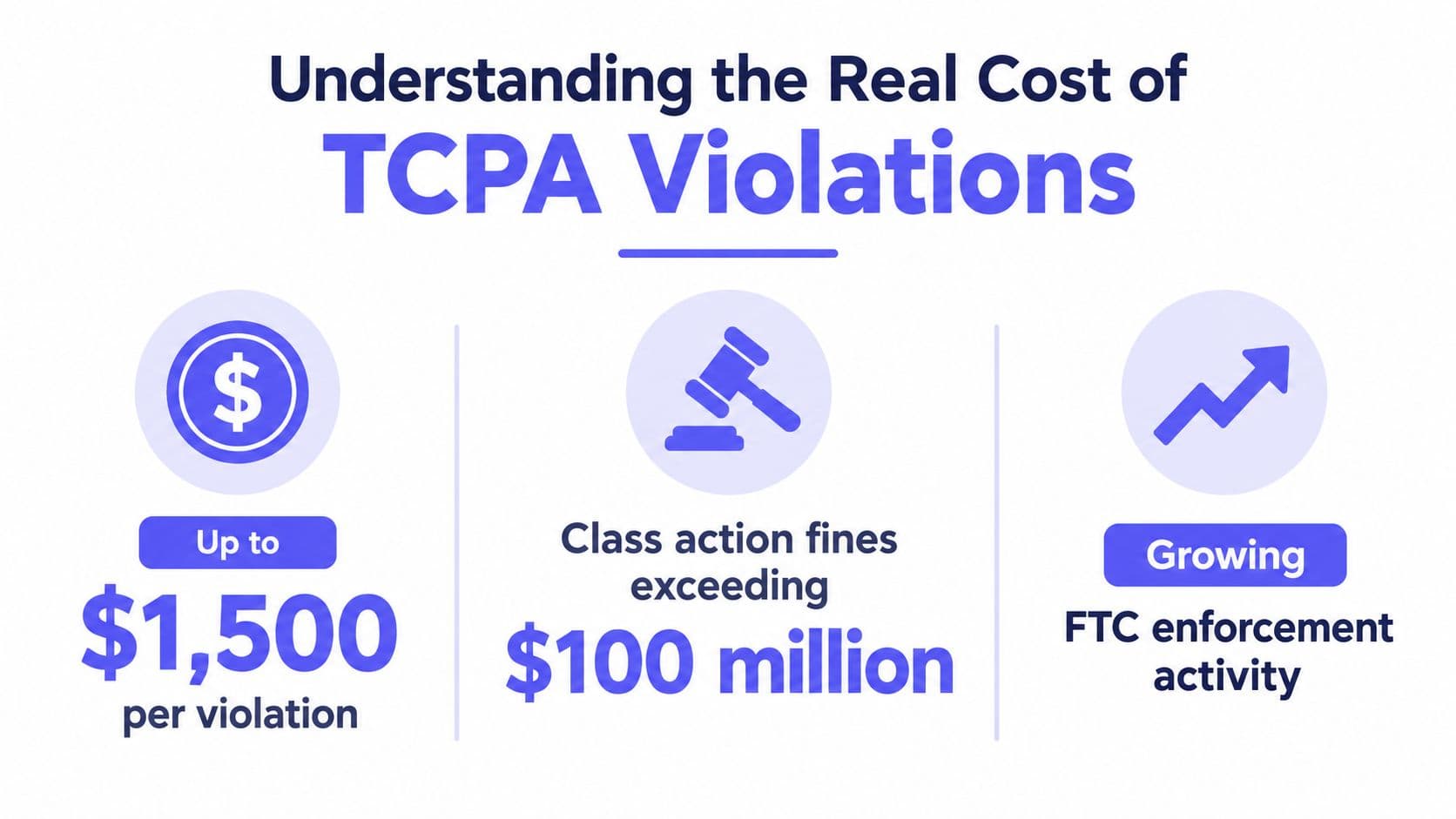
Understanding the Cost of TCPA Violations
For revenue operations, those figures describe an active suppression environment, not a distant regulatory concern. Every dialer, SMS workflow, and agent queue has to make an accurate eligibility decision before outreach begins.
The Registry had 254 million active registrations as of September 30, 2024, then exceeded 258 million by the end of fiscal year 2025. Unwanted calls were about 48% lower than fiscal year 2021, when the FTC received approximately 5 million reports, although fiscal year 2025 still produced more than 2.6 million complaints, as recorded in the FTC's 2024 Do Not Call data book.
Why static policies fail
A policy memo can describe agent behavior. It cannot stop a dialer from selecting a suppressed number, block an SMS workflow from relying on stale consent, or carry a verbal opt-out into every active campaign. The dialing mode matters here too, since power dialer vs predictive dialer is partly an argument about abandonment exposure, and a system that dials ahead of its reps has more ways to get this wrong. Those protections require execution-layer controls connected to the CRM, consent store, suppression service, dialer, and messaging platform.
A practical TCPA compliance checklist should test each outreach event:
- Before outreach: Check consent, suppression status, reassigned-number status, destination, applicable state rules, and local time.
- During outreach: Present approved scripts, capture verbal requests, and block prohibited automation.
- After outreach: Store the outcome, update suppression logic, and retain evidence showing why the contact was or was not eligible.
The Telephone Consumer Protection Act guidance from GrowOutly can help define these control areas. The operating model determines whether they work. Each control needs an owner, a system event, a pass or fail result, and an evidence record. Cross-channel SMS revocation matters here. A STOP response or spoken request should update a shared suppression record before another campaign can queue the contact.
Exposure is calculated per contact
Industry guidance describes TCPA statutory exposure at $500 for an unintentional violation and $1,500 for a willful violation per call, as outlined in this telemarketing compliance checklist. The operational risk lies in the word “per.” One consent-import defect, suppression-sync failure, or dialer rule can affect every contact processed by that workflow. State-level mini-TCPA rules can add separate requirements and increase the number of conditions a pre-dial gate must evaluate.
A 1% error rate at 5,000 daily calls produces 50 violations and $75,000 in statutory exposure before the week ends. That example is not a forecast for every organization. It shows why high-volume teams need automated gating instead of asking agents to identify restricted records manually.
Practical rule: If a compliance decision happens after the call connects, the control is already too late.
Capturing and Documenting Prior Express Consent
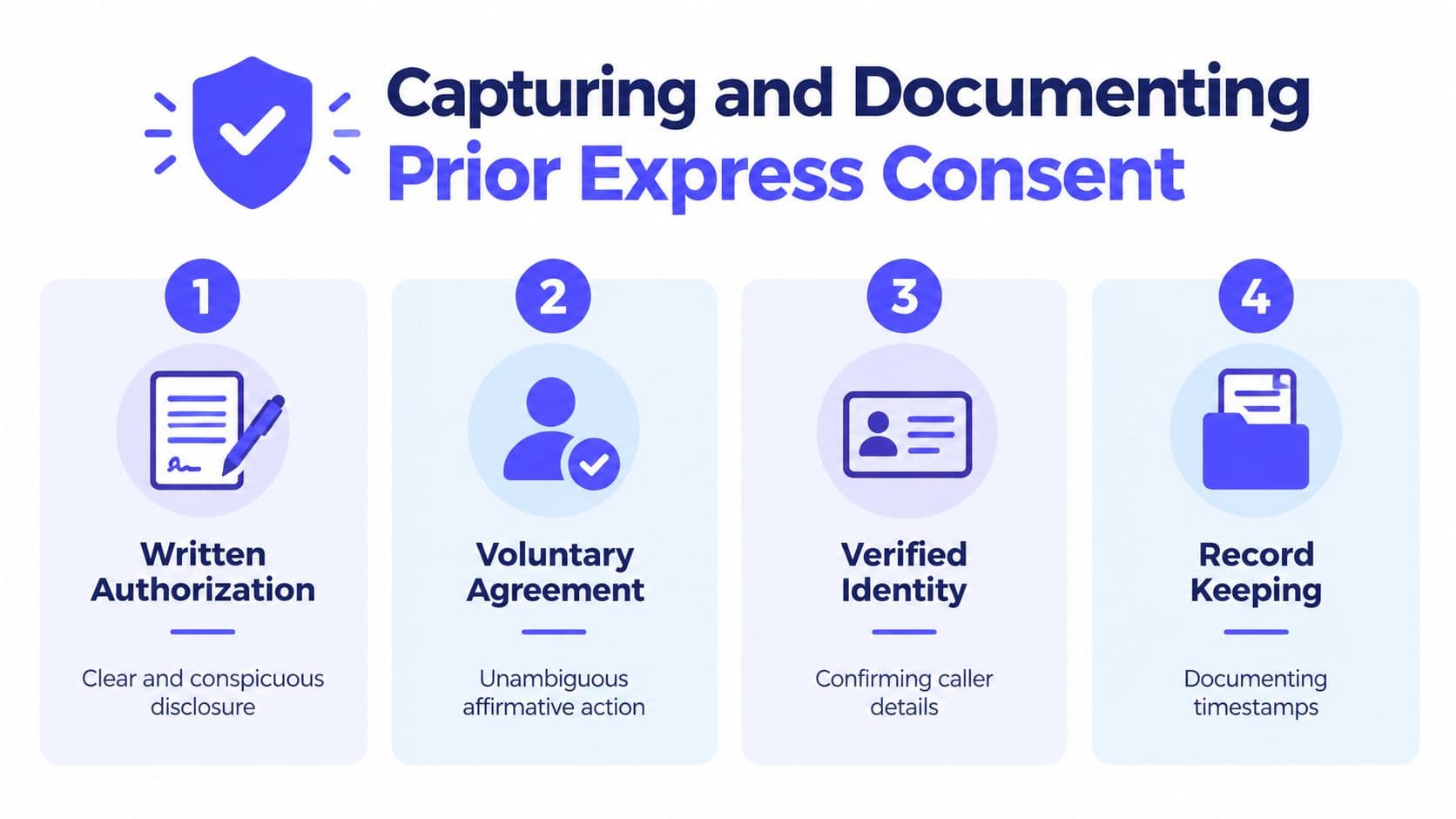
Consent is only useful when the business can prove what the person agreed to, who was authorized to contact them, and when the agreement occurred. A checkbox without surrounding context is weak evidence. The record should preserve the disclosure, the consumer's affirmative action, the submitted number, the seller or business identity, and the campaign purpose.
Recent compliance guidance says the FCC's one-to-one consent expectations require timestamped, auditable records at the individual-call level, and that revocation can be given orally during a live call, as described in the telemarketing compliance checklist. Build your consent model around that level of granularity, even if your current lead source provides less detail.
Design the capture event
Start with the form or source where consent is collected. The disclosure should be clear and conspicuous, positioned close to the action that submits the contact details, and specific about the communications the person may receive. Separate marketing consent from unrelated service terms so the user can understand the choice being made.
A practical consent record should include:
- The exact disclosure version: Store the rendered language or an immutable reference to the version shown at opt-in.
- The affirmative action: Record the checkbox, button, form submission, or equivalent event. Don't rely on a field that merely says “consented.”
- The contact identity: Tie the phone number to the submitted record and preserve relevant source context.
- The authorized party: Identify the business, seller, or campaign permitted to initiate contact.
- The timestamp: Store the event time in a consistent format, along with the relevant time zone where available.
- The evidence location: Keep the record accessible to compliance and legal teams without requiring an engineer to reconstruct it.
A lead export that contains only a phone number and a consent flag fails this test. So does a CRM note entered days later by an agent. Neither record reliably shows what the consumer saw or did.
Make consent portable, but not vague
Consent should travel with the contact as structured data, not as a comment buried in a vendor portal. Define fields for consent type, seller identity, channel, campaign, source, disclosure version, capture timestamp, and evidence reference. Your dialer, CRM, SMS provider, and reporting layer should read the same consent status rather than maintain competing copies.
Vendor-supplied leads need additional scrutiny. Require the partner to provide the original consent evidence and map that evidence to the specific contact delivered. If the partner can't show the disclosure and affirmative action, route the record to review or suppression instead of allowing a sales representative to make a judgment call.
Consent also needs a lifecycle. A live-call request such as “remove me” or “don't call again” should create a suppression event immediately, not a note for later processing. That event must be available to every future calling and messaging workflow, with the original consent retained for audit history rather than overwritten.
Building Pre-Dial and Pre-SMS Compliance Gates
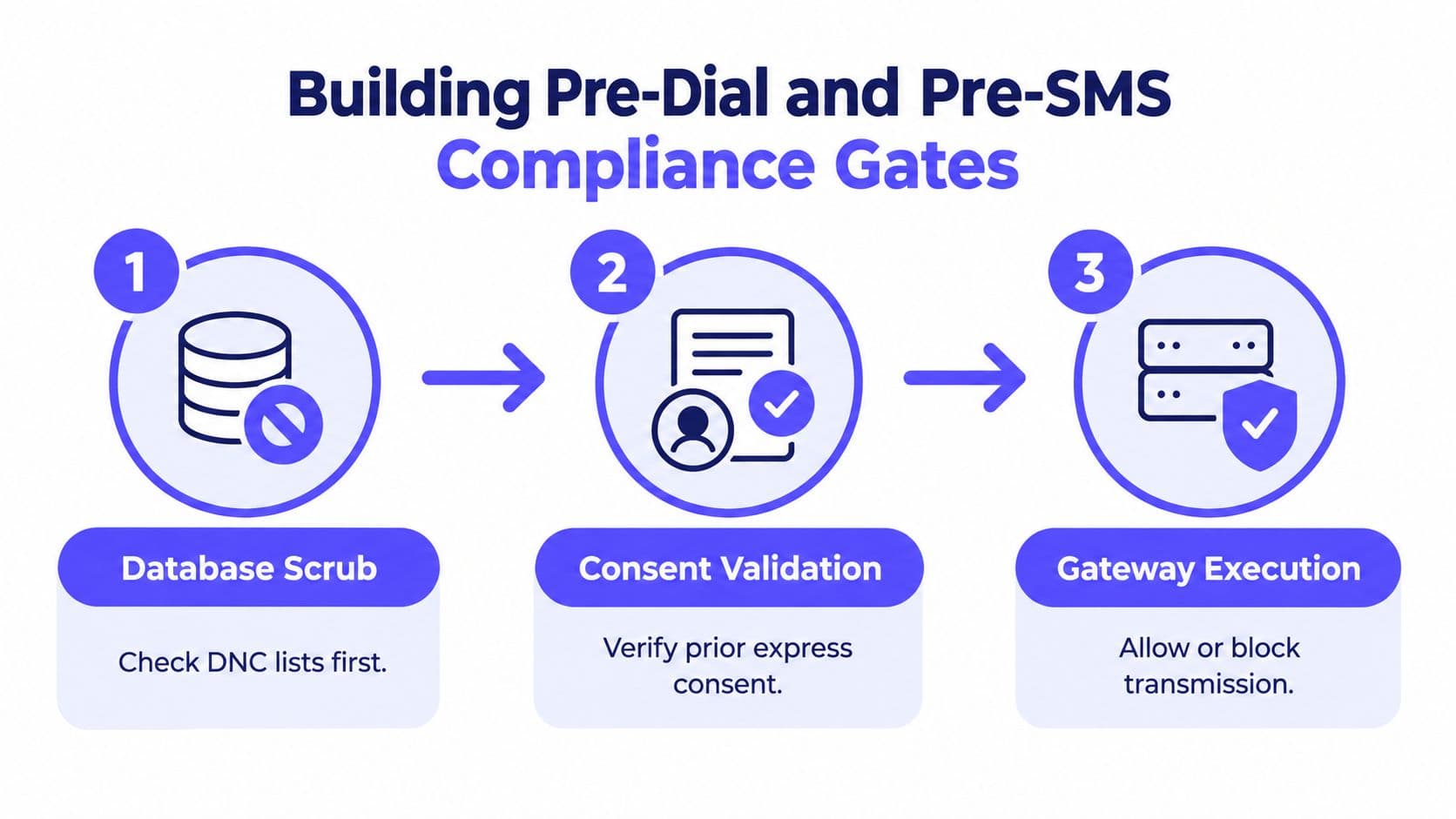
A suppression list is not a compliance gate if the dialer can bypass it. The decisive control runs immediately before transmission and returns an enforceable decision: allow, block, or send to review. Agents shouldn't be expected to inspect several systems while a power dialer is selecting the next record.
Use one decision service
The gate should receive a normalized contact number and campaign context, then evaluate the controls that apply to that specific attempt. At minimum, the decision should account for:
- Consent status: Confirm that the contact has the required consent for the channel and message or call type.
- Do Not Call status: Check applicable federal and state suppression sources before outreach.
- Internal suppression: Apply prior complaints, manual removals, legal holds, and vendor-specific exclusions.
- Reassigned-number data: Prevent a consent record for a former subscriber from being treated as permission for a new subscriber. Recycling is routine in pooled overlay markets, as our guide to area code 832 sets out.
- Local-time rules: Calculate the recipient's local time and block outreach outside the permitted window.
- Jurisdiction: Use the contact's location and campaign destination to select the applicable state rules.
- Channel state: Treat voice, SMS, and MMS as connected channels when the contact has revoked permission.
The result should be stored with the outreach attempt. “Blocked by state rule” is more useful than a generic “failed,” because operations can correct the source, route the contact to review, and demonstrate what happened later.
Keep the gate out of the agent's hands
Third-party checks often create latency or availability problems when they sit outside the dialer. A better architecture maintains a synchronized suppression layer, refreshes source data on a defined schedule, and performs the final decision inside the calling and messaging workflow. The system can still query an external source when necessary, but the agent should never have to wait for a manual lookup.
The same gate should control scheduled SMS. A text queued yesterday can become prohibited today because of a revocation, a changed campaign status, or a newly applied suppression rule. Recheck at send time rather than assuming that an earlier approval remains valid.
Test the failure paths
Teams typically test the happy path, then discover gaps when a contact uses an unusual phone format or an agent records an opt-out in free text. Test blocked numbers, missing consent, stale consent, unknown time zones, reassigned numbers, state conflicts, duplicate records, and provider outages.
The GrowOutly DNC compliance feature describes the kind of centralized pre-outreach control teams can use to combine suppression and calling rules in one workflow. Regardless of the platform, the design principle remains the same: the system must block transmission automatically when a required check fails.
Managing Opt-Outs and SMS Revocation Keywords
An opt-out becomes a synchronization event as soon as a consumer can submit it through SMS, a phone conversation, or another reasonable channel. Each request should create a durable suppression record, define its scope, and reach every affected outreach workflow before the next transmission.
For SMS, the FCC identifies stop, quit, end, revoke, opt out, cancel, and unsubscribe as per se reasonable reply-text revocation methods. The framework permits one clarification text after the request. That message may explain the scope of the suppression, but it cannot try to persuade the consumer to stay subscribed, as described in the FCC's April 2025 opt-out framework.
Build keyword handling as a rule, not a campaign feature
Process these terms at the messaging infrastructure layer. Campaign builders should not decide independently which keywords trigger suppression. A shared rules service can normalize capitalization, whitespace, punctuation, and common phone-number or contact-record variations before writing the opt-out event.
| Keyword Category | Recognized Terms | Processing Window | Confirmation Message Rules |
|---|---|---|---|
| Direct stop request | stop, quit, end | Process promptly and within the applicable compliance window | Send no marketing content |
| Revocation language | revoke, opt out, cancel | Process promptly and within the applicable compliance window | Use only a permitted clarification message if scope needs explanation |
| Subscription removal | unsubscribe | Process promptly and within the applicable compliance window | Don't add offers, incentives, or retention language |
The FCC consumer guidance on unwanted robocalls and texts states that revocation and Do Not Call requests must be honored within a reasonable time, no later than 10 business days after receipt. Set the operational target faster than that ceiling. A weekly batch process leaves a preventable window in which queued messages may still transmit.
Synchronize voice and messaging suppression
The FCC extended the effective date of the TCPA revoke all rule to January 31, 2027, according to Gryphon's January 2026 regulatory report. The rule would apply one opt-out across future calls and texts from the same sender, including separate campaigns.
Design the data model before that date. Store the revocation against the contact and sender, retain the channel and scope, and publish the event to voice, SMS, MMS, automated sequences, and agent queues. A text opt-out should remove the number from voice selection whenever the applicable scope requires it. A spoken request should suppress SMS without waiting for a separate marketing platform to be updated.
Use event-driven propagation where possible, with delivery status and retry handling for downstream systems. The pre-dial and pre-send checks should read the current suppression state at execution time, so a message queued earlier cannot bypass a newly recorded revocation. Test duplicate events, conflicting scopes, provider delays, and an opt-out arriving while an agent is preparing an outreach attempt.
Maintaining Audit Logs and Retention Records
A compliance program becomes defensible when it can answer five questions for any outreach event: who contacted whom, through which channel, under what permission, after which checks, and with what result. If those answers depend on an agent's memory or a spreadsheet assembled after a complaint, the organization has a documentation problem.
U.S. banking regulator exam procedures provide a useful operating standard. They direct examiners to sample call logs, scripts, recorded sessions, and fax advertisements, observe call-center operations, evaluate automated messaging and opt-out systems, and test marketing programs for effectiveness, as described in the OCC's Telephone Consumer Protection Act handbook.
Capture evidence as the work happens
An audit record should be generated by the system at each stage, not assembled manually afterward. Log the consent reference, suppression result, time-zone decision, campaign identifier, agent or automation identity, transmission status, and any resulting opt-out. That trail only holds together when the dialer writes to the same contact record everyone else works from, which is the queue-to-record loop power dialer CRM describes.
Keep the original event and later changes. If a contact revokes consent, don't overwrite the earlier consent record. Link the revocation to it, record the processing timestamp, and show which downstream systems received the suppression update.
A useful activity timeline includes:
- Consent events: Disclosure version, source, timestamp, channel, and evidence reference.
- Compliance decisions: Checks performed, decision returned, reason for a block, and data version used.
- Communications: Calls, texts, MMS, emails, recordings, transcripts, scripts, and delivery results.
- Human actions: Agent notes, oral revocation, supervisor overrides, reviews, and approvals.
- Suppression changes: Origin, scope, processing time, affected channels, and synchronization status.
Test the controls continuously
Periodic policy review asks whether the rules sound correct. Sampling asks whether the live operation follows them. Review a representative set of allowed and blocked attempts, then compare the system decision with the evidence behind it.
Role-based permissions matter here. Agents may need to record an oral request, but they shouldn't be able to delete the underlying consent event or remove a suppression record without an approved escalation. Compliance managers need access to evidence and exception reports, while engineering teams need visibility into failed integrations and stale data.
Call recordings and transcripts should follow the same retention and access model as consent data. A system that stores recordings separately from the contact timeline forces investigators to join evidence across tools. A unified workspace, such as the workflow described through call recording software from GrowOutly, can reduce that reconstruction burden when it connects recordings, transcripts, contact records, and compliance events.
A policy tells people what should happen. An audit log shows what did happen.
Navigating State-Level Mini-TCPA Variations
Federal TCPA compliance is a baseline, not a complete national operating standard. States including Texas and Florida have implemented stricter requirements than the federal TCPA, and more states are expected to follow within 12 to 24 months, according to Attentive's compliance-first SMS guidance.
That variation affects more than legal review. State rules can change how the system evaluates consent, calling hours, opt-outs, abandonment controls, and the meaning of an automated communication. A campaign approved under a federal-only rule set can still fail when it reaches a contact in a stricter jurisdiction. Regulated sellers tend to feel this first, and the cold calling playbook for insurance shows the same gate running in front of a territory-based motion.
Default to the stricter applicable rule
Don't ask agents to memorize state exceptions. Build a policy engine that evaluates the recipient's jurisdiction, campaign type, channel, consent record, and local time. Where rules conflict, default to the stricter applicable standard unless legal counsel has approved a documented exception.
The operating model should separate policy from execution:
- Policy owners define the rule: Legal and compliance teams document the applicable requirement and effective date.
- Operations map the rule: Revenue operations translates it into fields, decision logic, suppression behavior, and escalation paths.
- Engineering deploys the control: The rule enters the shared gate used by calling, SMS, MMS, and automation.
- Quality teams test outcomes: Auditors sample permitted and blocked events across jurisdictions and campaign types.
- Managers monitor exceptions: Any override requires a reason, an owner, and evidence of approval.
This structure avoids a common failure mode, where each campaign manager builds a slightly different interpretation of state requirements. One centralized engine can still support local variation, but it keeps the workflow consistent for agents and vendors.
Treat change management as part of compliance
Assign ownership for monitoring regulatory updates, then connect each change to a release process. Before a new rule becomes active, update the decision logic, test affected campaigns, notify agents, and verify that reports identify the new outcome reason.
Keep state and federal controls visible in the same audit record. A blocked attempt should show whether the decision came from consent, a federal suppression source, a state rule, a curfew, a revocation, or a data-quality failure. That level of detail helps revenue leaders protect pipeline without pressuring teams to bypass safeguards.
The right checklist is therefore a living operating system. It connects consent capture, real-time pre-dial and pre-SMS decisions, cross-channel suppression, evidence retention, and state-aware policy management. If you need to buy those controls rather than build them, our comparison of 10 TCPA compliance software options maps each tool to the gate it actually provides, from DNC and state suppression to consent evidence, reassigned-number checks, and litigator screening. For the calling layer underneath, 10 outbound call center software platforms scores vendors on dialing modes, CRM workflow, and pricing visibility.
GrowOutly brings outbound dialing, inbound routing, two-way messaging, CRM records, compliance checks, and audit visibility into one workspace for teams that want those controls close to execution. Visit GrowOutly to evaluate how its calling and outreach platform can support a more controlled TCPA workflow.