The message is ready. The customer is waiting. A candidate has gone quiet after the interview. Your team is staring at the same choice again, text or email, and the wrong call turns a clean outreach moment into a missed reply, a duplicate touch, or a compliance headache you didn't need.
The better question isn't which channel wins. It's which channel matches the intent of the message, the audience you're reaching, and the trust you need to preserve. Text gives you immediacy. Email gives you space, records, and room for detail. Most programs need both, but they need them in the right order and for the right reason.
The Channel Choice That Shapes Every Campaign
A support lead has a delivery delay to send before lunch. A sales rep has a quote ready, but the prospect still needs a comparison and a reminder. A recruiter has a candidate who stopped responding after the second call. In each case, the channel choice changes how the message lands, how fast it gets seen, and whether the next step feels helpful or intrusive.
That's why the old SMS-versus-email debate is too shallow. It treats channel choice like a beauty contest when it should be a routing decision. Intent, audience, consent, and trust matter more than habit, because the same message can fail in one inbox and work in the other.
The fundamental mistake is defaulting to whatever the team already uses. Sales teams often overuse text because it feels faster. Marketing teams often overuse email because it feels safer. Support teams bounce between both without a clear rule, then wonder why customers reply in the wrong place or opt out entirely.
Practical rule: Use the channel that matches the customer's expectation first, then use the second channel only when it adds new value.
That simple rule changes how you build the program. It keeps urgent messages short, keeps complex messages readable, and stops you from blasting the same content everywhere just because the tools make it easy. By the end of this guide, you'll have a framework for choosing the channel that fits each message.
Where Text and Email Sit in the Communication Stack
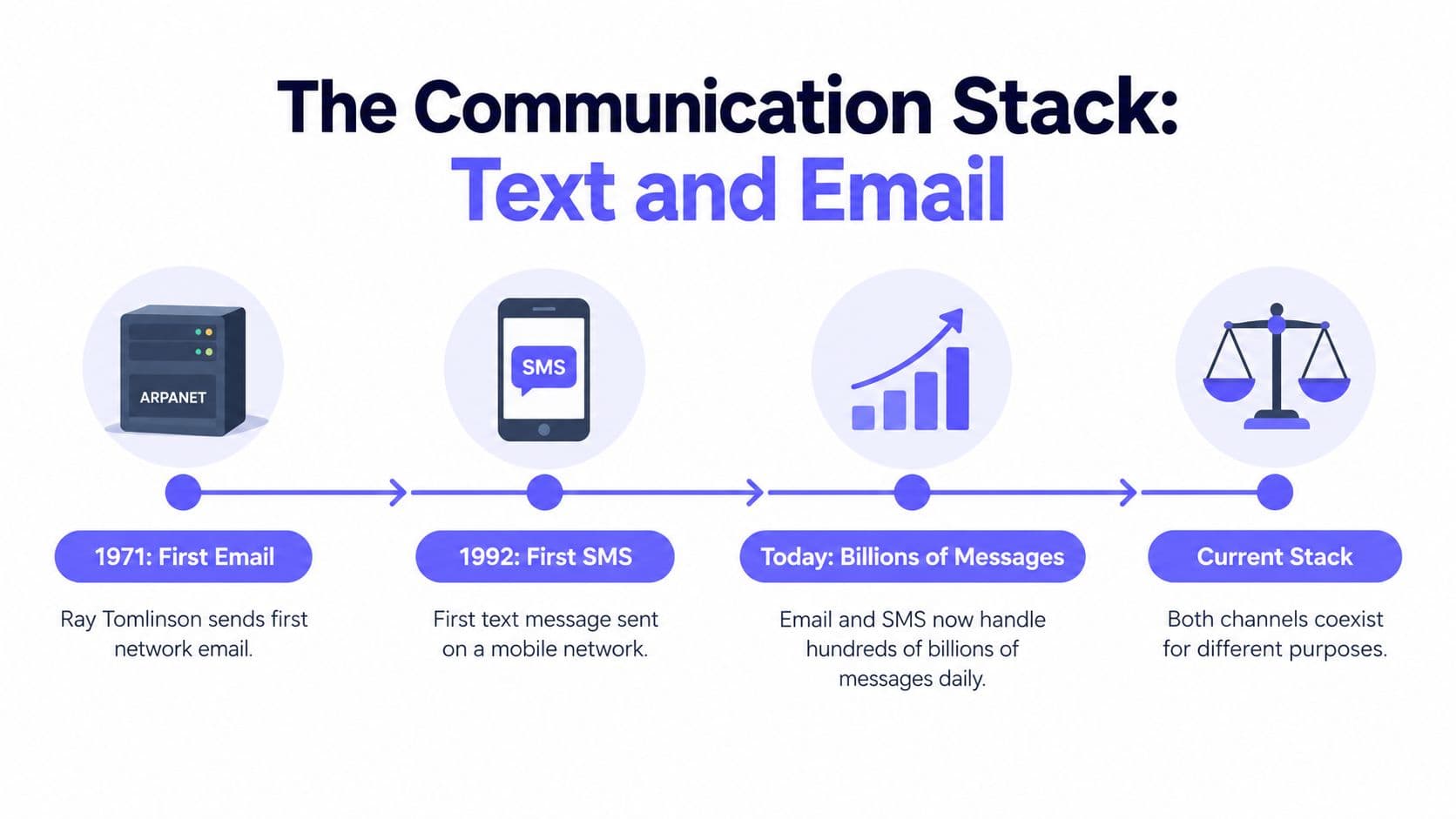
A customer with a delivery delay needs a text. A prospect reviewing a quote package needs email. That split is the decision point, because each channel serves a different job in the stack: text drives immediate attention, email carries context, records, and follow-up.
Email earned that role early. Ray Tomlinson sent the first network email over ARPANET in 1971 and introduced the @ symbol as the separator between user and host. By 1997, the worldwide email population had reached approximately 10 million users, and Radicati later estimated more than 3.8 billion people would use email in 2018, with daily volume running into the hundreds of billions of messages Radicati's 2018-2022 email statistics summary.
That scale is why email still anchors documentation, receipts, account access, and any message that benefits from a searchable trail.
SMS took a different route and grew fast. In August 2000, the GSM Association reported about 9 billion SMS messages worldwide in a single month, after roughly 1 billion global SMS messages about 15 months earlier. By the end of 2000, regional estimates totaled 100 billion mobile short messages per month, and GSM had more than 365 million customers, nearly 60% of the world's wireless market ClickZ summary of the GSM Association figures.
What that means in practice
Use email for the quote breakdown, the attachment, the decision recap, and anything the recipient may need to forward or search later. Use SMS for the delivery-delay alert, the appointment reminder, or the short nudge that has to land on a phone quickly.
That is the right stack order. Email handles detail and proof. Text handles speed and immediate attention. A smart program routes messages by intent, then adds the second channel only when it changes the outcome.
Trust sits underneath both choices. Text can feel intrusive if consent is weak or the timing is off. Email can create its own problems when teams send too much, bury the point, or mix transactional and promotional messages without a clear rule.
SMS vs Email on Speed, Length, Response, and Cost
Speed and attention
SMS is built for immediate attention. It gets delivered fast, is read fast, and works well for reminders, confirmations, and urgent follow-up. Email can still move quickly, but it is the better choice when the recipient needs to read, compare, or save the message.
Use email when the message carries detail, proof, or a decision trail. A quote breakdown, a product explanation, or a post-call recap belongs in email because the recipient can review it without pressure.
Length and formatting
SMS length is not just about visible characters. With GSM-7, a single segment carries up to 160 characters, and once a message is concatenated, a 6-byte User Data Header reduces capacity to 153 characters per segment. If even one character falls outside the GSM-7 alphabet, the message can switch to UCS-2/Unicode, dropping capacity to 70 characters for one segment or 67 characters for a concatenated segment Telnyx message encoding guidance.
That matters because a smart quote, emoji, accented character, or non-Latin character can turn a short-looking text into multiple billable segments. Email avoids that constraint. It gives you room for links, structure, and full context without encoding surprises.
Response behavior and cost
The strongest case for SMS is urgency. The strongest case for email is depth. Consumer preference data backs that split: people prefer SMS for shipping updates, while email is the better fit for brand news and product previews Attentive UK SMS and email marketing report. The job of the message matters more than the channel.
| Criterion | SMS | |
|---|---|---|
| Speed | Immediate, short-form attention | Fast enough, better for considered reading |
| Length | Tight, encoding-sensitive, easy to fragment | Flexible, better for detail and formatting |
| Response style | Quick replies, confirmations, reminders | Longer replies, comparisons, documentation |
| Cost | Can rise with extra segments and frequent sends | Usually better for rich, layered content at scale |
Cost is where careless texting gets expensive fast. At 67 characters per concatenated Unicode segment, a four-line reminder can turn into multiple segments, so urgency alone is not a reason to text. Use SMS for concise messages that need instant attention. Use email when the message needs context, proof, or comparison. If you use both, give each channel a separate job instead of sending the same copy twice.
Choosing by Intent and Audience Instead of Habit
A booking reminder arrives the night before a call. The customer gets a text they will see, then an email that carries the calendar details, meeting notes, and a clean record they can search later. That is better outreach than forcing one channel to do everything.
The cleanest way to settle text or email is to stop treating them like rivals. Use text for time-sensitive updates, confirmations, reminders, and two-way questions. Use email for comparison, education, promotional discovery, and detail-rich follow-up. The channels work together when each one has a distinct job.
Audience matters as much as intent
Channel preference is not random. Attentive's 2025 UK channel-preference data found that consumers subscribed to a brand's SMS program also engaged with that brand's emails, and another consumer study showed email still leads among Boomers Attentive UK SMS and email marketing report. That is the point. People rarely live in one channel only.
Do not force a single channel choice onto every message. If the goal is brand news or a product walkthrough, email usually fits. If the goal is a shipping update or a last-minute reminder, text usually fits. If the goal is a booking confirmation, pair them. Send the text for attention, then send the email for the booking record and the follow-up details. Use this appointment scheduling flow as a practical reference when you set that sequence up.
Keep the sequence tight. A reminder at T-24h and a recap at T-0 works because each touch adds something new instead of repeating the same message twice.
The skill is sequencing. The team that knows when to text, when to email, and when to stop talking usually outperforms the team that sends more.
Compliance Rules You Cannot Skip
A bad consent flow will sink both SMS and email before the campaign starts. UK rules treat permission for live or automated marketing calls as separate from direct marketing by text, and valid consent must be knowingly and freely given, clear, and specific ICO direct marketing and PECR guidance. Your sign-up form needs separate permissions, not one checkbox that tries to cover everything. US teams face the same split under a different framework, which what TCPA compliance is covers, including why channel, recipient, and purpose each change the consent standard that applies.
Use a setup that names the sender, states the marketing purpose, separates email, SMS, and calls, and keeps proof of when and how opt-in was collected. Existing-customer exceptions can apply in some jurisdictions, but they still require similar-product marketing and a simple opt-out at collection and in every message, as reflected in the ICO's rules on existing-customer marketing exceptions.
What every marketing text needs
Every marketing text should identify who sent it and give a clear opt-out route. The ICO says recipients need an opt-out opportunity when data is collected and each time you contact them for marketing, and every marketing email or text should explain how to unsubscribe ICO respect people's preferences guidance.
Use plain wording like “Reply STOP to unsubscribe”. Put it in the first message, the recurring campaign message, and the automated replies. If someone opts out, honor it immediately or as soon as possible. Keep texting after that and you create deliverability risk and regulatory risk.
Keywords your system must recognize
Your SMS stack should process standardized and ordinary-language opt-out keywords. CTIA guidance calls for STOP, and also requires senders to recognize stop, END, UNSUBSCRIBE, CANCEL, QUIT, and similar opt-out requests. It also calls for HELP and INFO handling, with mandatory keywords working across SMS and MMS, and one final confirmation message allowed after opt-out CTIA short code monitoring handbook.
Review the TCPA compliance checklist before you launch any SMS sequence. If your consent records are messy, your opt-out handling is weak, or your sender identity is unclear, the campaign is not ready.
Best Practices for Coordinated Text and Email Programs
The fastest way to make SMS and email work together is to stop letting them duplicate each other. One channel should lead, the other should support, and both should pull from the same consent record so you don't message someone through a permission they never gave. Our guide to full cycle sales makes the same argument about giving each channel a distinct job rather than repeating one message across all of them.
Build the program like one system
Store permissions by channel. If a contact opted into email but not text, the system should respect that split every time. Normalize templates before send so a harmless-looking smart quote or emoji doesn't push a text into Unicode and fragment it into extra segments. Audit merge fields before launch, because a broken field can change the encoding, the tone, or the message length.
Operational rule: no send goes out until the template, the permissions, and the suppression logic all agree.
Frequency caps matter just as much. A customer shouldn't get the same promotion by text and email on the same morning unless both touches serve a distinct purpose. If one message is a reminder and the other is a proof point, fine. If they're identical, you're training people to ignore both.
Make replies usable
Text replies should land in a shared inbox with context, not vanish into a phone on someone's desk. Email replies should sync into the same activity timeline, not sit in a separate mailbox where nobody sees the thread. If either channel needs human escalation, the agent should see the full history before responding.
A tool like GrowOutly fits naturally, since it combines outbound calling, two-way SMS, email outreach, CRM records, and scheduling in one workspace. That kind of setup matters because it reduces handoffs, keeps the conversation history together, and makes it easier to coordinate follow-up without losing context.
Respect timing windows
Send by local timezone, not by your team's timezone. Keep quiet hours in place, and don't let automation fire a text at the wrong time just because a sequence was scheduled that way. The channel choice is part of the experience, but the timing is part of the trust.
See how outbound teams organize follow-up in a shared workflow when you need SMS, email, and calling to move in the same direction.
Trust, Fraud, and the Hidden Cost of Speed
Fast delivery is not automatically better delivery. Aspen Digital's 2025 consumer cyber readiness research found that 74% of scam attempts experienced by Americans began through email, social media, text, or messaging apps Aspen Digital consumer cyber readiness report, and it also showed that people who experienced a cyberattack or digital scam were more likely to say the incident began by text or messaging app the following year. That should shape your outreach strategy. A message that feels suspicious does more damage than a slower one that feels verifiable.
Consumers also want a way to ask questions. Aspen Digital's findings on two-way texting expectations showed that people were frustrated when they could not ask questions about the information they received, and many wanted the ability to ask about promotions inside a texting or messaging app. If your text blasts land without a reply path, you are asking people to trust a one-way channel that already feels risky.
The trust rules that matter
Give recipients a way to verify sender identity. Link to contact details they can confirm independently. Let them reply and reach a human without losing the thread. Do not put sensitive information into SMS if it does not belong there.
Fraud alerts sit in a different bucket. The same research found that consumers saw fraud alerts as very important, and more than 72% expected them immediately after suspicious activity was detected. That is transactional urgency, not promotional pressure. Treat it differently.
The hidden cost of speed is trust erosion. The teams that win long term do not just move fast. They make the message easy to question, easy to verify, and easy to answer.
A Practical Framework for the Next Send
Use this checklist before the next campaign, reminder, or support flow goes out.
- Define the intent: Is this urgent, explanatory, transactional, or promotional?
- Match the channel to the job: Use text for immediacy, email for detail, both only if each adds distinct value.
- Check the consent record: Make sure the contact opted into that channel specifically.
- Verify the permissions: Separate email, SMS, and calling permissions in your workflow.
- Load the opt-out logic: Recognize STOP, END, UNSUBSCRIBE, CANCEL, QUIT, HELP, and INFO, and suppress future marketing immediately when needed.
- Set frequency caps: Don't duplicate the same promotion across channels on the same day without a reason.
- Route replies properly: Keep text and email responses in one timeline so agents can see the full history.
- Measure what matters: Track qualified replies, completed bookings, opt-out rate, time to resolution, and cross-channel duplicate exposure instead of obsessing over opens alone.
Start with email when the message needs explanation, comparison, or documentation. Start with text when the message is time-sensitive and short. Use both when the second touch adds a new layer, not when it just repeats the first one.
Holding both channels against one contact timeline is what a sales engagement platform is for, and our comparison of the 7 top sales engagement platforms scores the products that do it.
The strongest programs treat compliance and trust as the foundation, not the cleanup work. Choose text or email by intent and audience, sequence them with discipline, and you'll get a cleaner customer experience and a program that doesn't fall apart the moment volume increases.
GrowOutly gives teams one workspace for calling, two-way SMS, email outreach, CRM context, and scheduling, so follow-up doesn't splinter across tools. If you're building a program where text or email has to work together without creating compliance gaps or reply chaos, visit GrowOutly and see how the pieces fit into one workflow.