The longest feature list doesn't make a sales engagement platform the best purchase. A tool can offer refined cadences and still create extra work if reps must move between a dialer, CRM, SMS inbox, calendar, and compliance system. The better question is whether the platform fits the way your team sells.
This comparison weighs email, phone, and SMS cadences, CRM integration and automatic activity capture, analytics and coaching, pricing visibility, usage allowances, compliance controls, implementation effort, and fit for outbound, inbound, or phone-led teams. The category is becoming standard infrastructure for larger sales organizations, with one 2026 estimate placing global spend at $4.2 billion, up from $3.0 billion in 2025, and forecasting 38% CAGR growth (AISDR Guide's 2026 market summary).
The seven platforms below serve different workflows: all-in-one calling and compliance, enterprise orchestration, CRM-native engagement, data-plus-sequencing, Salesforce alignment, or phone-first outreach. The comparison also covers practical SMS outreach, including consent-aware targeting, message timing, personalization, opt-out handling, and coordinated follow-up across channels.
1. GrowOutly
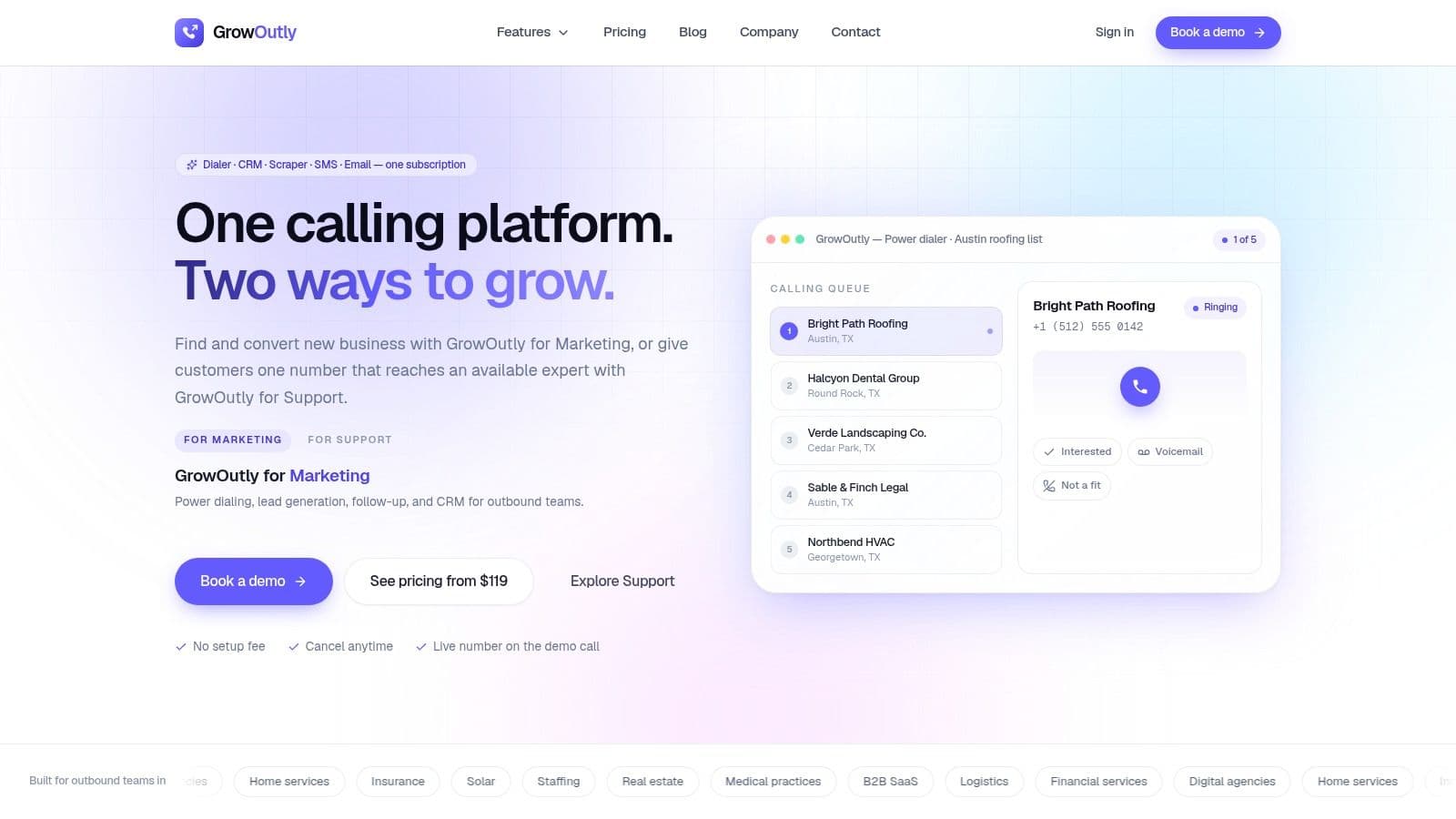
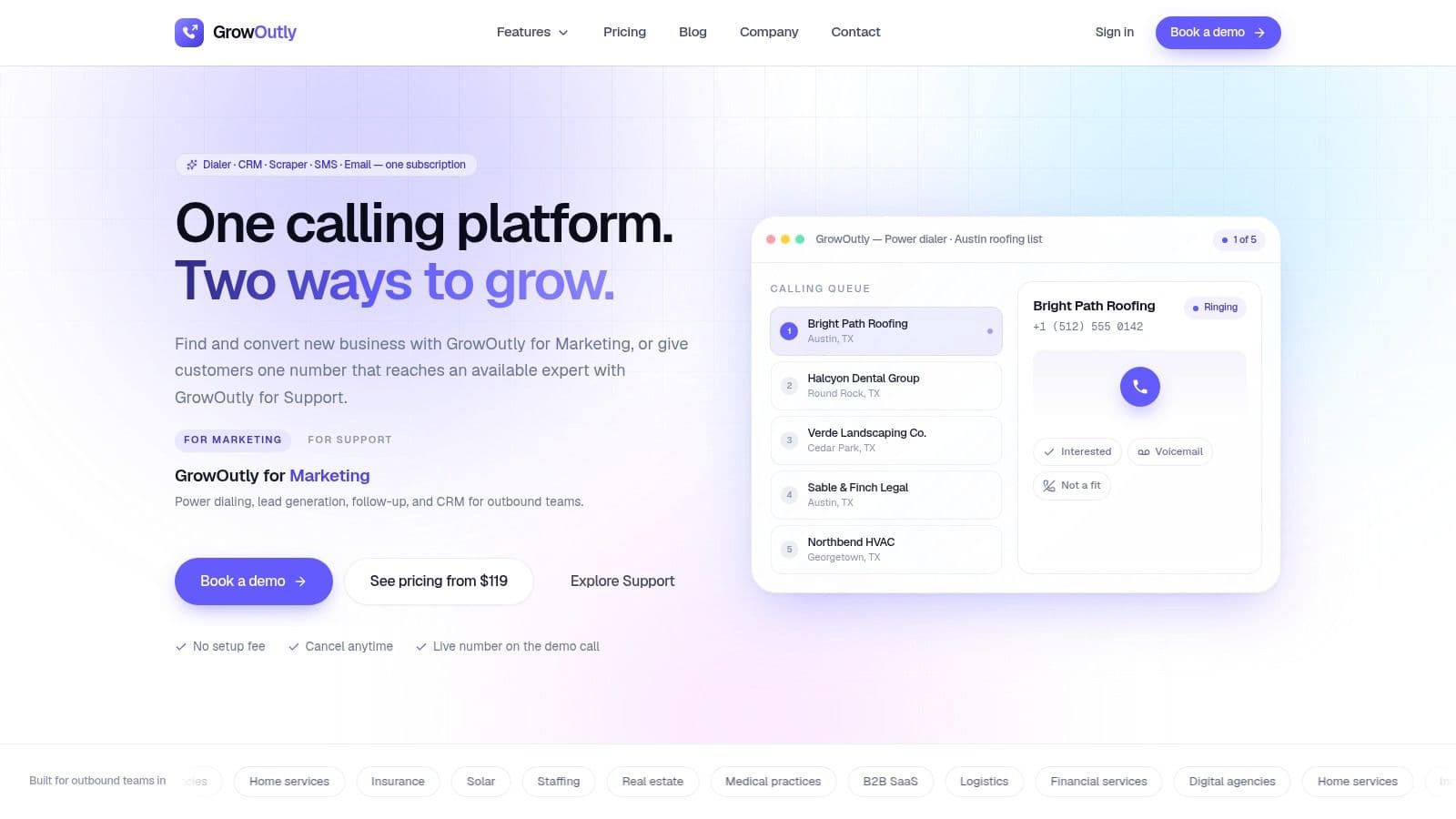
For teams that need calling, inbound routing, SMS/MMS, email, lead sourcing, scheduling, and CRM records in one workspace, GrowOutly offers unusually broad coverage (GrowOutly). It connects prospect discovery, outreach, meeting booking, and activity recording instead of leaving those steps across separate systems.
The outbound workflow includes a power dialer, queue-based calling, voicemail drop, local-presence caller ID, automated follow-up, and calendar booking. Inbound tools include IVR, skills-based routing, support queues, and caller context at answer, the behaviours our comparison of 10 inbound call routing software options scores across the wider field. Google Maps lead scraping produces verified, de-duplicated, dial-ready lists, while the built-in CRM handles pipelines, notes, custom fields, contact timelines, and interaction history.
Best practical fit: Agencies, home-service companies, insurance and solar teams, staffing firms, and support teams that lose time switching between calling, messaging, CRM updates, and scheduling tools.
Where GrowOutly stands apart
Its main advantage is consolidation. Calls, texts, emails, voicemails, and bookings can be logged automatically, reducing manual reconstruction of contact history. Power dialer CRM sets out what that write-back should actually contain, and which fields a rep still has to decide. Call recording, transcripts, audit logs, and role-based permissions give managers and compliance teams visibility into execution.
Compliance checks run before the action. The pre-dial and pre-SMS gates check National DNC, 50-state DNC, local curfews, and telemarketing litigator restrictions before outreach proceeds. GrowOutly states that these checks run in under 45 milliseconds, and reports an average 48-second path from Google Maps scraping to the first dial (GrowOutly compliance and speed documentation).
Pricing is more visible than on many enterprise sales engagement platforms. Plans are volume-based, with Base from $119 per month, Pro at $319 per month, and Essentials at $819 per month, plus custom Enterprise plans. Teams should model minutes, SMS, and virtual-number allowances before choosing a tier. SMS best practice still requires consent-aware targeting, clear opt-out handling, appropriate timing, and coordinated follow-up across channels. Replacing specialist tools may lower workflow friction, but onboarding and process changes remain part of the implementation cost.
2. Outreach
Outreach is designed for enterprise orchestration, where sales leaders need standardized cadences, task prioritization, governance, and reporting across multiple teams. Its strength is not sending more messages. It gives administrators a framework for controlling how sellers execute outreach and how managers inspect the resulting activity.
The platform supports multichannel cadences across email, phone, and social workflows, with task management and activity capture built into the execution layer. AI-assisted content and workflow automation can help reps prepare outreach and identify next actions, while integrations with major CRM and sales tools connect engagement activity to the broader revenue process. Its governance model, including roles, permissions, and reporting, is particularly relevant when different regions or teams need consistent operating rules.
Enterprise depth has a cost
Outreach makes sense when a business has enough process complexity to justify a dedicated orchestration layer. A large sales organization may value centralized controls, structured cadences, and analytics more than a small team values a fast, lightweight setup. That distinction matters because a feature-rich platform can become an expensive administrative project if managers haven't agreed on routing, sequence ownership, data standards, and coaching expectations.
Pricing isn't posted publicly, so buyers typically need a sales conversation. Packaging combines seats with usage for AI-driven workflows, which can provide flexibility but makes a like-for-like comparison harder before discovery. Implementation can also be complex for smaller teams that don't have sales operations support.
The platform's best use is a governed outbound motion with multiple managers, defined sales stages, and a CRM that needs disciplined activity capture. It isn't the obvious choice for a phone-first team seeking one workspace for telephony, SMS, scheduling, and CRM operations.
3. Salesloft
Salesloft suits teams that want to standardize prospecting and coaching in one system. It combines cadences, dialer and texting, meeting scheduling, conversation intelligence, mobile access, and CRM integrations instead of stopping at email sequencing.
The practical appeal is the connection between execution and review. Reps can work through multichannel cadences, place calls, send texts, schedule meetings, and use mobile tools for field or remote work. Managers can then examine conversations and engagement activity through conversation intelligence, using the same environment to support coaching and prioritization. Integrations with Salesforce, Microsoft Dynamics, and HubSpot make it a plausible choice for teams with an established CRM rather than a desire to replace one.
A sales engagement platform is most useful when it helps reps execute the buyer journey without losing context. Salesforce's sales engagement guidance emphasizes aligning outreach with buyer behavior, using preferred channels, balancing personalization with cadence consistency, and automating logging and scheduling. Salesloft's broad coverage supports that operating model, provided the team defines what should be automated and what requires human judgment.
Coverage versus adoption effort
Salesloft's advantage is breadth. A team can bring outreach, meetings, call analysis, and mobile activity into a coordinated system rather than assembling each capability independently. Its disadvantage is the enablement burden. Smaller organizations may need substantial implementation work, training, and governance before every feature produces daily value.
Pricing isn't listed publicly and usually requires a sales conversation. That lack of immediate price visibility makes total-cost modeling harder, particularly when the team also needs to account for seats, telephony, texting, integrations, and enablement. For a company that already has a mature sales process, the investment may be justified. For a small team looking for a simple cadence tool, it may be more platform than necessary.
For a broader explanation of how these systems differ from ordinary CRM tools, see what a sales engagement platform does.
4. Apollo
Apollo is best for data-plus-sequencing. It combines contact and company data, enrichment, email sequences, a parallel dialer, call recording, meeting scheduling, AI research, message drafting, analytics, and a Chrome extension for prospecting across the web.
That combination changes the buying question. A team doesn't have to acquire a data provider and a separate engagement platform before it can start building an outbound workflow. If the data layer is the part you are really weighing, our comparison of 10 B2B prospecting tools covers coverage, enrichment, and phone verification across the providers Apollo competes with, while 10 sales prospecting software picks looks at the platforms that carry a prospect from discovery through to a booked conversation. Reps can search for contacts and companies, qualify records, create sequences, call prospects, and schedule meetings from the same general environment. For SMB and mid-market teams, that can reduce tool sprawl and shorten the path from account selection to first touch.
The trade-off is control over data consumption. Exact plan limits and credits vary, so buyers should confirm quotas and fair-use terms rather than assume that database access and engagement usage are unlimited. Advanced governance and security requirements may also lead to custom plans, which can narrow the pricing advantage for organizations with demanding procurement standards.
Apollo's own sales engagement solution guidance recommends keeping cold outbound to about 6 to 8 touches over 2 to 3 weeks, with 48 to 72 hours between emails and 5 to 7 days between phone touches. It also recommends A/B testing subject lines and opening paragraphs and reviewing sequence performance monthly. Those rules are useful here because Apollo makes it easy to launch sequences, but easy deployment can also encourage teams to over-contact prospects.
Start with the quality of the list and the logic of the sequence. More records don't compensate for poor targeting or uncontrolled follow-up.
Apollo is a strong choice when prospect data is the bottleneck. It is less compelling when the main requirement is inbound call routing, deep telephony compliance, or a single operational workspace for support and outbound calling.
5. Groove by Clari
Groove by Clari is designed for Salesforce-first revenue operations. Its value comes from connecting sales engagement to activity capture, pipeline visibility, forecasting, and the wider Clari ecosystem rather than operating as an isolated sequencing product.
The platform supports cadences, automation, activity capture, AI-enabled assistance, and workflow insights. Deep Salesforce alignment is the defining consideration. Reps can work within processes that reduce manual CRM entry, while revenue leaders can connect prospecting activity to the pipeline and RevOps workflows they already manage through Clari.
The Salesforce decision
Groove is a logical fit when Salesforce is the system of record and Clari is already part of the operating model, or when the organization intends to build around that combination. A single-vendor path can simplify ownership across prospecting and revenue operations. It can also make reporting more coherent because engagement activity and forecasting workflows share a strategic home.
That fit becomes less certain outside Salesforce-centric environments. Teams using another CRM may not receive the same native depth, and the platform's broader value can be harder to justify without Clari's surrounding products. Public pricing is uncommon, and Groove is often purchased as part of broader Clari packages, so buyers need to assess the full commercial scope rather than evaluate it as a standalone seat-based sequencer.
Groove is therefore not the universal winner for multichannel outreach. It is the specialist choice for organizations that prioritize CRM discipline, Salesforce alignment, and RevOps visibility over independent telephony or highly transparent pricing.
6. HubSpot Sales Hub
HubSpot Sales Hub is the most natural option for teams that want sales engagement native to their CRM and marketing stack. Sequences, templates, snippets, tasks, meeting links, calling, and activity timelines sit on top of HubSpot's unified data model.
That native position reduces implementation friction for existing HubSpot customers. Reps can create one-to-one follow-up sequences, use stored contact context, make calls, schedule meetings, and review the activity timeline without moving between a separate CRM and engagement application. Marketing and sales teams can also work from the same broader HubSpot environment, which may matter more than specialized cadence controls for companies that value a consolidated customer record.
Sequences require Sales Hub Professional or Enterprise seats. HubSpot publishes plan tiers and pricing, giving buyers more visibility than platforms that require a sales conversation, although the relevant seat level and required product bundle still need careful review. Its channel breadth and governance are lighter than those of some specialist platforms for very large enterprises, particularly when teams need complex orchestration across regions and business units.
SMS requires a separate operational decision
HubSpot's CRM-native workflow doesn't remove the need to assess consent, DNC handling, message timing, and auditability. Teams should document those controls before adding text outreach, not after a campaign is running. TCPA compliance for sales outreach should be treated as an operating requirement, not a footnote in a tool evaluation.
HubSpot is the sensible choice when the CRM already anchors the business. It may not be the best fit for a call-heavy organization that needs advanced dialer queues, inbound routing, or telephony-led productivity in the same depth as a specialist platform.
7. VanillaSoft
VanillaSoft serves phone-first outreach. Its progressive and preview auto-dialing, call recording, lead management, routing, SMS, and agent activity history are built around teams that spend much of the day calling rather than managing elaborate multichannel programs.
The platform is well suited to insurance, solar, recruiting, appointment setting, and local services. Queue-based workflows help agents work through prioritized leads, while lead routing and workflow automation reduce the manual decisions between one call and the next. Native SMS and integrated telephony keep the core communication history near the agent desktop, which is valuable when speed and consistent lead handling matter more than advanced social or email orchestration.
A power dialer can improve the calling workflow by reducing idle time between conversations, but dialing speed shouldn't be the only evaluation criterion. Teams must also inspect how the platform handles consent, DNC suppression, curfews, call recording permissions, SMS opt-outs, and audit records across the markets where they operate.
Where the platform is narrower
VanillaSoft places less emphasis on the advanced multichannel cadences associated with specialist sales engagement leaders. A team that needs branching email journeys, extensive AI prioritization, conversation intelligence, or broad social workflows may need additional tools. Pricing is typically handled through sales, with fewer public plan details for early comparison.
Its practical fit is clearer for inside sales than for enterprise orchestration. If the business measures success through calls connected, appointments set, and leads routed quickly, VanillaSoft can align closely with that motion, and our comparison of 10 outbound call center software platforms covers the rest of that phone-led category on dialing modes and campaign controls. If the business needs one strategic layer for email, social, phone, SMS, coaching, and pipeline analytics, a broader platform may be more appropriate.
Top 7 Sales Engagement Platforms Comparison
| Platform | Implementation complexity 🔄 | Resource requirements ⚡ | Expected outcomes 📊 | Ideal use cases 💡 | Key advantages ⭐ |
|---|---|---|---|---|---|
| GrowOutly | Medium 🔄🔄, all-in-one migration & onboarding | Moderate ⚡⚡, usage-based minutes/SMS, paid tiers from $119/mo | Faster list-to-dial, higher connects (site claims 3.4x conversations) 📊 | Outbound sales teams (agencies, home services, insurance/solar, staffing) | All-in-one workspace, fast Google Maps scraping, pre-dial compliance gates, scalable cold-caller network ⭐⭐⭐⭐ |
| Outreach | High 🔄🔄🔄, enterprise governance & rollout | High ⚡⚡⚡, enterprise seats, integration and admin overhead; sales-led pricing | Scaled cadences, governance, AI-assisted workflows and detailed reporting 📊 | Large enterprises needing strict governance and AI workflows | Broad enterprise ecosystem, robust admin controls and analytics ⭐⭐⭐ |
| Salesloft | Medium-High 🔄🔄🔄, configuration plus enablement | Medium-High ⚡⚡⚡, CRM integrations, enablement effort | Standardized prospecting + coaching, AI prioritization and conversation intelligence 📊 | Teams standardizing prospecting/coaching, mobile/field reps | End-to-end engagement to coaching, strong CRM integrations, mobile experience ⭐⭐⭐ |
| Apollo | Low-Medium 🔄🔄, simpler setup with data-first model | Low-Medium ⚡⚡, free tier available; confirm credits/quotas for scale | Combined data + engagement, faster prospecting with enrichment and sequences 📊 | SMB to mid-market wanting integrated contact database + engagement | Large contact database + sequencing, cost-effective entry, Chrome prospecting extension ⭐⭐⭐ |
| Groove by Clari | Medium-High 🔄🔄🔄, deeper CRM/RevOps integration | High ⚡⚡⚡, often purchased as part of Clari, strong Salesforce dependency | Improved activity capture and pipeline visibility tied to RevOps 📊 | Salesforce-first orgs that want tight forecasting and RevOps workflows | Deep Salesforce alignment, reduces CRM manual entry, connects to forecasting/Clari ⭐⭐⭐ |
| HubSpot Sales Hub (Sequences) | Low-Medium 🔄🔄, native if already on HubSpot | Low-Medium ⚡⚡, Sequences require Professional/Enterprise seats; published pricing | Faster adoption, unified CRM activities and simpler automation 📊 | Teams already on HubSpot seeking native engagement features | Native to HubSpot CRM, unified data model, clear published tiers and pricing ⭐⭐⭐ |
| VanillaSoft | Low-Medium 🔄🔄, phone-forward, focused rollout | Medium ⚡⚡, telephony and lead routing resources | Efficient high-volume calling and appointment setting for inside sales 📊 | Call-heavy SDR/BDR teams (insurance, solar, recruiting, local services) | Purpose-built for dialing, progressive/preview auto-dialing, lead routing and SMS integration ⭐⭐⭐ |
Choose the Platform That Fits Your Outreach Motion
The best sales engagement platform is the one that matches the team's dominant workflow, not the one with the most impressive feature inventory. Market adoption reinforces why this distinction matters. A 2022 industry summary reported that leading platforms can reach more than 60% daily active users, compared with 10% to 20% for traditional enterprise software, while estimating a market value of $7.4 billion in 2022 and nearly $30 billion by 2032 (Persistence Market Research). A tool that fits the daily motion will usually matter more than a tool that wins a checklist comparison but frustrates reps.
Choose GrowOutly if you want unified calling, inbound routing, SMS, email, CRM, lead sourcing, scheduling, and embedded compliance checks. It's particularly suitable when separate tools are causing handoff problems or when both outbound marketing and customer support need shared contact context.
Choose Outreach for enterprise governance, structured orchestration, AI-assisted workflows, and centralized administration. Choose Salesloft when broad engagement coverage, conversation intelligence, coaching, mobile access, and CRM integrations matter more than rapid deployment.
Choose Apollo when the main challenge is combining prospect data with sequencing and dialing. Choose Groove by Clari when Salesforce alignment and RevOps visibility are central to the operating model. Choose HubSpot Sales Hub when the company already relies on HubSpot and wants engagement to remain native to its CRM. Choose VanillaSoft when phone-led, high-volume workflows and lead routing are more important than advanced multichannel orchestration.
SMS deserves its own evaluation because automation can increase operational risk when compliance is added later. A practical opt-in flow can use a keyword such as “Text DEMO to 55555”, triggering a welcome message and adding the contact to the appropriate list. The keyword should be short and easy to spell, and the automated reply should include the brand name, message frequency, data-rate language, and opt-out instructions, as outlined in guidance from Sinch and Omnisend.
Before expanding, use this implementation sequence:
- Map current handoffs: Document where reps switch between the dialer, CRM, email tool, SMS inbox, scheduler, and reporting system.
- Verify CRM synchronization: Confirm that calls, texts, emails, meetings, notes, dispositions, and opt-outs write back to the correct contact and deal records.
- Model usage: Estimate expected minutes, SMS volume, virtual numbers, seats, data credits, and AI usage against each platform's allowances.
- Document compliance controls: Define consent, National DNC and state DNC handling, curfews, call recording permissions, opt-outs, and audit responsibilities.
- Create restrained SMS templates: Keep messages personalized, identify the brand, state required terms, and provide a clear opt-out path.
- Coordinate channels: Plan how a text relates to an email and phone touch so prospects don't receive disconnected or excessive follow-up.
- Define analytics: Track replies, connects, meetings, conversions, sequence performance, and rep activity rather than relying only on send volume.
- Run a controlled pilot: Test one audience, workflow, and team before expanding the platform across every segment.
The right decision should become clearer after that exercise. Pick the platform that removes the most friction from your actual outreach motion while preserving CRM accuracy, measurable performance, and responsible communication.
Whichever one you choose, the platform only decides how many qualified conversations a rep gets. What happens inside them is still execution, so pair the decision with the close sales techniques that turn a live answer into a booked next step.
GrowOutly brings outbound dialing, inbound call routing, SMS/MMS, email outreach, lead generation, scheduling, CRM records, and pre-outreach compliance checks into one workspace. If your team wants to replace disconnected tools with a coordinated calling and follow-up workflow, visit GrowOutly to explore the platform.