Your team probably doesn't have an effort problem. It has a workflow problem.
A rep starts the day in a spreadsheet, copies a contact into a dialer, flips to email for a follow-up, opens the CRM to log a note, then drops a scheduling link into a reply that may or may not get used. An hour passes. Activity happened, but very little moved forward. The rep feels busy. The manager sees incomplete data. The prospect gets a fragmented experience.
That daily friction is why the sales engagement platform category exists. It isn't just software for sending more emails. At its best, it's the operating layer that pulls calling, messaging, sequencing, contact history, and booking into one place so reps can work a clean process instead of stitching one together every morning.
The Fragmented Morning That Started a Software Category
At 8:30 a.m., an SDR opens five tabs before making the first call. One tab has the lead list. Another has the CRM. A third has the dialer. A fourth has the email tool. The fifth is the rep's calendar, because if someone says yes, the fastest way to lose momentum is to say, “I'll send over some times.”
By 9:30, that rep has done a lot of motion. They've clicked through records, copied phone numbers, sent follow-ups, and tried to remember whether the prospect who asked for a callback was already texted by someone else on the team. Nothing about that looks dramatic. That's why it survives so long inside sales orgs.
Tool sprawl creates fake productivity
Most outbound teams don't break because reps are lazy or managers don't care. They break because the workflow lives in too many places.
Common symptoms show up fast:
- Follow-up gaps: The rep means to call back, but the reminder sits in a spreadsheet no one trusts.
- Duplicate touches: One rep emails while another texts because neither sees a shared timeline.
- Weak reporting: Managers can count activity, but they can't easily see which sequence or channel produced meetings.
- Slow booking: A live conversation cools off while the rep hunts for availability.
A sales engagement platform was built to remove that drag. It gives the rep one workspace for outreach execution, not just data storage. Calling, SMS, email steps, notes, and booking all happen in one record.
The category didn't emerge because teams wanted another dashboard. It emerged because disconnected tools were wasting selling time every single day.
Why the category took off
Outbound teams moved from manual calling and spreadsheet-based follow-up toward multichannel workflow automation, and the market followed. Sales engagement platform adoption among B2B companies rose from 35% in 2020 to 62% in 2023, while enterprise adoption among companies with 500+ employees reportedly increased 34% year over year in 2026, according to World Metrics coverage of sales engagement software statistics.
That shift matters because it marks a change in how teams view the software. This is no longer a nice-to-have layer for ambitious SDR teams. For high-volume outbound groups, it has become core infrastructure.
When a team standardizes sequencing, calling, scheduling, and activity tracking inside one system, rep behavior changes. Less toggling. Fewer dropped handoffs. More consistent follow-through.
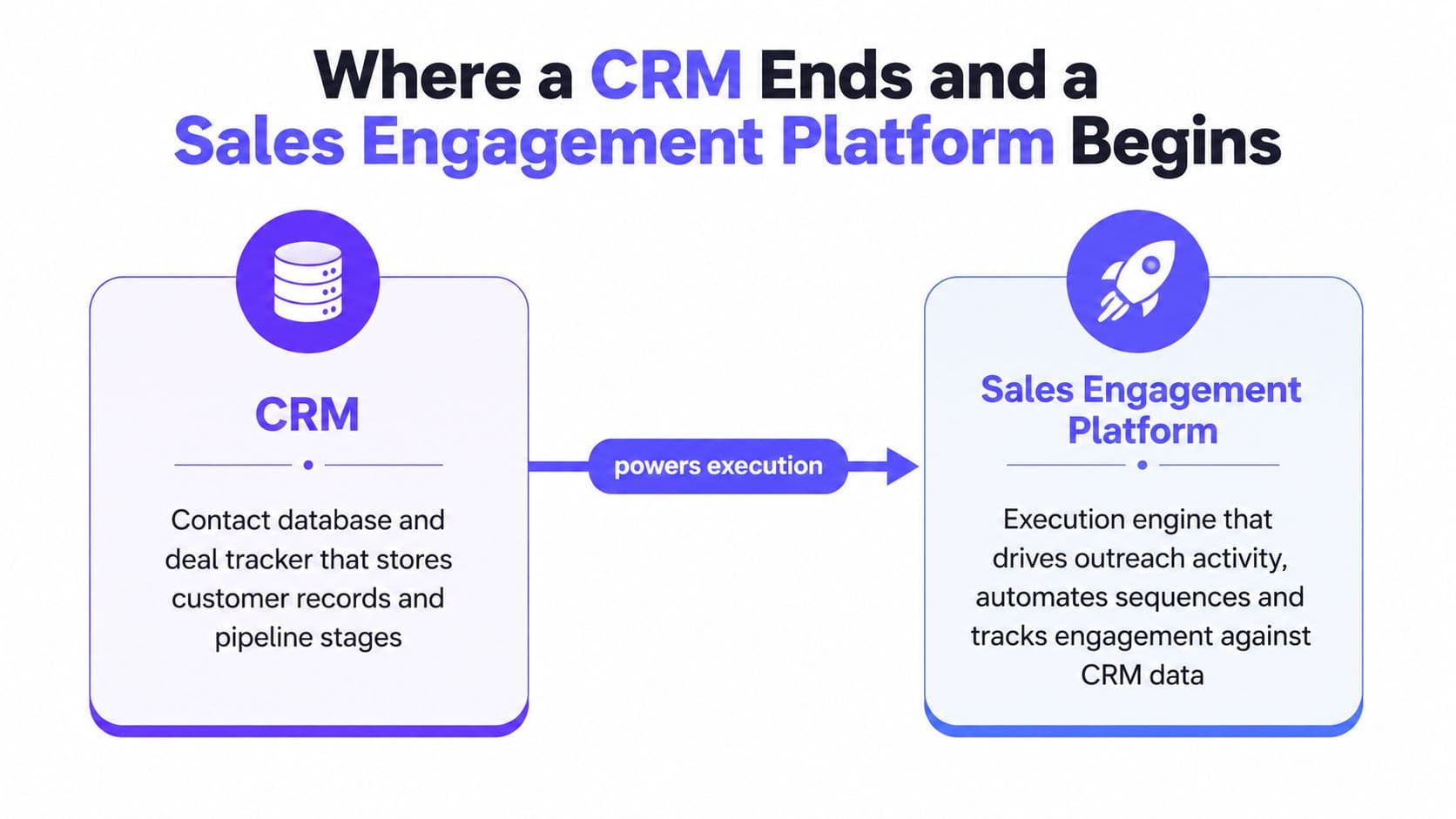
Where a CRM Ends and a Sales Engagement Platform Begins
A lot of teams blur these two categories, and it causes expensive decisions.
A CRM is where you store account, contact, and pipeline data. A sales engagement platform is where reps execute outreach against that data. If you ask a CRM to do the job of an execution engine, the team usually compensates with exports, reminders, side spreadsheets, and manual task chasing.
The simple boundary
A CRM answers questions like:
- Who is this contact?
- What company are they from?
- What stage is the opportunity in?
- What happened last quarter?
A sales engagement platform answers different ones:
- What should the rep do next?
- Which channel should they use?
- Has this person already been emailed, called, or texted?
- Did that outreach produce a reply, a meeting, or an opt-out?
That difference sounds subtle until the team scales.
What breaks when the CRM becomes the outreach engine
When teams run outbound directly from a CRM without a real engagement layer, the process gets fragile:
| CRM vs Sales Engagement Platform Decision Guide | If Your Team… | You Likely Need… | Why It Matters |
|---|---|---|---|
| Scenario 1 | tracks accounts and deals but reps still send follow-ups manually | a CRM | data storage may be enough if outreach volume is low |
| Scenario 2 | exports lists, rotates between a dialer and inbox, and logs activity after the fact | a sales engagement platform | execution gets standardized and captured automatically |
| Scenario 3 | needs calls, SMS, email sequences, booking, and shared visibility in one workflow | both, tightly connected | one system stores truth, the other powers action |
| Scenario 4 | struggles with duplicate records and inconsistent follow-up rules | an integrated operating layer | fewer handoffs reduce latency and cleanup work |
Modern buying teams increasingly want this operating-layer model, not a basic sequencer bolted onto a database. As noted in this comparison of modern sales engagement platform evaluation criteria, the category is now judged on lead sourcing, channel orchestration, deliverability controls, action automation, reporting, and pricing model, because point tools that only send messages don't solve the workflow problem.
For teams already thinking about the data side first, it helps to start with the basics of CRM functionality and then ask what's still missing in daily execution.
Practical rule: If your reps are still building their own daily call lists and follow-up order by hand, you don't just have a CRM problem. You have an execution problem.
The Core Features That Define a Sales Engagement Platform
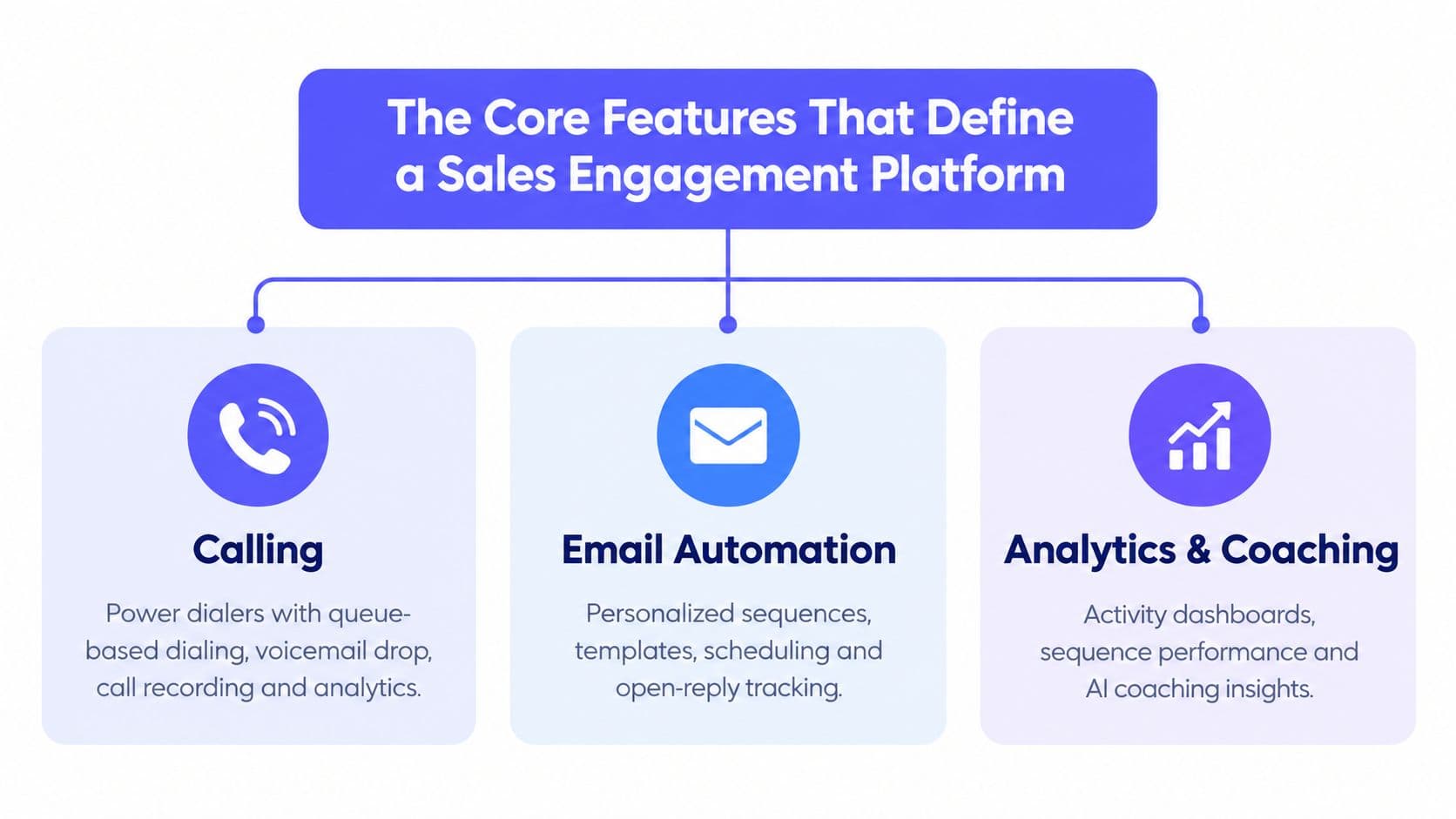
Once you stop treating the category as “an email sequencer plus maybe a dialer,” the core feature set gets much clearer. A credible sales engagement platform needs to support three things well: outreach execution, sequence control, and performance visibility.
Calling is still the fastest path to a live conversation
For outbound teams, calling features can't be an afterthought. Reps need queue-based dialing, voicemail drop, call recording, and caller ID tools that help them move through a list without dead time. If the platform also supports inbound handling, routing, IVR menus, voicemail-to-text, and skills-based distribution, the team can work both response and prospecting workflows in one system.
That matters because a conversation often starts in one channel and finishes in another. The rep who places the call should also see the text thread, the last email, and the booking history on the same record.
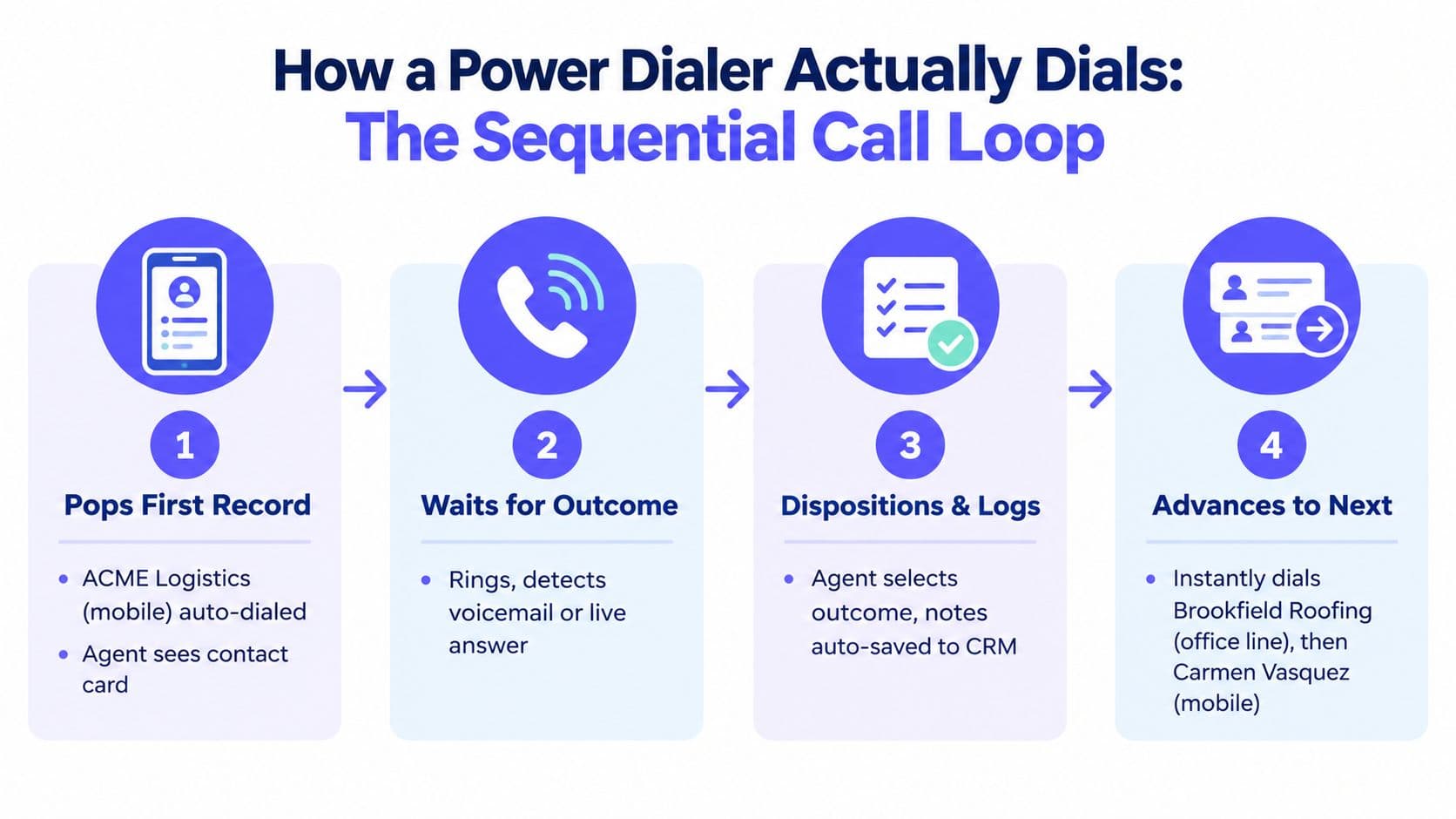
The dialing mode underneath those calls is worth understanding before you compare vendors. What a power dialer is and how it works breaks down the sequential call loop, the branch logic behind each disposition, and why it gives reps more control than predictive pacing.
Here's a walkthrough format many teams find useful when evaluating broader platform capability:
Sequencing should coordinate channels, not isolate them
Email sequencing remains important, but sequencing alone isn't enough. The platform should let teams build single-step and multi-step workflows with merge fields, reply tracking, scheduling controls, and contact timelines. It should also support two-way SMS and MMS in the same workflow so the record reflects the full conversation.
What reps need isn't “more channels.” They need one sequence that knows when email was sent, when a call was dispositioned, and whether a text got a reply.
A strong setup usually includes:
- Email steps: Personalized templates, reply detection, and timing controls.
- Voice tasks: Queue-driven calls tied directly to sequence logic.
- Messaging steps: Shared-number SMS that updates the same contact record.
- Booking actions: Calendar links or live scheduling inside the rep workflow.
Analytics should show where the process breaks
Managers don't just need activity totals. They need conversion telemetry that shows where contacts stop progressing. Did prospects open but not reply? Reply but not book? Book but fail to show? Reps also need contact-level history so they know what happened before the next touch.
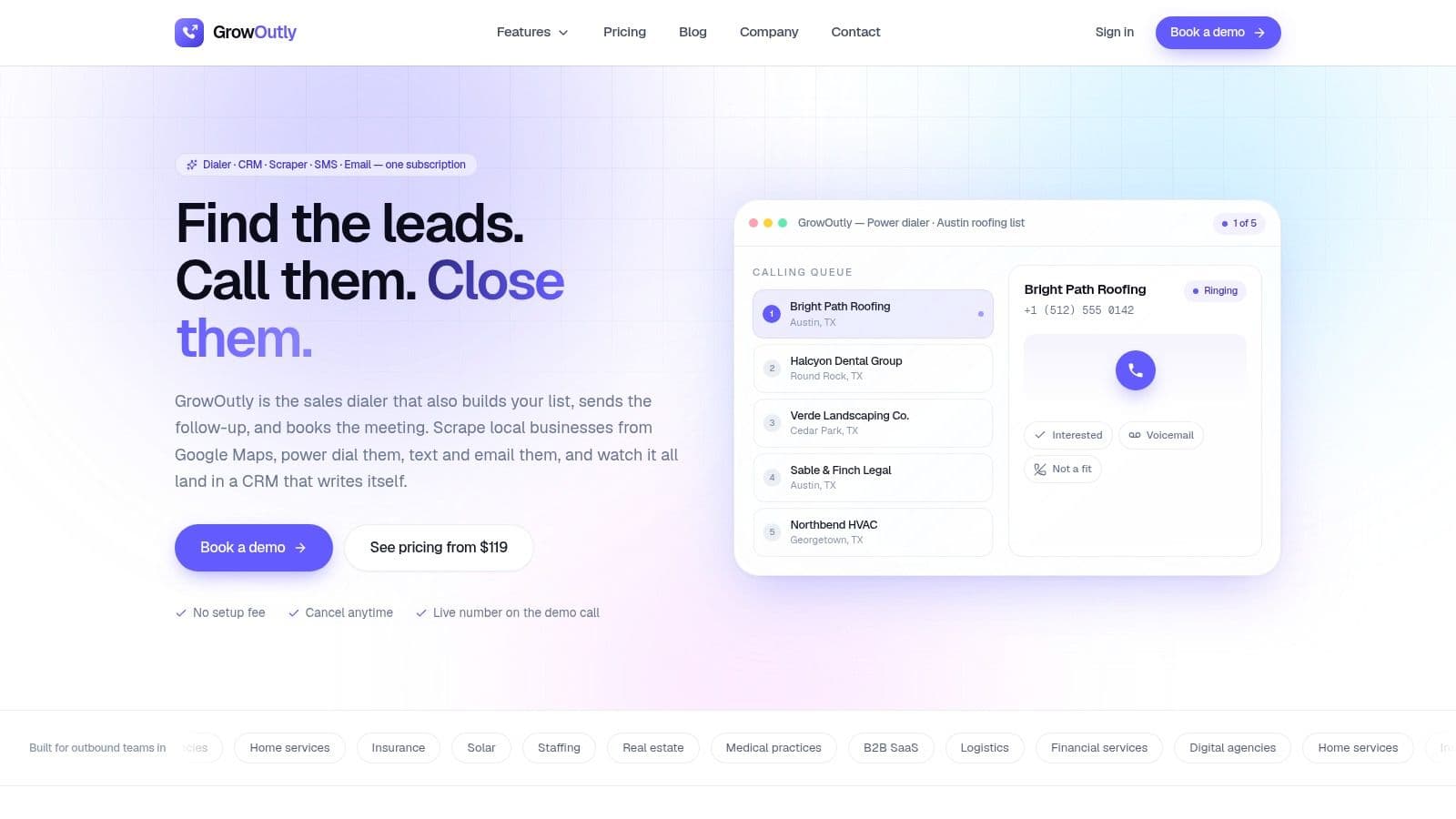
That's why modern platforms increasingly pull adjacent capabilities into the same environment. Lead sourcing, CRM pipelines, and calendar booking matter because they shorten the path from list creation to meeting held. Platforms like GrowOutly's feature set reflect that broader model by combining dialer, messaging, email outreach, booking, and built-in CRM functions inside one workspace.
How the Right Platform Transforms Outbound Outcomes
A good sales engagement platform doesn't just make the dashboard cleaner. It changes response speed, compliance discipline, and how often a conversation turns into a booked meeting.
The clearest improvement usually comes from multichannel orchestration. SMS open rates reach around 98% compared with roughly 22% for email, and adding calling to SMS workflows increases median engagement rates to about 24% versus 9% for text-only sequences, according to ZoomInfo's sales follow-up statistics summary. That's not an argument for replacing email with text. It's a reminder that channel timing matters.
Faster responses come from channel design
A common mistake is treating every prospect the same way. Teams blast email, wait too long, then call cold with no context. A tighter workflow works better in practice:
- Start with a low-friction touch such as a brief email.
- Use SMS as an accelerator when the sequence calls for immediacy.
- Use voice as the conversion layer when someone shows intent or partial engagement.
- Book live when interest appears instead of sending scheduling options later.
When all of that happens in one record, reps don't lose attribution between tools. The team can see which sequence path produced the meeting.
Shared-number messaging, calling, and booking on one timeline makes optimization possible at the sequence level, not just the campaign level.
Compliance is part of throughput
Buyer guides often treat compliance like a legal footnote. Outbound teams know better. If your reps are calling and texting at volume, the platform has to help prevent risky outreach before it happens.
That means practical controls such as pre-dial and pre-SMS checks, internal suppression handling, territory-aware calling windows, and audit history. A workflow that blocks a bad touch before connect is better than a cleanup process after the fact.
Booking is where good outreach often gets lost
Many teams win the conversation and still lose the meeting. The rep says, “I'll follow up with a link,” the prospect gets busy, and momentum disappears.
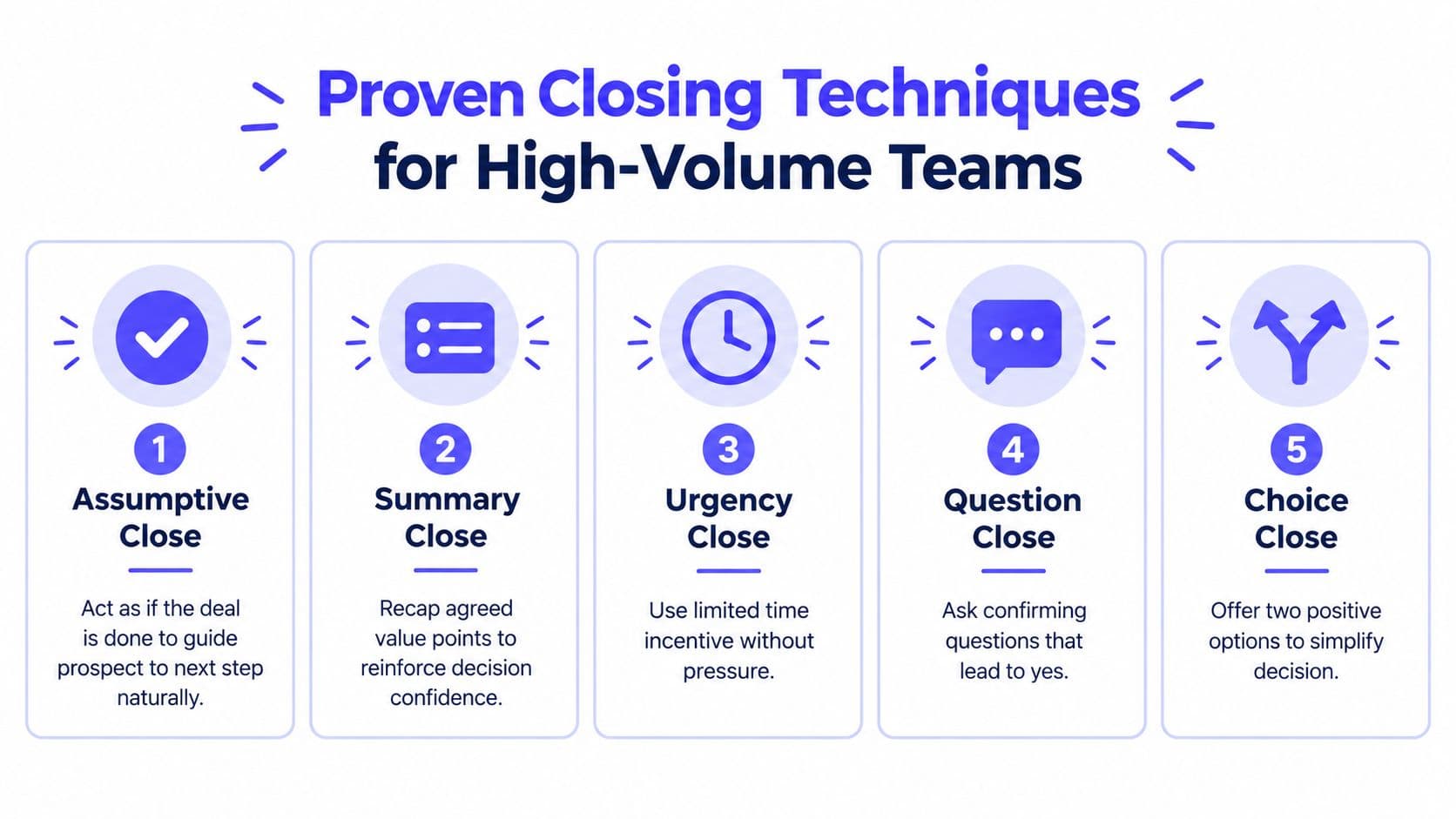
A better platform lets the rep move directly from conversation to scheduled meeting with live availability. Then reminders keep the meeting intact. The language reps use in that moment matters as much as the tooling — the closing techniques that actually work are mostly about asking for the next step while the conversation is still live. The rep who used to spend the first hour of the day jumping across tabs now works one flow: source, contact, follow up, and book. That's what changes outcomes. Not more activity for its own sake, but less friction between each step.
Real-World Scenarios Across Different Outbound Teams
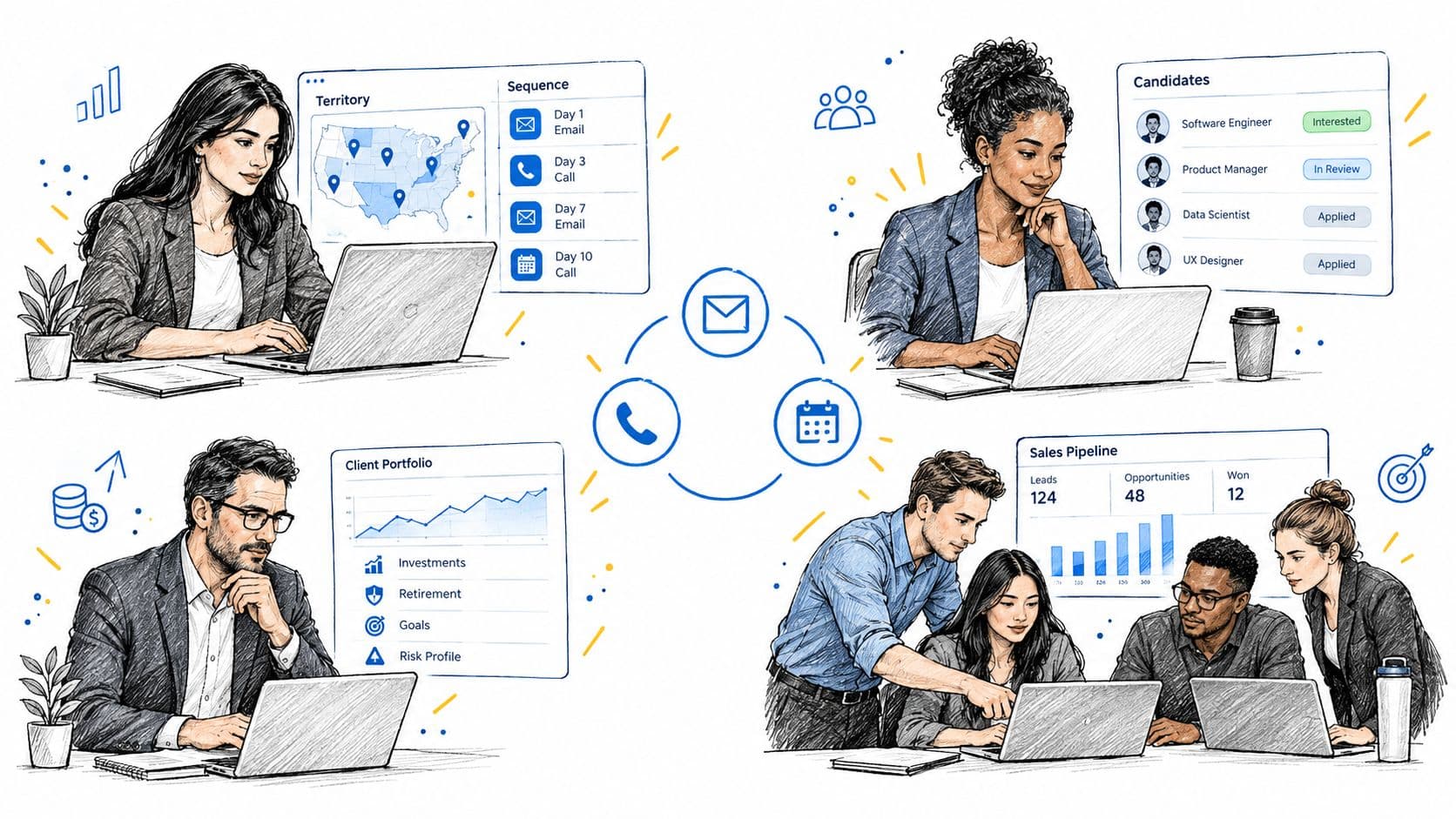
A sales engagement platform makes more sense when you look at how different teams use it. The architecture can stay similar while the workflow changes a lot.
B2B SaaS and agencies use it for coordination
A B2B SaaS outbound team usually cares about account coverage, clean stage progression, and consistent follow-up after light intent. The platform helps the team run territory-based calling and email sequences while keeping pipeline updates close to the outreach itself.
A digital agency or lead-gen firm has a different headache. Multiple reps may touch the same book of business, and clients expect fast follow-up without duplicate messages. Shared inboxes, sequence visibility, and one contact timeline matter more here than a long feature checklist.
Local services and regulated teams use it for speed with control
A roofing, HVAC, or landscaping sales team often needs to build lists fast by territory, call immediately, and turn a live conversation into an estimate on the calendar. In that world, the handoff between list building, dialing, and booking has to be tight or the lead cools off.
Insurance and solar teams care about a different risk. They may run high-volume calling in territory-based motions where compliance controls can't sit outside the rep workflow. Power dialing, local presence caller ID, suppression logic, and call history all need to work together. Our cold calling playbook for insurance walks through that compliance gate, the territory list build, and the call arcs regulated teams run against it.
A useful way to think about fit is this:
- If your team sells by account: Prioritize sequence coordination, CRM stage clarity, and rep collaboration.
- If your team sells by territory: Prioritize lead sourcing, dial speed, and booking on the call.
- If your team works regulated outreach: Prioritize gating, suppression, and audit trails before adding extra channels.
- If your team runs campaigns for clients: Prioritize shared visibility so multiple users don't collide on the same prospect.
No platform should be chosen because it “has the most features.” It should be chosen because it matches the pattern of work your reps perform every day.
Best Practices for Running Outbound Inside a Sales Engagement Platform
The platform only helps if the operating habits are sound. Bad list hygiene and sloppy sequence design will still create poor outcomes. The difference is that a good platform gives you a place to enforce better habits.
Start with list hygiene and suppression
Before any campaign launches, validate where the records came from and scrub them against the National Do Not Call list, applicable state lists, and your internal suppression list. Outbound marketing lists should be scrubbed against the National Do Not Call Registry at least every 31 days, and teams should maintain an internal suppression list that updates quickly after opt-out requests, as noted in this TCPA compliance checklist for outbound campaigns.
Independent guidance also recommends validating lead sources, documenting scrubbing activity, and honoring opt-outs within 24 hours where possible, with a 30-day maximum in some compliance frameworks, according to AgentTech's DNC list compliance guide.
Operational takeaway: Don't let reps decide manually whether a record is safe to contact. Build suppression into the workflow.
Build sequences that escalate intelligently
Good sequences don't just alternate random channels. They move from lower-friction to higher-commitment touches.
Try a pattern like this:
- Open with email: Use it for context and relevance.
- Escalate to SMS when appropriate: Use it when immediacy matters or when a light nudge can revive attention.
- Use voice for conversion: Call when there's intent, a question, or a reason to lock the next step.
- Stop fast on opt-out signals: Internal suppression should update quickly across channels.
Operational takeaway: Design each touch to earn the next one, not to repeat the last one.
Manager habit: Review active sequences for channel logic, not just message copy. Most weak campaigns fail in orchestration before they fail in wording.
Protect booked meetings after the rep wins them
Teams spend too much energy generating meetings and too little protecting them. Automated reminder sequences that send a confirmation immediately after booking, followed by nudges at 48 hours, 24 hours, and approximately 2 hours before the appointment can reduce no-shows by 30 to 40 percent, and adding a one-click reschedule link to every reminder further cuts missed appointments, according to Agentic Calendars on reducing no-shows with AI reminders.
Operational takeaway: Treat reminder cadence as part of the sales process, not an admin afterthought.
Keep audit logs, opt-out records, and activity history intact. If a manager can't reconstruct what happened with a contact, the workflow isn't mature yet.
How to Evaluate and Choose the Right Sales Engagement Platform
Most buying teams compare platforms the wrong way. They line up feature grids, circle the channels they like, and overlook the critical question. Does this system replace fragmented workflows, or does it add one more tab to the stack?
That's the decision lens that matters.
Use workflow consolidation as the first filter
A platform should reduce handoffs between prospecting, outreach, booking, and reporting. If reps still need exports to move contacts from one step to the next, the tool may automate activity while preserving the underlying mess.
Modern sales engagement platforms are increasingly judged by end-to-end workflow depth rather than sequencing alone, with evaluation rubrics now emphasizing lead sourcing, channel orchestration, deliverability controls, action automation, reporting, and pricing model because tools that only send messages behave like point solutions instead of true engagement systems, as described in this review of how to compare sales engagement platforms.
Score the platform on five practical criteria
Use a framework like this during demos and trials:
-
Lead sourcing depth
Can the team build or ingest workable prospect lists without extra cleanup layers? The less CSV handling, the better. -
Multichannel orchestration
Can email, calling, SMS, and booking run inside one contact workflow? Or are channels stitched together loosely? -
Compliance and deliverability controls
Look for pre-dial controls, suppression handling, audit logs, and safeguards that reduce risky outreach before it happens. -
Reporting visibility
The platform should expose reply quality, meeting outcomes, and sequence-level performance, not just counts of tasks completed. -
Pricing model fit
Heavy outbound teams should pay attention to whether cost scales with actual usage or becomes a seat-based bottleneck. For buyers comparing cost structure in more detail, it's useful to review GrowOutly pricing alongside other vendors' models.
Watch for the hidden costs of partial integration
The strongest technical fit keeps contact data, sequence state, call outcomes, and calendar events in one workspace. Every extra import and export increases latency, creates duplicate records, and raises the odds that one channel's logic won't match another's.
That's also why demos should focus on a full rep workflow, not isolated features. Don't just ask to see the dialer. Ask to see what happens when a lead is sourced, called, texted, replied to, booked, rescheduled, and suppressed. The quality of those transitions is where the value sits.
If you want a head start on the shortlist, this comparison of 10 outbound call center software platforms scores vendors on dialing modes, CRM workflow, compliance controls, and pricing visibility against the team size each one actually fits.
Don't buy the platform with the longest feature list. Buy the one that makes your current workflow shorter, cleaner, and easier to enforce.
Reference calls matter too. Ask how teams run outbound inside the product. A polished demo can hide operational gaps that show up only once reps start using the system every day.
GrowOutly offers a cloud-based outbound sales platform that brings together a power dialer, lead sourcing, two-way messaging, email outreach, built-in CRM, and calendar booking in one workspace. If you're trying to replace disconnected tools with a cleaner outbound operating layer, visit GrowOutly and look at how the workflow fits your team's actual calling, messaging, booking, and compliance needs.