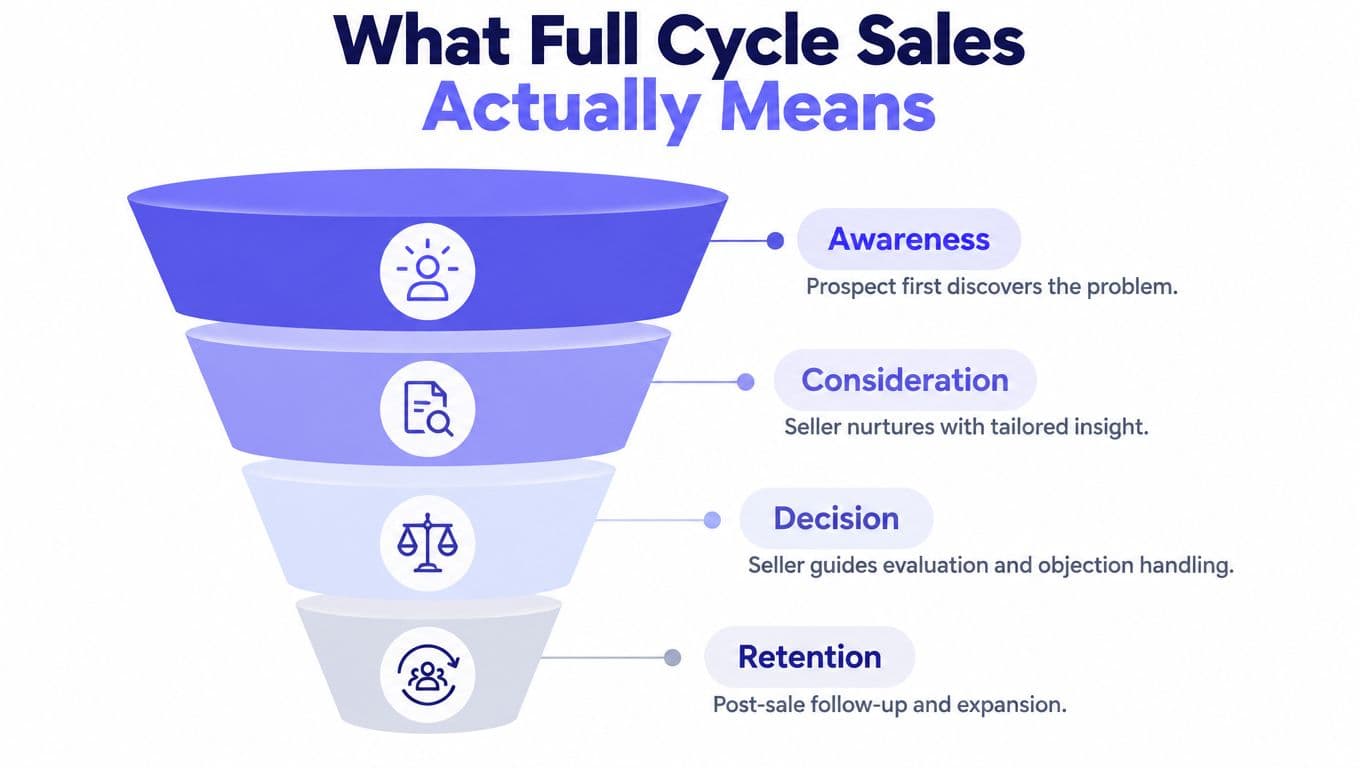
Full cycle sales manages a prospect from initial awareness through lead generation, qualification, opportunity development, closing, and retention in one continuous workflow. In practice, that continuity matters because 39% of leads reach marketing-qualified lead, 38% of marketing-qualified leads reach sales-qualified lead, 42% of sales-qualified leads reach opportunity, and 37% of sales-qualified leads close won, so every handoff leak shows up in the numbers sales funnel benchmark.
The surprising part is that the strongest full-cycle teams don't just remove handoffs, they design for them with discipline. Buyers now do much of the journey on their own, so the rep who owns the whole path has to be faster, more coordinated, and more selective than the old “one rep does everything” stereotype suggests buyer journey benchmark.
Full Cycle Sales: Definition and Operating Model
Full cycle sales is more than one person doing every task, it is one continuous operating system. The model begins when a prospect recognizes a problem and continues through qualification, closing, onboarding, and, for some teams, expansion or renewal.
The historical funnel remains useful because it makes conversion loss visible at each stage. Awareness creates leads, leads become qualified leads, qualified leads become opportunities, and opportunities become customers. Filling the top of that funnel is its own tooling decision, which our comparison of 10 sales prospecting software picks covers from discovery through to the first booked conversation. The model shows where progress stops instead of hiding weak performance inside a single revenue figure.
Teams often confuse “full-cycle” with “do everything yourself.” A better definition is one owner, one record, one context trail from first touch through post-sale follow-through. That continuity helps when a buyer revisits the conversation days later or adds a stakeholder who needs the full history. A rep rebuilding context across disconnected tools loses time and deal momentum. That is the whole argument for consolidating the stack, and our comparison of the 7 top sales engagement platforms scores the products built to hold that one record.
Full-cycle ownership also has a capacity limit. If prospecting, meetings, CRM updates, proposals, onboarding, and renewals exceed the hours or attention available, keeping every task with one rep creates slower responses and shallow execution. Keep ownership together when the workload is manageable and context materially improves conversion. Split tasks when specialization increases speed, quality, or coverage without breaking accountability.
Practical rule: full cycle sales works when the same owner can keep context intact without drowning in admin.
For teams using a platform approach, the relevant comparison is fragmentation versus continuity. If prospecting, scheduling, CRM updates, and follow-up live in separate places, reps spend more energy stitching together the workflow than advancing deals. A clear operating model, supported by tools that coordinate engagement activity, matters as much as the script. See what a sales engagement platform does for a broader view of that stack.
The Six Stages of Full Cycle Sales
The six stages are simple on paper and messy in real life. A good full-cycle rep doesn't treat them as silos, because the quality of one stage changes the next one.
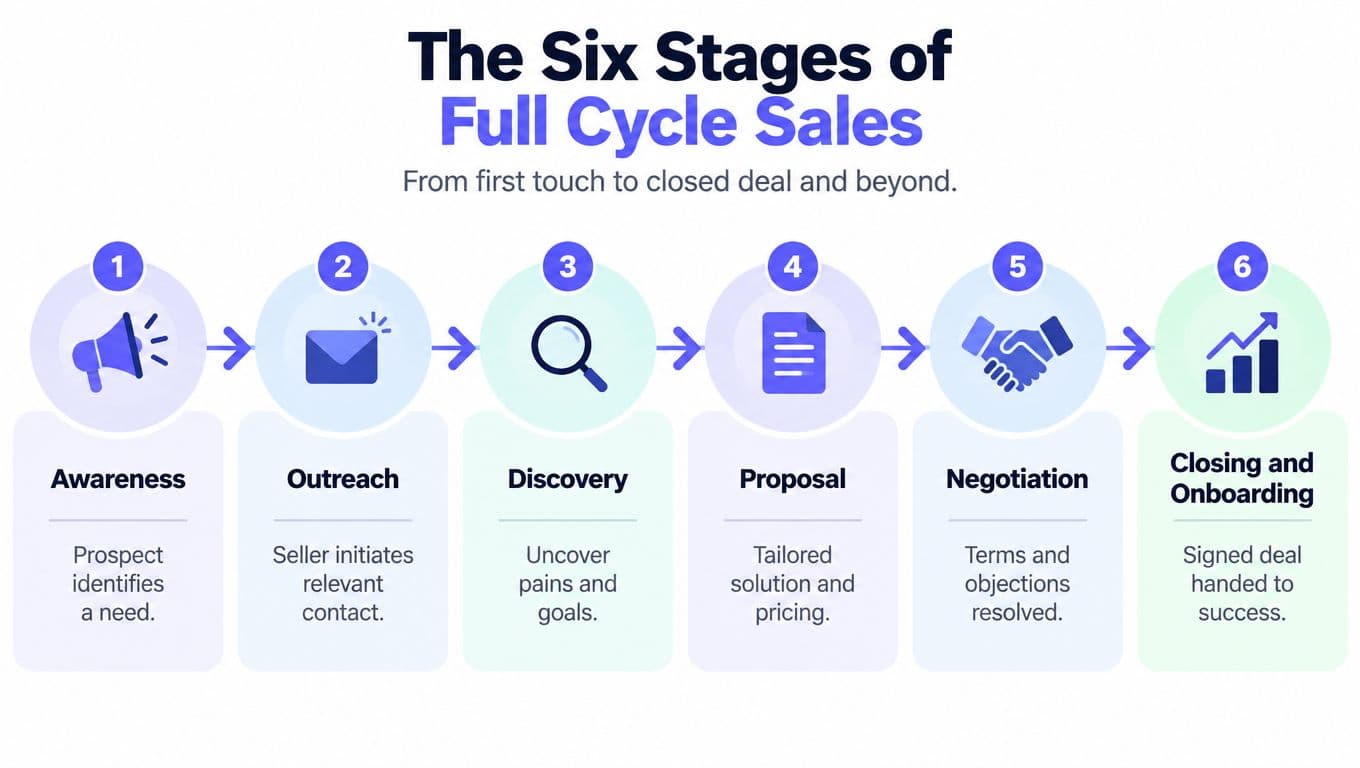
- Awareness and lead generation start with fit, not volume. In B2B services, home services, insurance, solar, and staffing, the job is to find the people who already have the problem you solve.
- Outreach and response turn that fit into a live conversation. The rep opens the door with relevant contact, not a generic blast.
- Discovery and qualification separate curiosity from real opportunity. Budget, timing, authority, need, and urgency become visible here.
- Proposal and solution design translate the problem into a custom path forward. In practice, software teams, trade businesses, and staffing firms show how the offer maps to the buyer's situation at this stage.
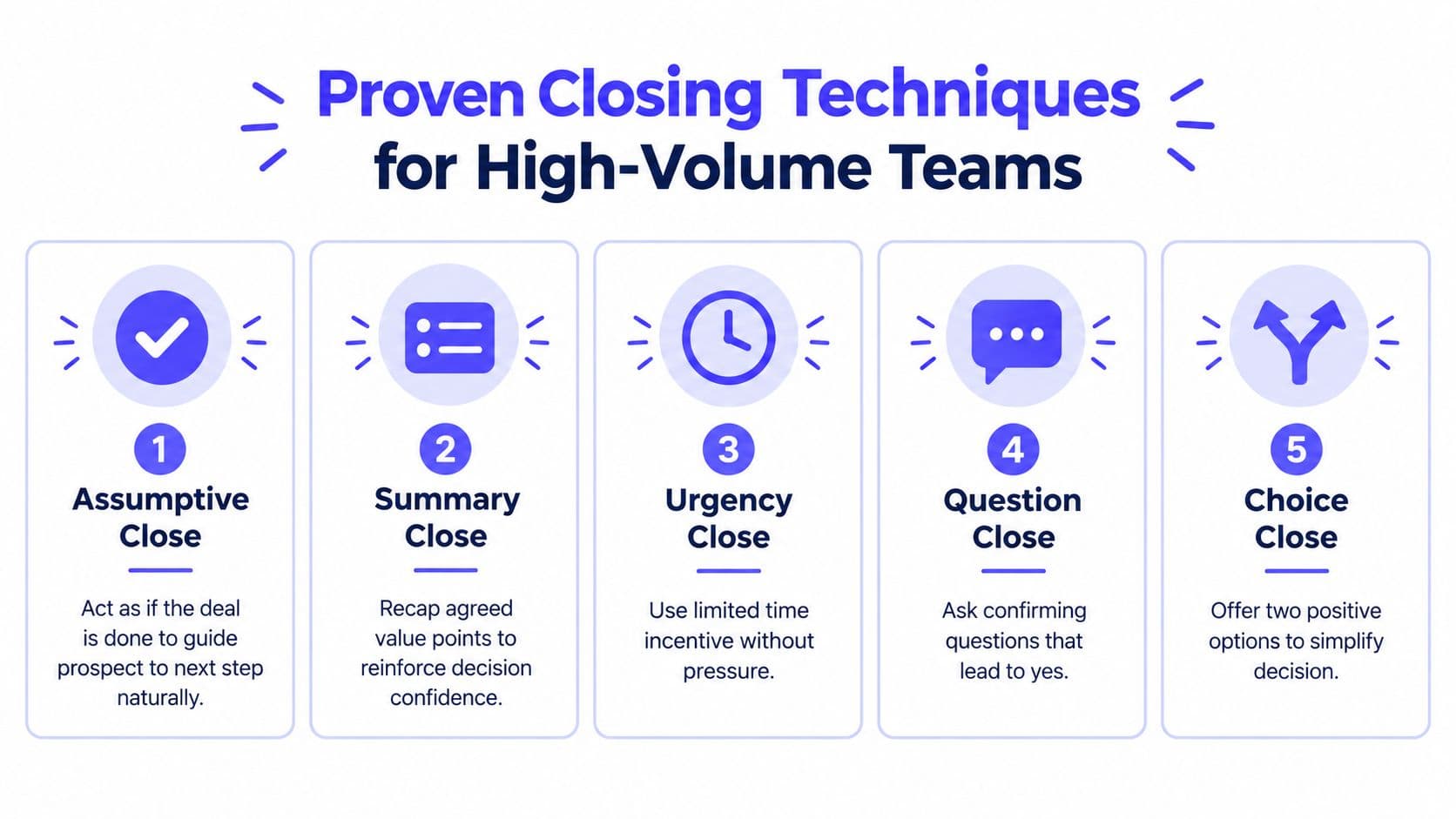
- Negotiation and close handle objections, terms, and decision friction. If discovery was weak, this stage drags. The close sales techniques that hold up in high-volume outbound — the assumptive close, LAER objection handling, and a structured multi-touch follow-up — are what keep this stage from becoming a waiting game.
- Onboarding, retention, and expansion protect the handoff after signature. A full-cycle rep who disappears here leaves future revenue on the table.
The value of the sequence is that each stage creates evidence. A home-improvement rep who books the visit, qualifies the homeowner, confirms the budget range, and documents the timeline builds a cleaner close than a rep who just “keeps calling.” The same is true in staffing, where role clarity and response speed often matter more than a long pitch.
In practice, the six stages also reveal where teams get stuck. Most pipeline problems are not mysterious, they're stage problems. If awareness is strong but proposals stall, the issue isn't “motivation,” it's usually qualification or mismatch. If deals close but onboarding fails, the sale wasn't really complete.
The Modern Full Cycle Sales Role
Buyer behavior changed before sales org charts did. Benchmarks show that roughly 60% to 70% of a B2B purchase journey can happen through self-directed research before any direct sales contact buyer research benchmark.

That changes what full-cycle ownership really means. The rep is not just closing, the rep is identifying demand, creating or capturing interest, responding across email, SMS, and voice, coordinating stakeholders, booking meetings, keeping CRM notes clean, and following up until the decision is made. A 2024 buyer-journey benchmark from AI buyer benchmark puts first direct sales contact at about 61% of the journey, which fits the reality that buyers often arrive with research already in hand. In many deals, that also means speaking to 6 to 10 decision makers and influencers, with cycles taking about 25% longer than earlier comparable ones stakeholder benchmark.
What the role demands now
The role is broader because the buyer's journey is broader. A rep may start with a cold call, then support a buyer who has already read reviews, compared vendors, spoken internally, and used AI-assisted research. The conversation is no longer “let me introduce the product.” It is “show me you understand my situation better than the other options I have already looked at” AI buyer benchmark.
That raises the bar on commercial judgment. The rep has to know when to ask, when to send proof, when to book, and when to give the buyer space. Teams that treat the role as pure persistence usually burn out the rep and irritate the buyer.
Full-cycle selling today is less about owning a script and more about owning the buyer's context.
For service businesses and local territory teams, one person often handles the early call, qualification, estimate, and follow-up. For larger deals, the rep may still own the relationship while bringing in specialists at the right time. The point is continuity with judgment, not ego-driven ownership.
Why Operational Capacity Matters More Than Removing Handoffs
Handoffs matter, but capacity matters more. Recent benchmark reporting shows reps spend only about 28% to 30% of their workweek on active selling, with the rest consumed by data entry, admin, meetings, research, and proposal work sales productivity benchmark.
Selling time yield is the metric that changes the conversation
The practical metric is selling-time yield, active customer-facing hours divided by paid hours. If a rep works 40 hours and sells for 28% of that time, that is roughly 11.2 selling hours. Push that to 40%, and the team gains 4.8 additional selling hours per rep each week without adding headcount. That is capacity you can plan around.
A unified system matters here. Automatic logging of calls, texts, emails, dispositions, and meeting outcomes reduces duplicate entry. Standardized next-step fields and timestamps make the forecast more trustworthy. A tool like GrowOutly fits this operating logic because it combines dialing, messaging, CRM activity, and scheduling in one workspace, and the workflow behind power dialer CRM workflows keeps the record tied to the rep instead of rebuilt later.
The wrong instinct is to celebrate fewer handoffs while ignoring whether the rep can realistically carry the whole workload. A full-cycle rep with too many active opportunities becomes slower, not better. I have seen strong sellers lose deals because their day filled up with follow-up, admin, and context switching.
That is why managers should watch:
- Activity-to-opportunity conversion, to see whether motion turns into pipeline.
- Time from lead creation to first attempt, to expose delay.
- Follow-up completion rate, to catch dropped threads.
- Opportunity aging, to spot deals that are sitting too long.
When those numbers slip, the issue is often fragmentation. A rep with too many disconnected tasks loses context, and context loss is expensive. In some teams, the answer is not fewer handoffs. It is cleaner role boundaries, so the work matches the available capacity.
Speed to Lead and First Contact Mechanics
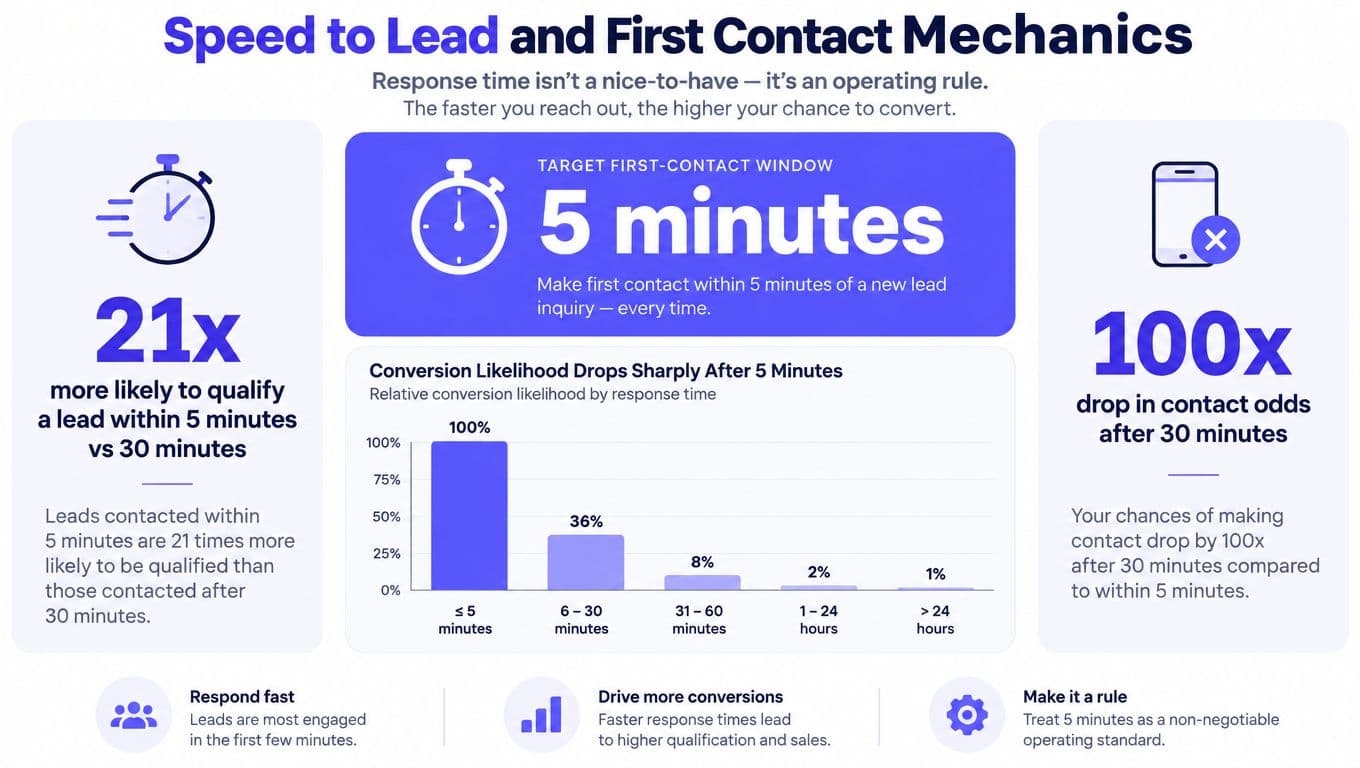
Speed-to-lead is one of the few levers that changes outcomes fast. MIT and InsideSales analysis found that contacting an inbound lead within five minutes made teams about 100 times more likely to reach the lead than waiting 30 minutes, and responding within an hour was also reported as roughly 7 to 60 times more likely to produce meaningful contact than waiting longer lead response benchmark.
How to build the response system
The reason is simple. Interest is highest right after the inquiry, and every minute gives the buyer room to get distracted, get contacted by someone else, or decide the problem isn't urgent. For full-cycle teams, that means first response can't depend on a rep noticing a notification. It has to be routed and timed.
A workable system has four parts. First, event-triggered routing captures the inquiry immediately. Second, compliance checks happen before outreach. Third, a coordinated call, SMS, email, and scheduling sequence starts the moment the lead comes in. Fourth, unanswered attempts trigger a controlled retry path instead of ad hoc chasing.
A few metrics make the system measurable:
- Median first-response time
- Percentage contacted within five minutes
- Contact rate by response-time band
- Qualification rate
- Booked-meeting rate
For teams that need inbound routing, inbound call routing software is often the difference between answering with context and starting over. That matters because the rep who answers first usually shapes the buyer's next step.
If the response isn't immediate, the buyer experiences delay as indifference.
The follow-up cadence should stay persistent but controlled. Once the buyer replies, books, declines, or opts out, the sequence has to stop or change. In full-cycle selling, the first touch is not a courtesy, it's an operating discipline.
Multi-Channel Outreach Best Practices
Single-channel selling is usually a weak system dressed up as simplicity. A non-competitor sales-outreach summary reports average response rates of roughly 5% to 8% for email-only sequences, 12% to 18% for SMS-only sequences, 22% to 28% for combined email-and-SMS, and 28% to 35% for email, SMS, and voice together outreach benchmark.
Give each channel a job
Email is for context. It lets the rep explain the problem, share detail, and leave a paper trail the buyer can revisit. SMS is for short prompts, timing confirmation, and low-friction replies. Voice is for qualification, objections, and urgent follow-up when the buyer is available.
The mistake is duplicating the same message across every channel. That feels efficient to the sender and sloppy to the buyer. Better practice is to coordinate the sequence so each touch adds something new, and every reply updates the same record.
SMS needs compliance, not improvisation
SMS is powerful, but it's also regulated and easy to mishandle. Salesforce guidance for U.S. messaging says outbound texts should go only to prior opt-in consent, recipients must be able to revoke consent, and commercial messages should be limited to daytime hours Salesforce SMS guidance. It also recommends recognizing HELP as a support request and STOP as an unsubscribe request, while suppressing variants like STOPALL, UNSUBSCRIBE, CANCEL, END, and QUIT.
Useful SMS outreach keywords include Reply STOP to opt out, Reply HELP for help, consent, message frequency, message and data rates may apply, privacy policy, and terms.
A compliant message should be clear about who's sending it, how often messages may come, and how to opt out. That isn't just legal hygiene. It protects deliverability and trust. If a prospect asks for less contact, the system has to respect that immediately, not wait for someone to update a spreadsheet. Our TCPA compliance checklist for outbound teams sets out how to run that as one pre-dial and pre-SMS gate so suppression applies everywhere at once.
When Full Cycle Sales Can Work Against You
Full-cycle ownership is not automatically superior. Ebsta's 2025 GTM benchmarks reported that 78% of sellers missed quota, up from 69% in 2024, which is a useful reminder that removing handoffs doesn't fix weak prioritization or poor capacity design Ebsta GTM benchmark.
Decide what stays with the rep, what gets automated, and what gets handed off
The right framework is operational, not ideological. Some activities should stay with the rep because they require trust, judgment, or conversation. Others should be automated because they're repetitive and low-value. Some should move to specialists because the deal is too complex or the service burden is too high.
Transactional and territory-based businesses often benefit from continuity. The buyer wants one person who knows the neighborhood, the account, or the recurring need. Complex enterprise deals are different. They may need solutions engineering, legal review, implementation, or customer-success support before the deal should move forward.
The practical planning questions are straightforward:
- How many active opportunities can one rep manage well
- What's the quota-to-pipeline ratio
- What service level is promised after close
- When does a deal leave the rep's personal queue
That's the nuance most guides miss. Fewer handoffs are not always better. Fewer unowned handoffs are better. Deliberate handoffs to the right specialist can protect both conversion and customer experience, especially when the sale gets technically dense or operationally heavy.
If you're building this model and want one workspace for dialing, messaging, CRM activity, and scheduling, GrowOutly is one platform that supports that workflow without forcing the rep to switch systems. For teams trying to balance speed, compliance, and continuity, visit GrowOutly and see whether a unified calling and outreach stack fits your sales motion.