Most advice about usa area code 832 is lazy. It treats the prefix like a city stamp, when in practice 832 is a Houston overlay marker, not a location certificate. If you run outbound or support operations, the right question isn't “Is this caller in Houston?” It's “Does this number behave like a real, reachable, compliant business line inside the Houston overlay complex?”
That matters because 832 sits inside a shared numbering pool with 713, 281, 346, and 621 across the greater Houston region (Houston overlay complex notice). In that environment, the prefix tells you almost nothing about the caller's exact location, and it tells you even less about trust. Use it as an operational tool, not a geography myth.
What USA Area Code 832 Actually Represents Today
832 is a shared Houston overlay marker. It sits in the same numbering space as 713, 281, 346, and 621, so the prefix does not carve out its own geographic zone or prove where a caller is standing. The operational takeaway is simple: the code tells you the number belongs to the Houston numbering complex, not to a specific neighborhood or district.
Stop treating the prefix like proof of origin
Houston area codes no longer map cleanly to place. 832 is part of a larger numbering pool, and that shared pool is what matters for sales, support, and routing decisions. If your team reads an 832 caller as being in one exact part of town, you are guessing.
That guess creates avoidable mistakes. You can over-trust a call, under-value a lead, or route traffic on a detail that carries no geographic certainty. Caller ID is useful for identification, but it does not prove location or legitimacy.
Practical rule: treat 832 as a shared Houston assignment pool. Verify the number, the identity, and the routing, not the prefix.
Use the code as an operational marker, not a location test. If you are provisioning numbers for a team, 832 works only when it sits inside a managed identity strategy, with verification and routing checks built in.
How Area Code 832 Entered Service and Joined an Overlay Complex
Houston got 832 as a relief valve. It entered service on January 16, 1999, added on top of the existing Houston numbering area to ease numbering pressure in a fast-growing market. That decision changed dialing behavior at once. It also killed the old habit of treating one code as “inside town” and another as “outside town.”
The overlay model changed how Houston numbers work
832 was the first Houston overlay, and it forced 10-digit dialing for local calls in the area. That is the operational fact that matters. Once the overlay arrived, the prefix stopped carrying clean geographic meaning and became an assignment label instead.
The Houston overlay complex kept growing. 346 joined in 2014, and 621 followed in 2025 to preserve number supply for the metro area (Houston customer notice). Each added layer made the old prefix-to-location reflex less reliable. By the time 621 came online, the area code was doing routing work, not location work.
Treat the whole Houston set as five co-equal codes tied to the same calling region. If your team still reads 832 as a clean map of where someone is standing, the routing logic is outdated and the verification logic is weak.
Update your routing assumptions to reflect five co-equal Houston codes. A 1999-era mental model will misroute and mis-verify calls today.
Cities, Counties and Communities Inside the 832 Footprint
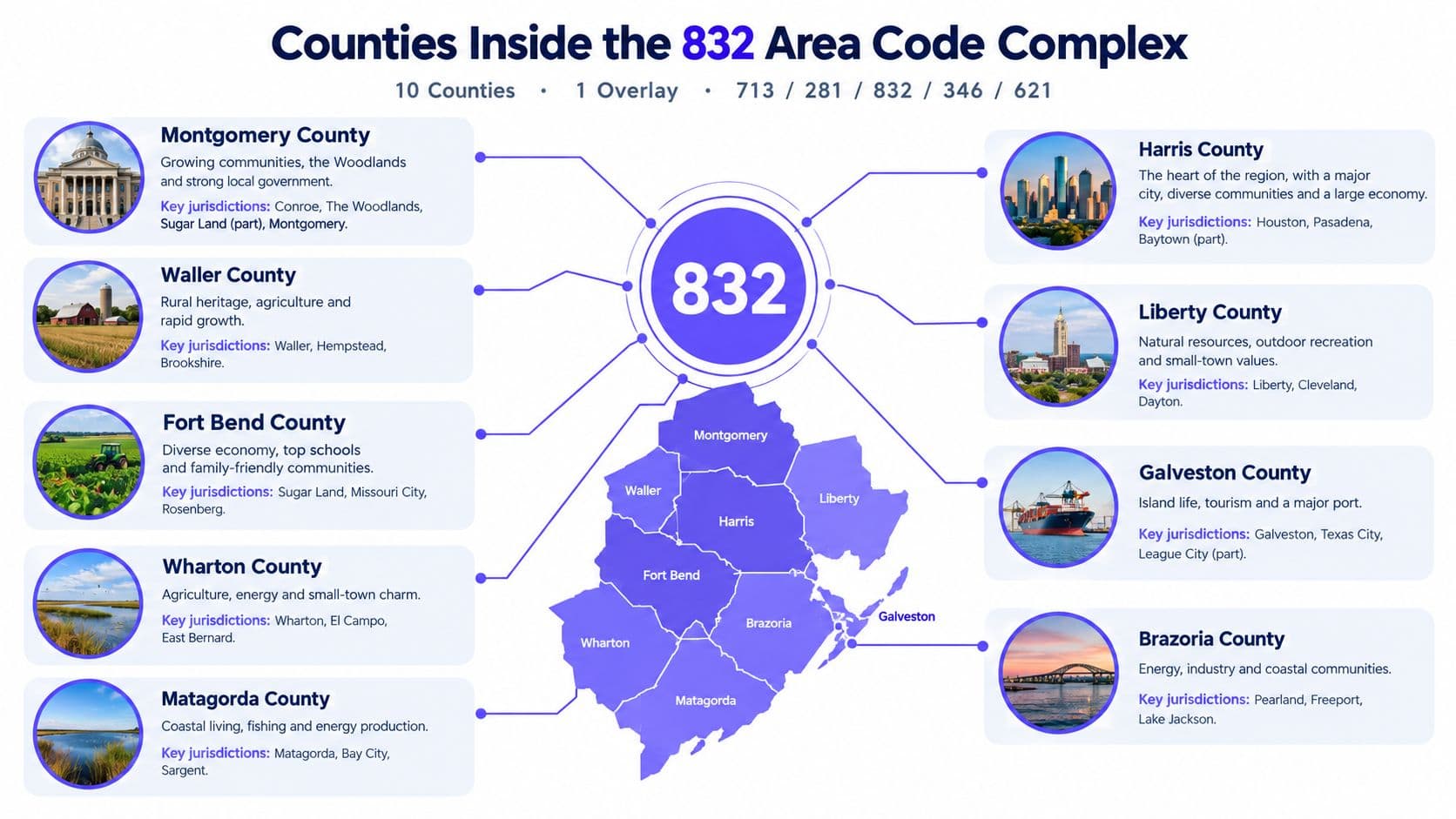
The 713/281/832/346/621 complex covers the Houston region and the surrounding communities as one shared footprint. 832 does not mark a more authentic Houston location than 281 or 346. It is a pooled overlay, and the operational value comes from that shared coverage.
The counties commonly tied to this footprint are Harris, Fort Bend, Brazoria, Galveston, Montgomery, Waller, Liberty, Chambers, San Jacinto, and Austin (NANPA Texas numbering resources). The major cities include Houston, Sugar Land, Pearland, League City, Baytown, Missouri City, Galveston, The Woodlands, Conroe, and Alvin. Representative smaller communities include Friendswood, Manvel, Rosenberg, Deer Park, Pasadena, Tomball, and Katy.
What that means for outbound teams
For outbound teams, 832 works as a local-presence number across the Houston footprint. It gives callers a familiar Houston-area identity, but it does not prove a specific neighborhood, suburb, or county. That distinction matters. The overlay is broad by design, so the prefix is useful for trust, not for precise location claims.
Use the number for the right job. A Houston support line, a sales pod covering Fort Bend, or a branch line serving the metro all fit cleanly inside this footprint. Do not sell 832 as evidence of a narrow origin it cannot provide. If you need local credibility, pair the number with accurate caller ID, proper verification, and a routing setup that matches the actual service area.
Time Zone, Dialing Rules and Number Pool Mechanics
Houston's 832 lines run on Central Time and follow U.S. daylight saving rules. That matters for callback timing, SMS windows, and live support coverage. If your team sends or calls on the wrong clock, you create friction fast, even when the number itself is valid.
Dialing is ten digits
832 requires 10-digit dialing. Even local calls inside the Houston overlay area need the area code, because the network treats the number as part of a shared overlay, not a standalone local exchange. Use the full number every time. Anything else is asking for routing errors.
The supply side works the same way. 832 numbers are assigned from carrier pools in blocks, so business teams usually receive a provisioned line instead of picking one line by line. That is normal in overlay markets. You get an available number that already sits inside the carrier's inventory.
| Setting | Value | Operational Note |
|---|---|---|
| Local time | Central Time | Use Houston local time for callbacks and send windows |
| Dialing pattern | 10 digits | Area code is required for local calls |
| Number allocation | Shared carrier pool | Most business lines arrive pre-provisioned |
| Reassignment risk | Real and frequent | A previously owned line can be reused after disconnection |
Reassignment is the part teams miss. Number recycling happens, so an 832 line can change hands and still look familiar on caller ID. Because number recycling is normal in pooled overlays, verify the current subscriber status of any 832 line before you build reputation assumptions on it.
That also explains why CNAM and reputation lookups can be stale. A line may carry an old display name, an old business record, or a previous use pattern that no longer applies. Treat the live status of the number as the source of truth, not the history attached to it.
Why 832 No Longer Predicts Caller Location
An 832 prefix is a routing label, not a residence certificate. That distinction kills most of the old location logic people try to attach to it. In overlay markets, the originating carrier and the calling platform matter more than the prefix, because they determine where the call enters the network.
The prefix is visible, the origin may not be
A caller can present an 832 number while originating from a hosted PBX, a VoIP platform, or a contact center outside Texas. That's normal in modern telephony. The call displays the number that was provisioned, not necessarily the place where the agent is sitting.
The same problem shows up in pooling. One shared 832 block can move through multiple carriers and resellers over time, which means neighboring numbers can live on different service paths even though they look similar on caller ID. The result is simple, prefix-based trust is weak.
The right verification layer is number plus identity. Check the business record, the caller-name data, and the attestation context you're receiving. Don't give the area code a job it can't do.
A clean Houston prefix can still be spoofed, and a messy one can still belong to a legitimate business. The prefix is evidence of provisioning, not proof of intent.
Provisioning a 832 Local Presence Number the Right Way
If you're buying or assigning an 832 number, start with the business use case. Maybe you need to lift answer rates in Harris and Fort Bend, maybe you're supporting a Houston branch, or maybe you need a stable outbound identity for an SDR pod. Pick the number for that job, then wire it into your workflow like it matters, because it does.
Provision for reachability, not just display
The line must answer. If it's going to appear on caller ID, it has to receive callbacks on the same identity your team is using to outbound. A masked or dead-end line defeats the whole point of local presence. If voicemail is part of the flow, record a Texas-local greeting that matches the campaign and the expected caller experience.
A responsible setup also needs a fallback path. If the primary line is unavailable, missed calls should route to a human or a staffed queue, not disappear into a dead number. That's how you preserve trust while using a local presence strategy.
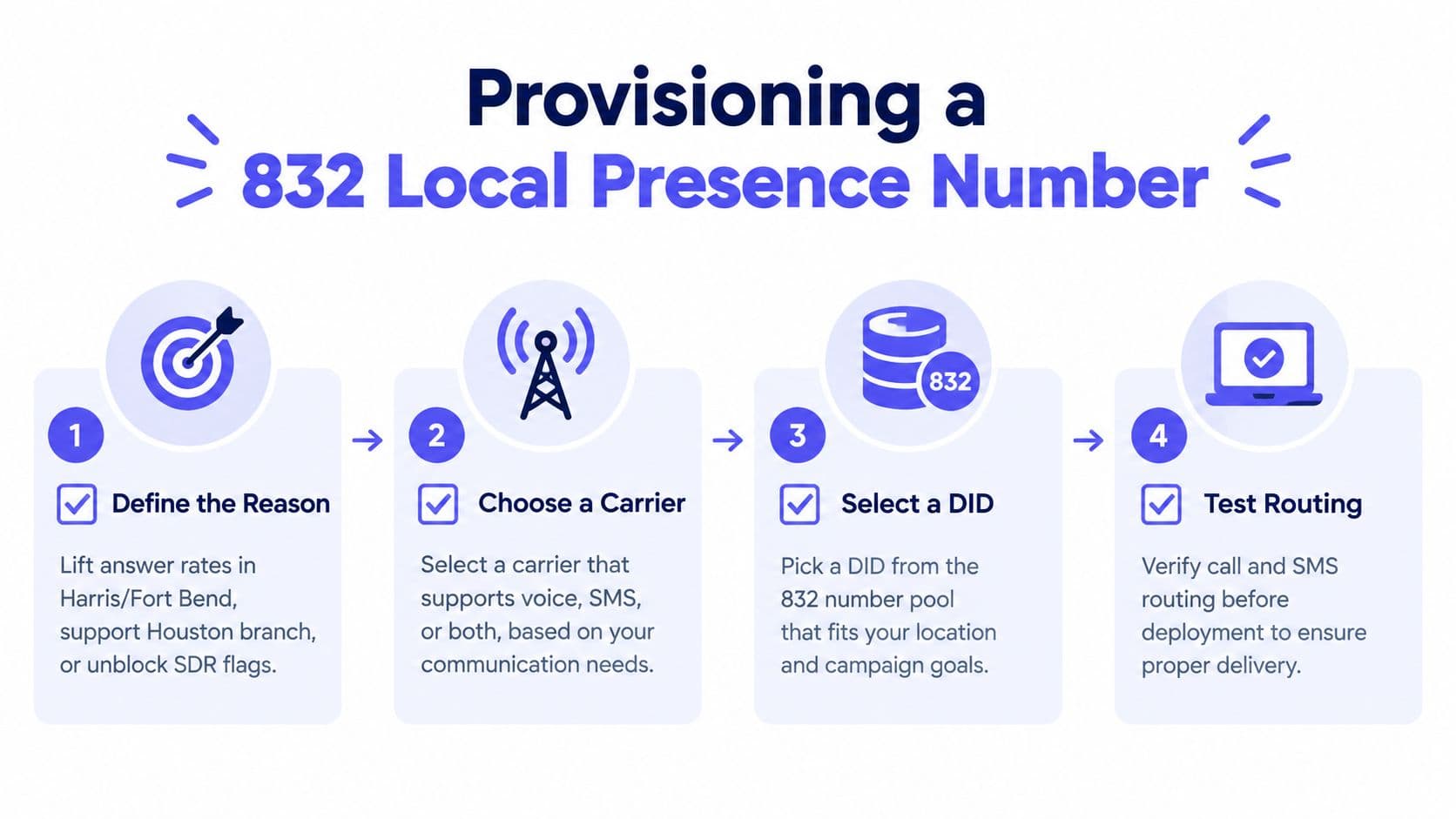
- Define the reason. Use the number to support a Houston branch, local sales motion, or support queue.
- Choose the carrier path. Make sure the line can handle voice, SMS, or both, depending on the campaign.
- Select a live 832 DID. Use a number you own or are authorized to present.
- Test routing before launch. Call it from inside and outside the target environment, then confirm callbacks and voicemail.
Which platform provisions and rotates that line matters as much as the number you end up with. Our comparison of outbound call center software platforms covers how each one handles number management, local presence pools, and caller ID logging, which is the part of the decision an area code can't answer for you.
If your stack needs SMS tied to the same line, GrowOutly SMS features fit naturally into this type of workflow because the same identity can support outbound messaging and logging without forcing your team to juggle disconnected tools.
Compliance Gates That Must Run Before a 832 Dial or SMS
A local-looking number doesn't exempt you from compliance. It increases the need for discipline, because callers often trust local IDs more quickly than unfamiliar ones. That makes bad process more dangerous, not less.
Run the gates in sequence
First, scrub against the National DNC Registry and any state-specific suppression list. Then screen against litigator and known-claimant records using the same identity your team will use on the call record. After that, enforce your time window rules in local Houston time, because outbound work that lands outside the allowed window creates risk fast.
The consent record has to be clean too. If you're calling or texting from 832, keep the exact wording, channel, timestamp, and proof of consent attached to the CRM record. For SMS, add opt-in capture and a clear opt-out path that processes STOP replies quickly.
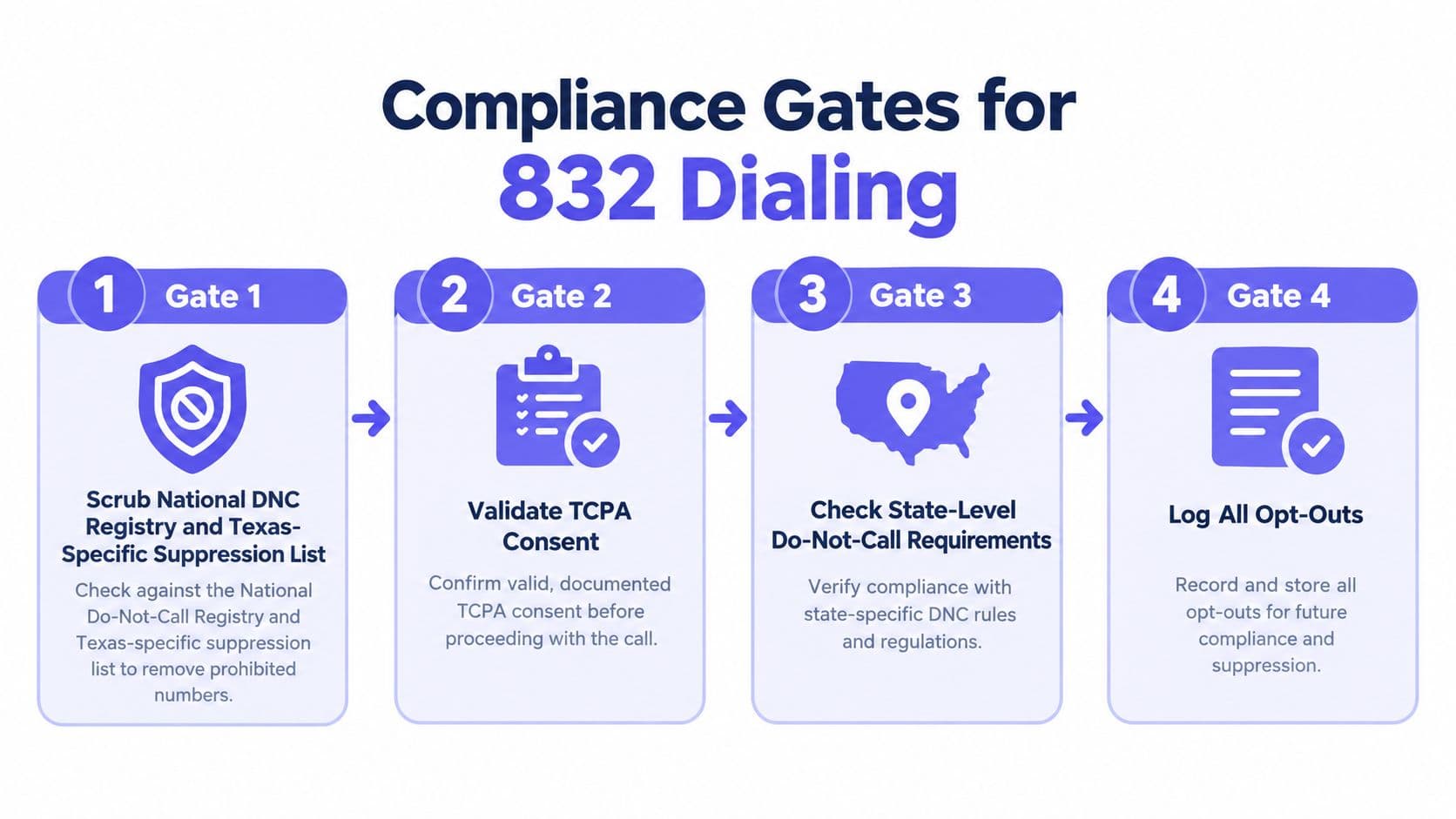
Non-negotiables before launch:
- Registry scrub: Run National DNC and state suppression checks before any dial.
- Consent proof: Store the exact opt-in language and the channel it came from.
- Opt-out handling: Keep the stop path active and logged.
- Audit trail: Preserve scrub logs, consent logs, and number provisioning records.
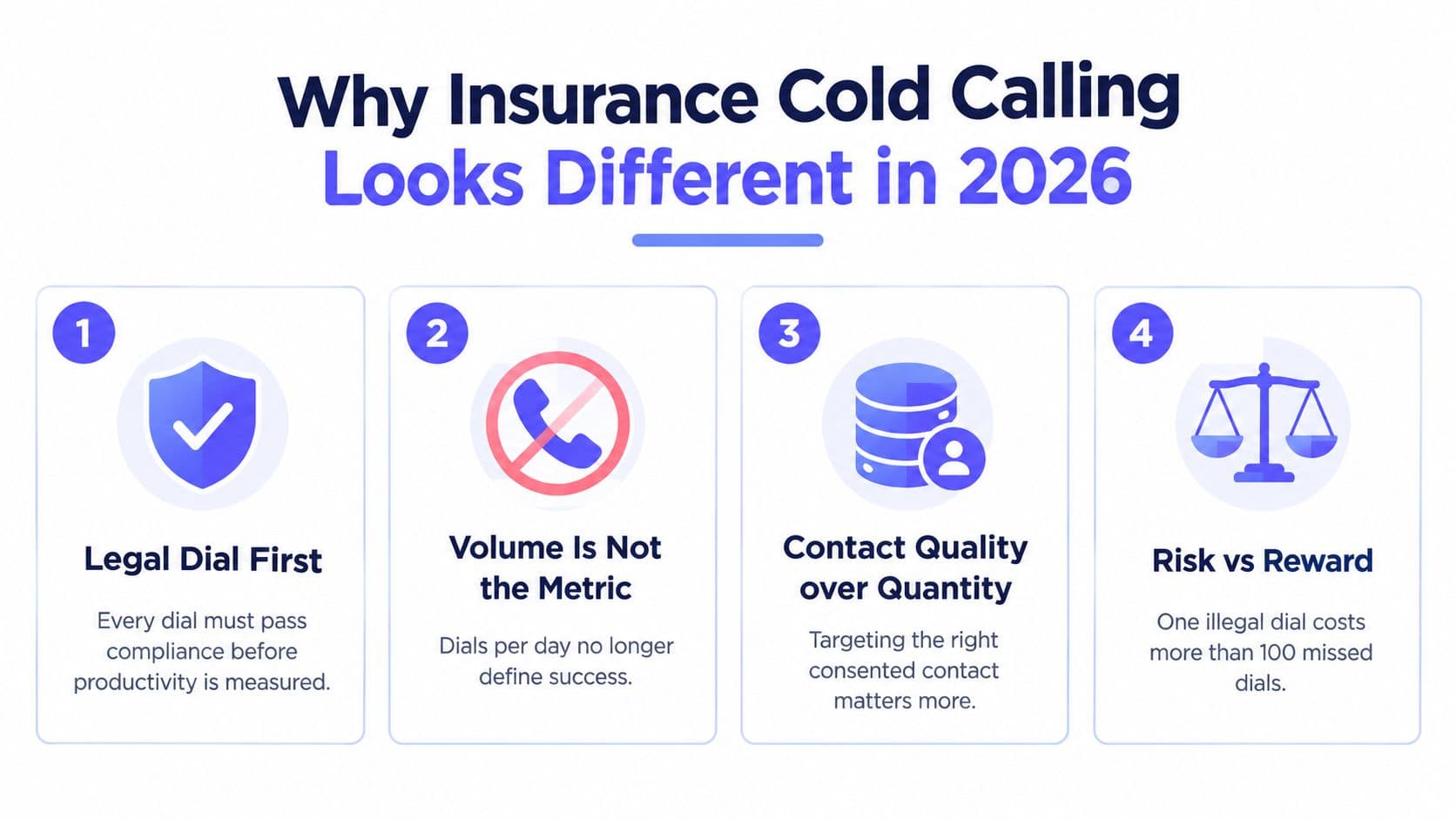
Regulated teams usually need that sequence written down rather than remembered. The cold calling playbook for insurance runs the same gate in order — registry scrub, litigator screen, consent proof, calling window — alongside the territory list build that feeds it, which is a useful template even if you never sell a policy.
GrowOutly DNC compliance belongs in that workflow if you want compliance checks embedded before the call or text connects.
Don't confuse local presence with permission
A local number can help your answer rates, but it does not create consent. That's the mistake that gets teams into trouble. If your records are incomplete, fix the records first and the dialing strategy second.
Robocalls, Neighbor Spoofing and the 832 Trust Problem
People often ask whether 832 is a scam area code. That's the wrong question. The code itself is legitimate, but scammers can spoof it, and they do because Houston numbers are familiar, abundant, and easy to trust at a glance. The prefix is neutral. The behavior is what matters.
Verify the number, not the feeling
Repeated missed calls from an 832 number can be a classic sign of spoofed robocalls, and the displayed area code may not even originate from Texas (scam guidance). That's why neighbor-spoofing works. The caller wants the number to look local enough that someone answers. If your team responds only to the prefix, you're playing the scammer's game.
Decisioning should happen at the number level, the caller-name level, and the attestation level. If you're running an outreach team, compare the number against your vetted business records and make sure your callback path is real. If you're receiving inbound calls, don't assume an 832 display makes the caller safe or local.
The practical takeaway is blunt. 832 should help with local familiarity, but it should never be treated as a trust signal by itself.
Local Presence Dialing Best Practices for 832 Outreach
Local presence only works when the number behaves like a real business line. If it rings into a dead end, if it can't receive callbacks, or if it's used to mask sloppy routing, you'll burn the exact trust you're trying to create.
Use one number like a real asset
Provision an 832 line that answers during declared hours and returns missed calls promptly. Register it under the right business identity, then keep the record synchronized with your CRM so each attempt is attributable. If you're running SMS from the same number, keep the messaging and calling history together so support and sales can see the full picture.
The smartest teams also rotate across the Houston overlay codes instead of hammering one prefix endlessly. That doesn't replace compliance, and it doesn't make the number more authentic by itself. It keeps your caller identity from looking stale.
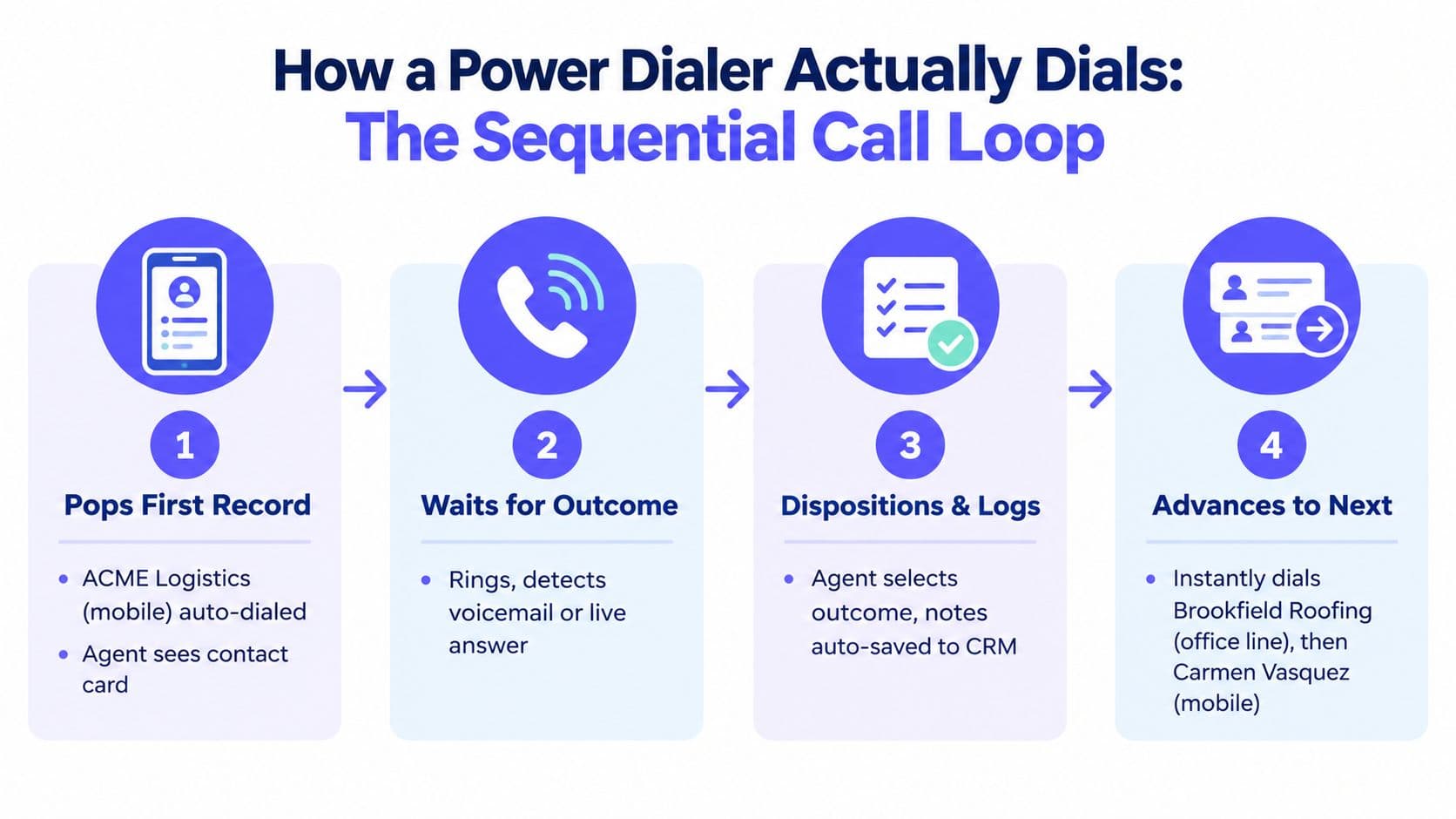
Rotation is a dialer setting, not a habit you can ask reps to remember. What a power dialer is explains how the queue matches a local number to the next lead and logs which caller ID was used, which is what turns number health into something you can review instead of guess at.
GrowOutly outgoing calls fits this operational model because you can manage outbound identity, routing, and logging in one place instead of duct-taping separate tools together.
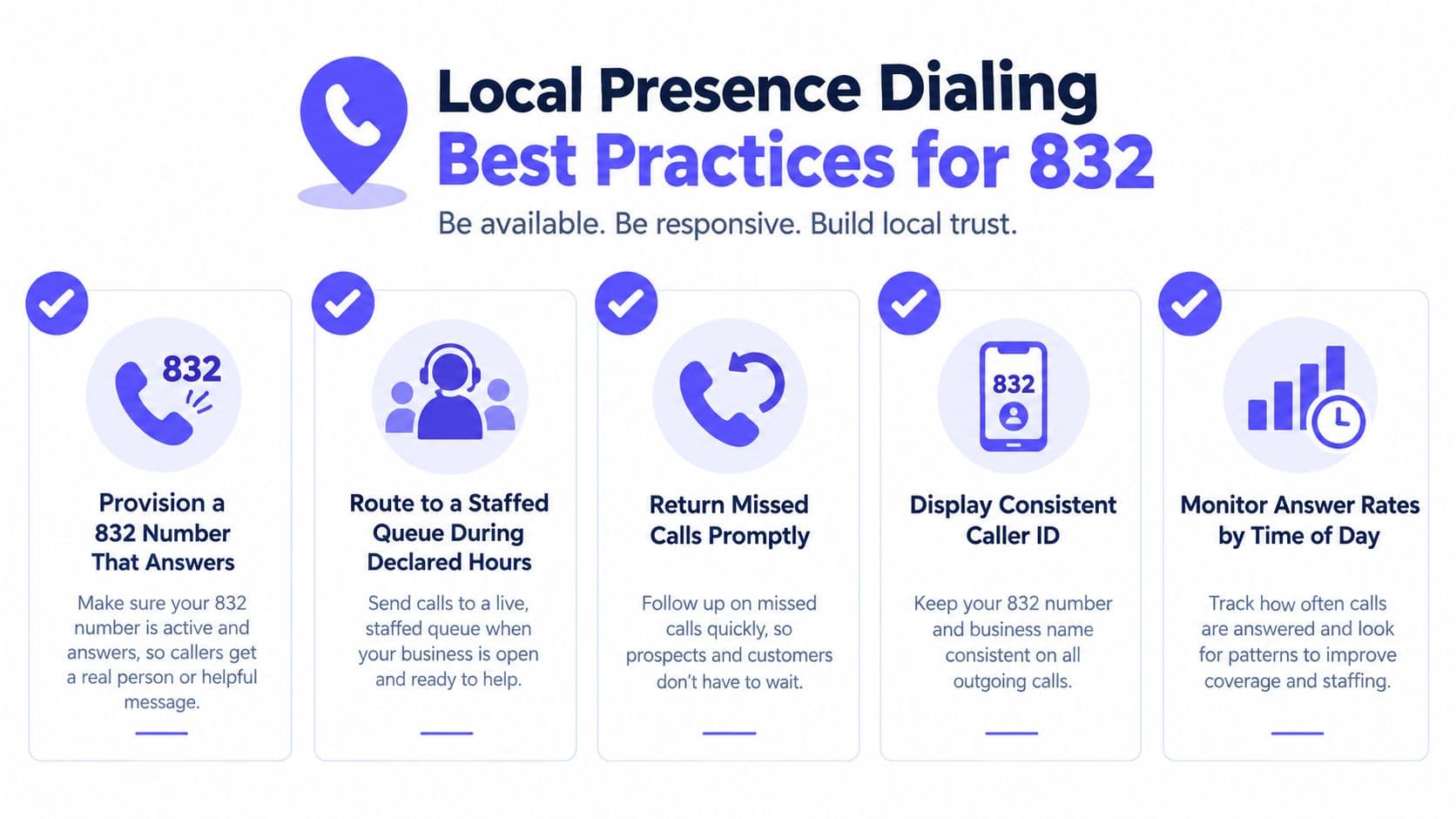
- Provision a live line: Use an 832 number that answers.
- Route to a staffed queue: Don't send local callers to voicemail by default.
- Return missed calls fast: Callback speed is part of local presence.
- Keep caller ID consistent: Don't flip identities without a reason.
- Monitor by time of day: Track when the line gets answered and when it doesn't.
If a local presence line can't be called back, it's not local presence. It's decoration.
Quick Reference Matrix for the Houston Overlay Codes
Treat the Houston overlay family as one operating area, not five separate identities. 713, 281, 832, 346, and 621 all sit inside the same dialing rules, and the differences are inventory and history, not caller experience.
| Code | Year Activated | Reason Added | Dialing Pattern | Operational Use |
|---|---|---|---|---|
| 713 | 1947 | Original Houston code | 10 digits in the overlay market | Legacy Houston identity |
| 281 | 1996 | Added to relieve growth pressure | 10 digits | Broad Houston suburban and metro use |
| 832 | 1999 | Overlay to preserve number supply | 10 digits | Local presence, sales, support, and general Houston assignment |
| 346 | 2014 | Relief overlay for continued demand | 10 digits | Additional Houston number supply |
| 621 | 2025 | Newest overlay to extend supply | 10 digits | Fresh inventory for the same Houston footprint |
Use the code that fits your provisioning plan and your compliance workflow. Stop chasing a prefix because it sounds more local. Once a number sits inside the Houston overlay complex, it behaves the same way for dialing, routing, and reachability.
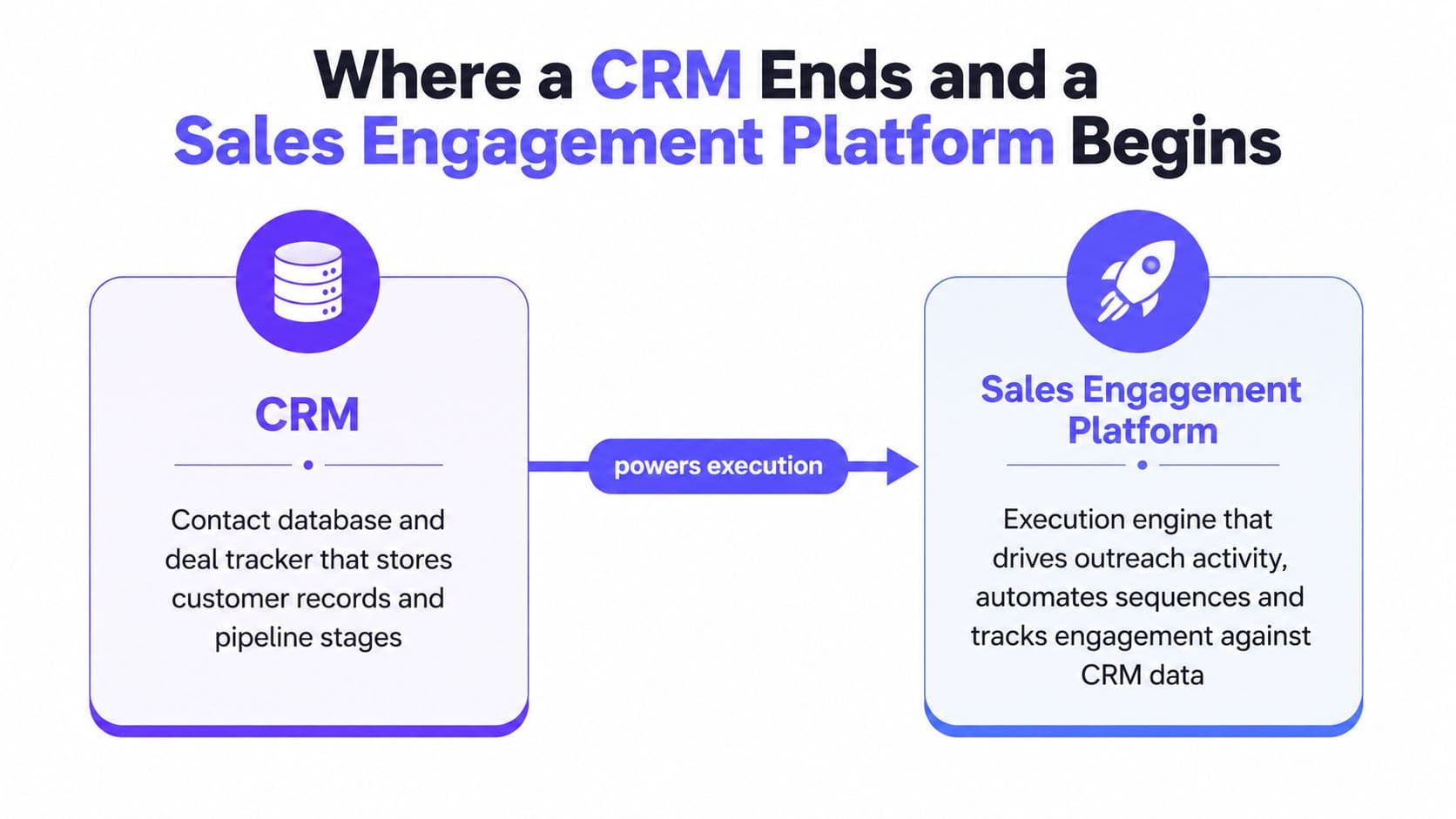
For teams that manage 832 as part of a wider local-presence stack, the right move is simple. Keep the number, the workflow, and the audit trail together, or you will end up with a Houston-looking line that is hard to verify and harder to defend. Holding those three in one place is exactly what a sales engagement platform is for — the call, the text, and the record of both landing on one contact timeline instead of three systems that each know part of the story.