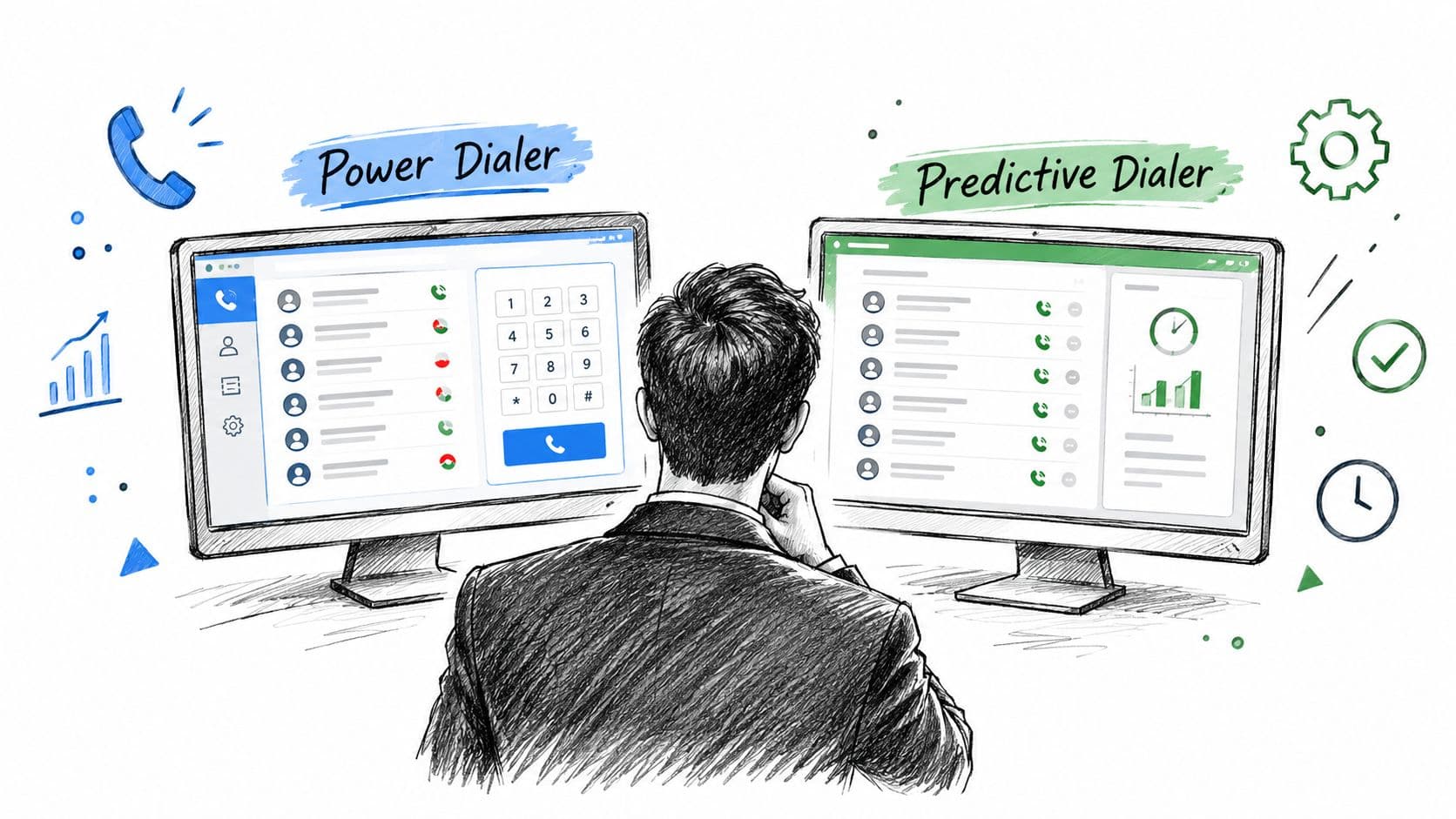
You're staring at the same ugly trade-off every outbound leader faces. Your reps need more conversations, compliance is tighter than it used to be, and nobody wants a tool that looks fast on paper but creates sloppy connects, dropped calls, or a mess in CRM afterward. The power dialer vs predictive dialer choice is really a decision about what your team is optimizing for, and if you're serious about revenue, you should stop treating raw call volume as the only scoreboard.
| Factor | Power Dialer | Predictive Dialer |
|---|---|---|
| Pacing | One call at a time, after the rep finishes the last one | Multiple calls launched ahead of agent availability |
| Best fit | Teams that want control, cleaner conversations, and lower risk | Large teams that need aggressive throughput |
| Compliance posture | Safer by design because it doesn't run ahead of a live rep | Faster, but abandonment risk has to be managed tightly |
| Conversation experience | Natural, immediate, and steady | Efficient at scale, but more exposed to awkward delays |
| Workspace fit | Strong when you want calling plus CRM, SMS, and compliance in one flow | Strong when scale is the dominant goal |
Understanding Power and Predictive Dialers
A sales manager usually feels the difference before the numbers even land. One rep wants fewer dead moments and better context before each call, while another wants the queue moving so fast that no one is waiting around for a lead to pick up. That tension is exactly where the power dialer and predictive dialer split.
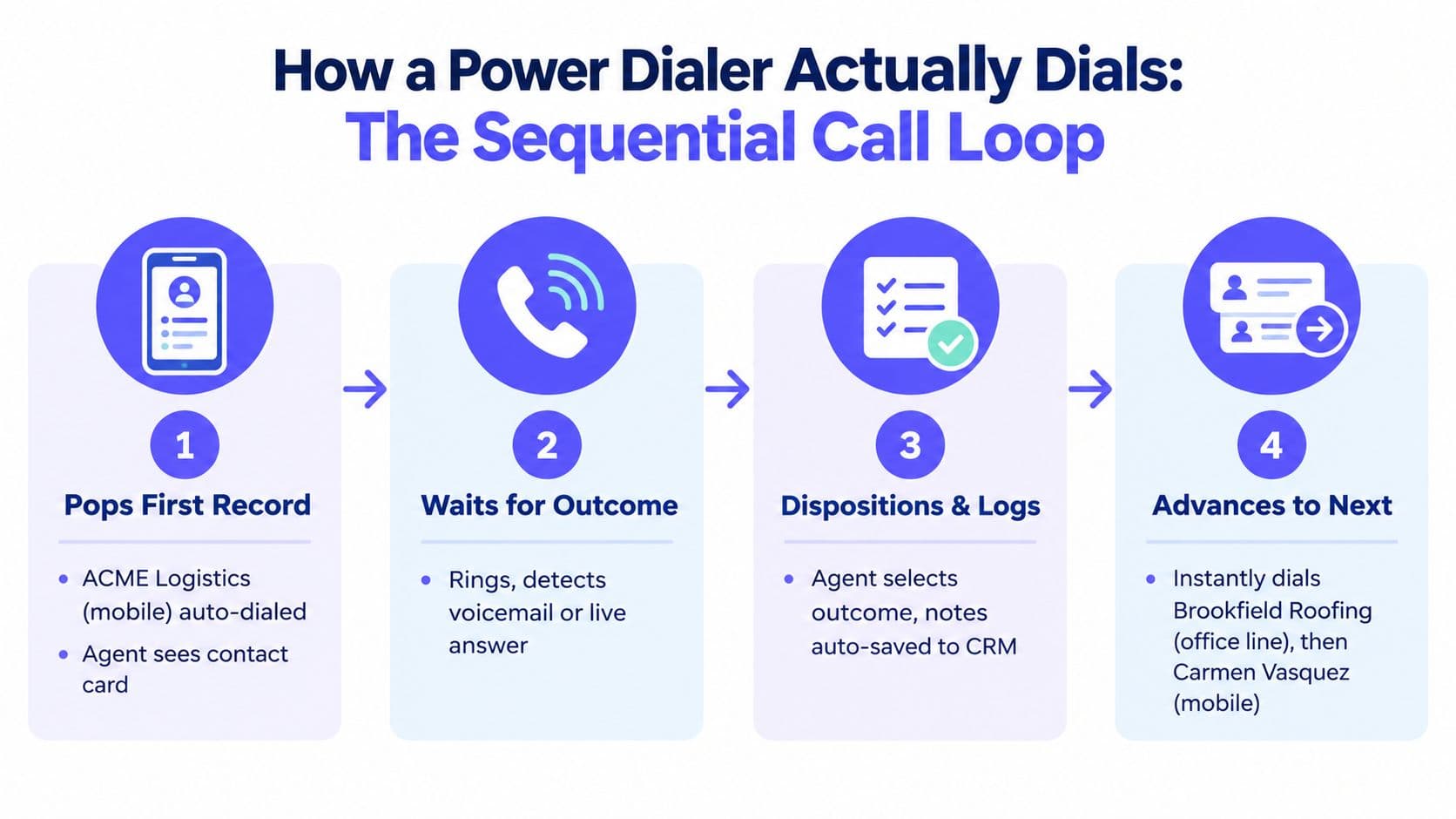
A power dialer is the controlled option. It calls the next number only after the rep finishes the prior conversation, which keeps the pacing clean and gives the rep full attention on the person they're speaking to. If you want the mechanics of that one-to-one workflow first, what a power dialer is and how it works walks through the call loop, the branch logic behind each outcome, and the CRM write-back that follows.
A predictive dialer is the aggressive option. It uses historical calling patterns and answer behavior to place calls in advance, then routes a live answer to the next available agent. In plain English, it's built to keep a team busy, not to keep every call hand-carved for a specific rep.
Practical rule: if your team lives or dies on call control and conversation quality, start with a power dialer. If your team is a large outbound machine and every idle second hurts, predictive starts to make sense.
The distinction matters because the systems shape rep behavior. A power dialer rewards preparation, steady pacing, and cleaner customer interactions. A predictive dialer rewards scale, fast list processing, and a higher tolerance for operational complexity. If you've ever watched one team feel polished while another feels frantic, that's usually the dialer showing up in the workflow.
Dialing Strategies and Operational Mechanics
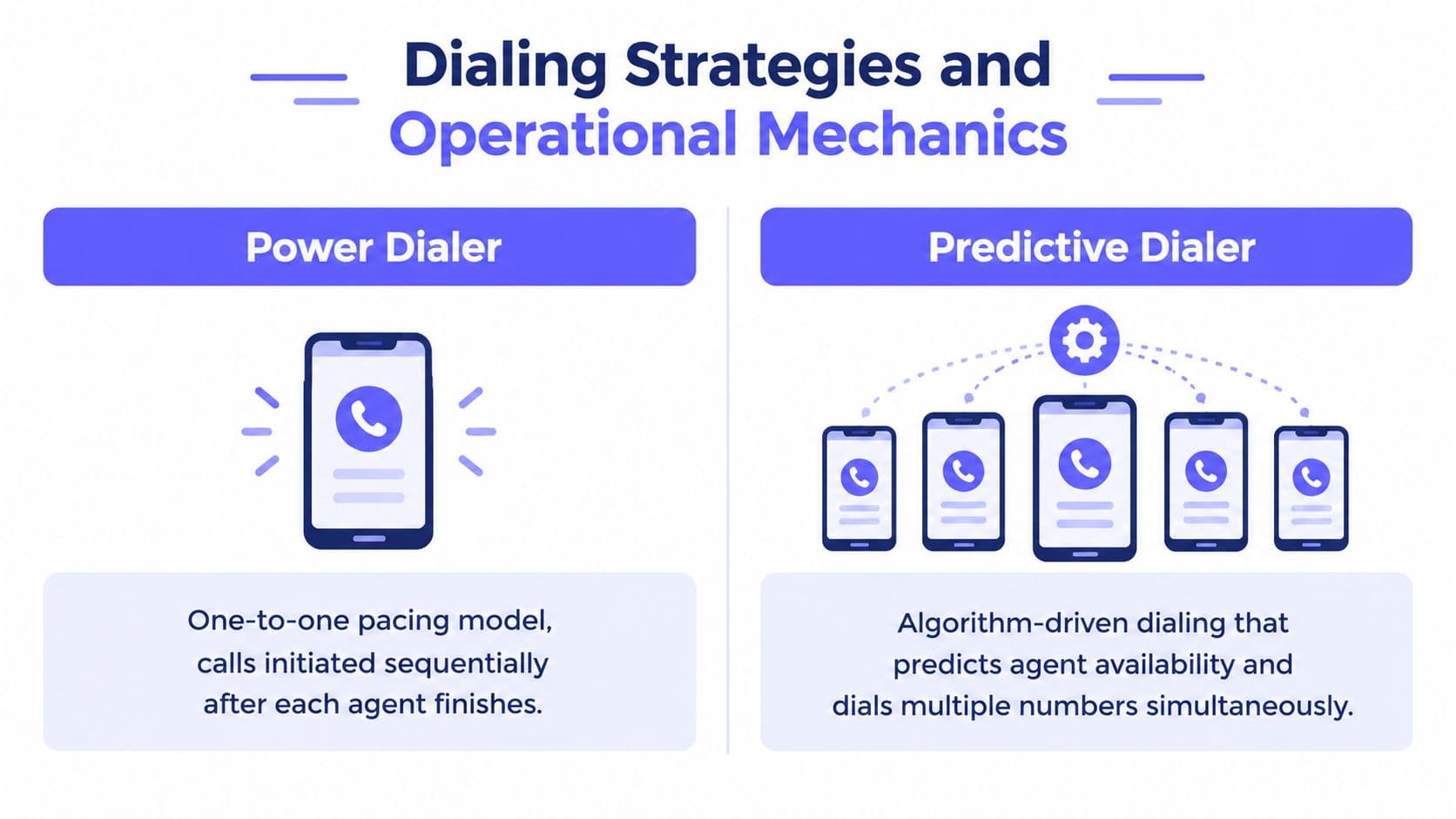
The mechanics are simple, and that's why people overcomplicate the decision. A power dialer waits for the rep. A predictive dialer guesses when the rep will be free, then gets ahead of the queue. That difference sounds small until you're running a live campaign with real prospects, real objections, and real compliance risk.
What happens on each call
A power dialer uses a strict 1:1 agent-to-call flow, so the next number only dials once the current call ends. That keeps the rep in control and removes the chance that someone answers before a human is ready. It also removes the weirdness prospects feel when they pick up and hear silence.
A predictive dialer works the opposite way. It places multiple calls at once, then connects the live answer to the first available rep. That model is what creates the throughput advantage, but it also means the system has to forecast agent availability well enough to avoid wasted connections and abandonment.
The best way to think about it is this: power dialing is a conversation model, predictive dialing is a forecasting model. One protects timing. The other chases efficiency.
A rep should never be chasing the system. If the software outruns the team, the team starts sounding rushed, inconsistent, and hard to trust.
For teams that care about customer experience, the steady pacing of a power dialer is a real advantage. For teams that care about volume first, predictive dialing can compress a lot of list work into a short window. The right answer depends on whether your calling motion is built for careful engagement or mass outreach.
Throughput and Connect Rate Analysis
Throughput is the first number many sales teams reach for, and it's the wrong number to worship in isolation. Yes, predictive dialers are faster. Industry comparison guides place predictive systems at 110 to 300 calls per hour while power dialers typically sit around 60 to 90 calls per hour, and another benchmark puts power dialing around 20 to 25 calls per hour per agent versus 45 to 50 calls per hour per agent for predictive dialing Kixie's dialer comparison guide AloWare's parallel dialer overview.
That does not mean predictive automatically wins. It means predictive is better at sheer list consumption, especially when the team is large and the list is clean. Power dialing gives up raw speed in exchange for tighter agent control, cleaner pacing, and less friction in the live conversation.
What the volume numbers actually tell you
The key question is what happens after the connect. Predictive systems are designed to maximize live talk time, and one set of published benchmarks says they can lift talk time by 200% to 300% versus manual dialing Skipcall's power vs predictive dialer guide. That's useful for big outbound teams that already know their message and can absorb a faster cadence.
Power dialing is the better fit when the rep needs context, focus, and room to handle the conversation well. If your list is small, qualified, and expensive, a slower pace can protect revenue because the rep isn't being rushed into a half-formed pitch.
Bottom line: throughput is only valuable when the contacts are worth the effort. Bad list hygiene at high speed just creates a faster version of the same waste.
That makes the data layer part of the dialer decision, not a separate project. Our comparison of 10 B2B prospecting tools covers the sourcing, enrichment, and phone verification that decide whether a faster pace is worth running at all.
One more thing gets ignored too often. A predictive dialer may produce more calls, but the rep experience can degrade if the system is tuned too aggressively. If the call center feels frantic, the gains from volume often disappear into weaker conversations and lower trust.
Compliance Risks and Regulatory Exposure
Many teams get this wrong. They treat compliance as a checkbox and choose the dialer that looks fastest, then wonder why the campaign creates risk instead of revenue. Predictive dialing needs the tightest supervision because it can run ahead of the rep pool if pacing is not controlled.
The FCC and TCPA abandoned-call rule caps abandonment at 3% of calls answered by a live person, measured per campaign over a 30-day period, and a call counts as abandoned if it is not connected to a live sales representative within 2 seconds of the called person's completed greeting FCC guidance on the abandoned-call rule. Teams that care about staying inside the line usually set pacing below that ceiling, often around 1% to 2%, so they have room for answer spikes and voicemail misclassification.
Why power dialing is safer by design
A power dialer does not run ahead of a live rep, so it avoids abandonment entirely. That is a major operational advantage for regulated teams in healthcare, finance, and any other environment where a compliance miss creates immediate pain. It also keeps the rep experience calmer, because every call starts only when someone is ready to speak.
A predictive dialer can still be run responsibly, but only if someone monitors abandonment as a core KPI and adjusts pacing quickly. Ignore that control, and the system will keep optimizing for speed in a way that exposes the campaign. The issue is not the software itself, it is how the model behaves under pressure.
For teams that need cleaner guardrails, the DNC and compliance workflow matters as much as the dialer. A broader workspace that keeps calling, CRM logging, and compliance checks together reduces the chance that a bad contact slips through. GrowOutly's DNC compliance controls fit that approach because they place the compliance layer next to the dialing workflow instead of treating it as an afterthought.
Ideal Team Sizes and Use Cases
The best dialer is not the one with the biggest claims. It's the one that matches the shape of your team. Predictive dialing works best when you have enough agents to keep the algorithm honest, and one of the common technical thresholds is 8+ agents before predictive pacing performs well Skipcall's power vs predictive dialer guide. That's why large outbound shops tend to lean into it.
Where predictive fits and where it doesn't
Predictive dialers make sense for high-volume outbound. That includes large lead-gen operations, call-center style motions, and campaigns where the main objective is to process a huge list quickly. If your team is measured by contact volume and live talk time, predictive can absolutely earn its keep.
Power dialers fit the teams that care more about control and context. Insurance, solar, staffing, recruitment, and other relationship-driven motions usually benefit from the steadier rhythm, and the cold calling playbook for insurance shows what that looks like in a regulated motion, from the compliance gate through the territory list build to the call arcs reps run against it. Those teams need reps who can absorb account context, call outcomes, and next steps without feeling like the dialer is shoving them into the next call before they've finished the last one.
The bigger strategic point is the broader workspace. Modern teams don't just need a dialer. They need calling, SMS, CRM logging, compliance checks, and follow-up all in one place. That's the fundamental difference between a tool that helps one campaign and a platform that supports how revenue and support teams work.
Decision cues I trust
- Large, high-volume team: predictive is usually the better fit.
- Medium-to-high volume team with control needs: power dialing wins more often.
- Regulated list or sensitive outreach: power dialing is the safer default.
- Complex conversations and relationship selling: power dialing usually performs better.
- Need for a broader workspace: choose the system that keeps calling, records, and compliance together.
That's also why I'm skeptical of teams buying a dialer in isolation. If the tool can't support the rest of the motion, you're just adding another disconnected system to maintain.
Once the mode is settled, the question becomes which platform implements it well. Our breakdown of 10 outbound call center software platforms scores vendors on exactly that, which dialing modes each one supports, how deep the CRM workflow goes, what the compliance controls actually gate, and the team size each product really fits.
Implementing a Compliant Multi-Channel Strategy
A dialer choice gets better when you stop measuring calls in isolation. Outbound teams that perform well connect voice, SMS, scheduling, and CRM context, then keep every step inside a compliant workflow. A dialer by itself does not solve that operating problem.
Start with call timing and disposition discipline
Rep timing matters. Calling during local prospect windows such as 8 a.m. to 12 p.m. and 4 p.m. to 6 p.m. helps answer rates, and good teams build their cadence around that reality. JustCall's cold-calling best practices also stress disposition mapping, so outcomes like connected, left voicemail, no answer, wrong number, and callback requested trigger the next action instead of sitting in a dead queue.
Add SMS the right way
SMS works only when compliance is built in from the start. Guidance for SMS marketing points to prior express written consent, clear records of the consent language and timestamp, and straightforward opt-out handling through STOP Bloomreach's TCPA and CTIA SMS guidance. In practice, reply handling should route STOP to suppression and HELP to support without manual cleanup.
If your team texts without consent tracking, you are running a liability, not a channel.
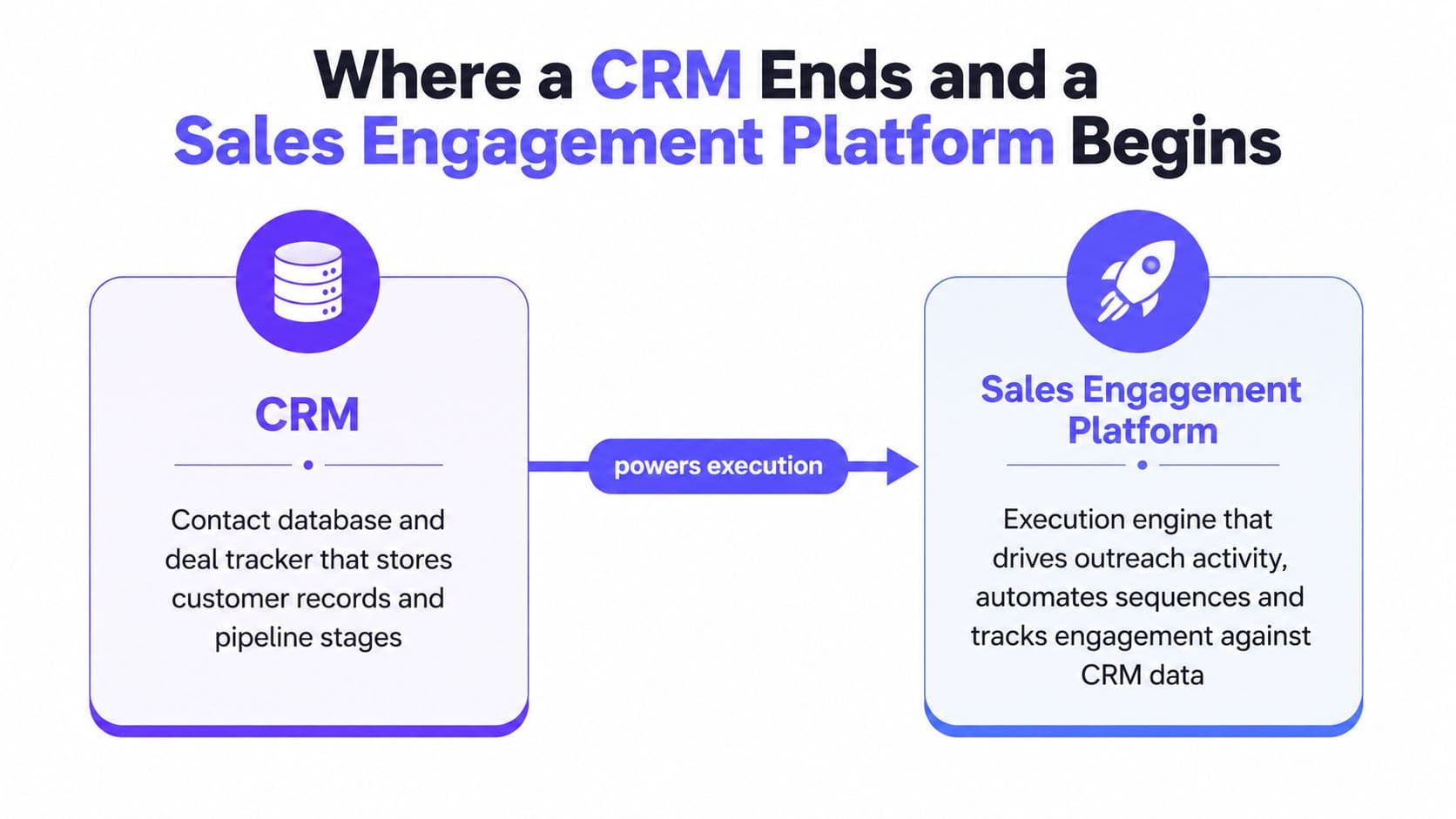
The strongest setup keeps calls, texts, and activity logging in one workspace so reps do not lose context between tools. That reduces mistakes and keeps compliance rules attached to the actual workflow. A sales engagement platform overview is useful here because it frames voice, messaging, and CRM as one operating layer instead of separate systems.
If you want that broader workspace approach, GrowOutly fits the model well. It gives revenue teams one place to manage outreach, record activity, and keep compliance visible without fragmenting the process across disconnected tools.
Final Recommendation and Next Steps
I'd make the choice like this. If you run a large, high-volume outbound operation, need aggressive list processing, and have the compliance muscle to monitor abandonment closely, a predictive dialer can be the right move. If you run a sales-focused team, sell into regulated or relationship-heavy markets, or care about a cleaner rep experience, a power dialer is the better default.
That's especially true when you're thinking beyond calls alone. The strongest setup is not “best dialer” in isolation, it's a broader workspace that combines calling, SMS, CRM history, compliance gating, and scheduling in one place. That's how you keep reps productive without turning every campaign into a software juggling act.
Whichever mode you land on, the dialer only decides how many conversations a rep gets. What happens inside them is still execution, so pair the decision with the close sales techniques that turn a live answer into a booked next step instead of another callback request.
I've seen teams overbuy predictive because they wanted more speed, then spend months cleaning up the mess that came with it. I've also seen teams stick with power dialing, keep the conversation quality high, and outperform larger groups because the workflow stayed disciplined and compliant. The difference wasn't ideology, it was fit.
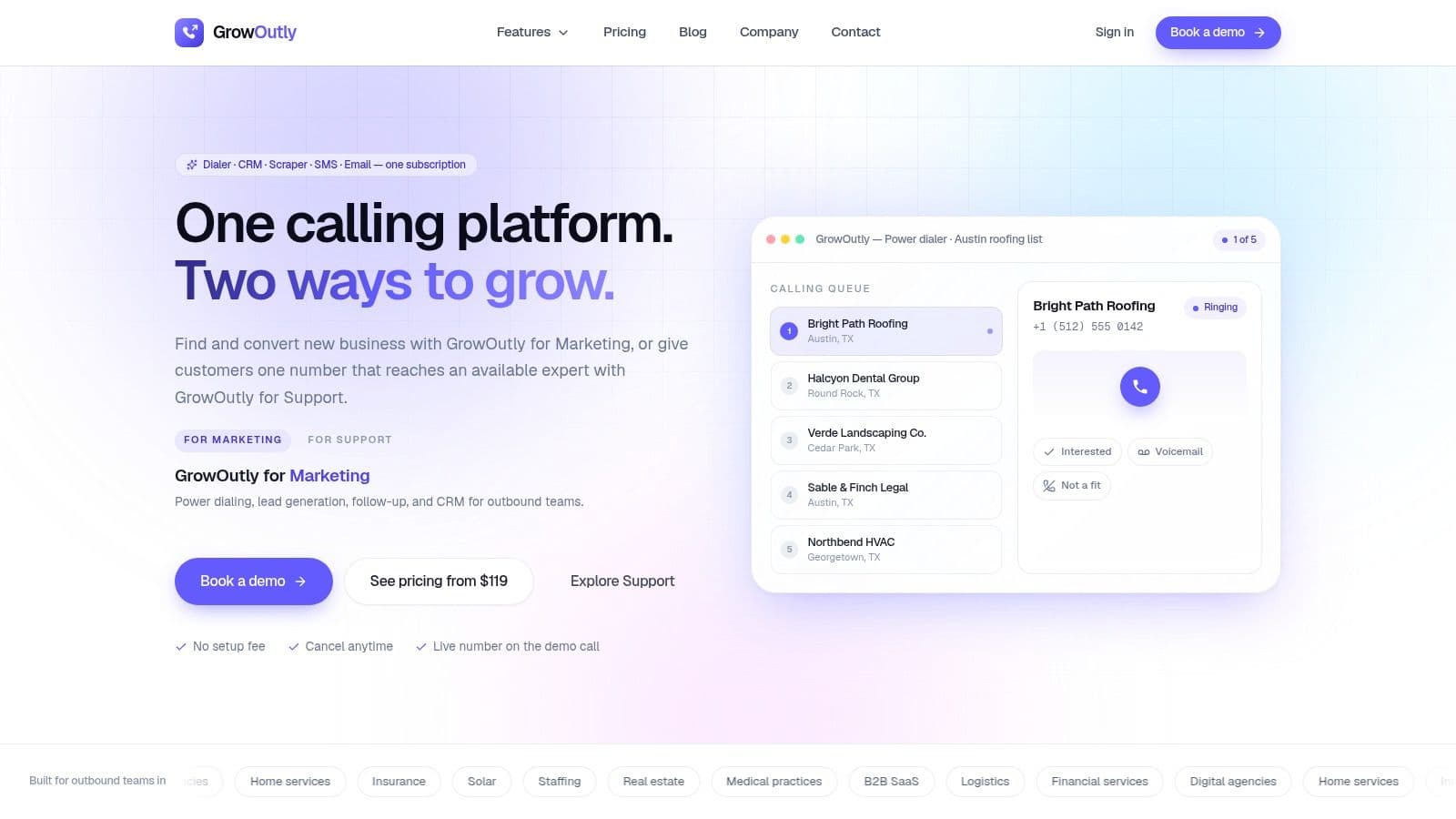
If you want a single workspace that keeps outbound calling, CRM context, SMS, and compliance in the same flow, GrowOutly is built for that kind of operating model. It gives marketing and support teams a practical way to manage outreach without scattering work across separate tools. Visit GrowOutly to see how that setup can support your team's dialer, messaging, and compliance needs.