The most popular advice about inbound vs outbound calls is to choose the motion that matches your business: inbound for service, outbound for sales. That's the wrong starting point. A customer can call about a problem, request a quote during that conversation, and need a business-initiated follow-up afterward.
My recommendation for 2026 is straightforward: share customer context, but keep ownership, permission checks, and performance scorecards separate. Connect the conversations without pretending the operations are interchangeable.
Why Inbound and Outbound Are Not an Either-Or Choice
Choosing between inbound and outbound creates an artificial boundary around the customer. Customers don't organize their needs around your departmental structure. They expect the next person they speak with to understand what happened before.
Voice still deserves serious operational attention. Live telephony represented 62% of inbound interactions at the end of 2024, according to the contact-center research summarized by Contact Center Pipeline. That's historical evidence supporting a voice strategy in 2026, not a new measurement of this year's channel mix.
The useful decision isn't whether to answer calls or make them. It's where to allocate capacity, what each team owns, and which customer signals justify another conversation.
Connect the customer journey, not the quotas
Consider a customer who calls because a service appointment hasn't been confirmed. The immediate job is to fix the scheduling problem. A requested callback belongs to that service workflow; a promotional pitch doesn't belong there because an agent now has the customer's attention.
Similarly, an inbound product question can establish a relevant next step. If the caller explicitly asks for a specialist to discuss options, the outbound team shouldn't restart with a generic prospecting script. It should continue the conversation the customer requested.
Operating principle: Share the history. Don't share a blanket assumption that every customer wants another sales call.
A connected model needs clear boundaries:
- Customer ownership: Name the person responsible for the next action, especially when support hands work to sales.
- Purpose: Record whether the follow-up concerns resolution, scheduling, retention, or a commercial inquiry.
- Permission: Keep the requested action distinct from broader marketing authorization.
- Capacity: Reserve enough coverage for incoming demand before assigning shared agents to campaigns.
Small teams can run both motions with carefully scheduled responsibilities. Growing teams should separate queue ownership from campaign ownership. Larger operations can specialize further while retaining a common customer record.
Integration is a workflow decision, not an instruction to blend every agent's job. You can connect inbound intelligence to outbound execution without making support responsible for prospecting or sales responsible for unpredictable queue coverage.
Defining Each Model in Operational Terms
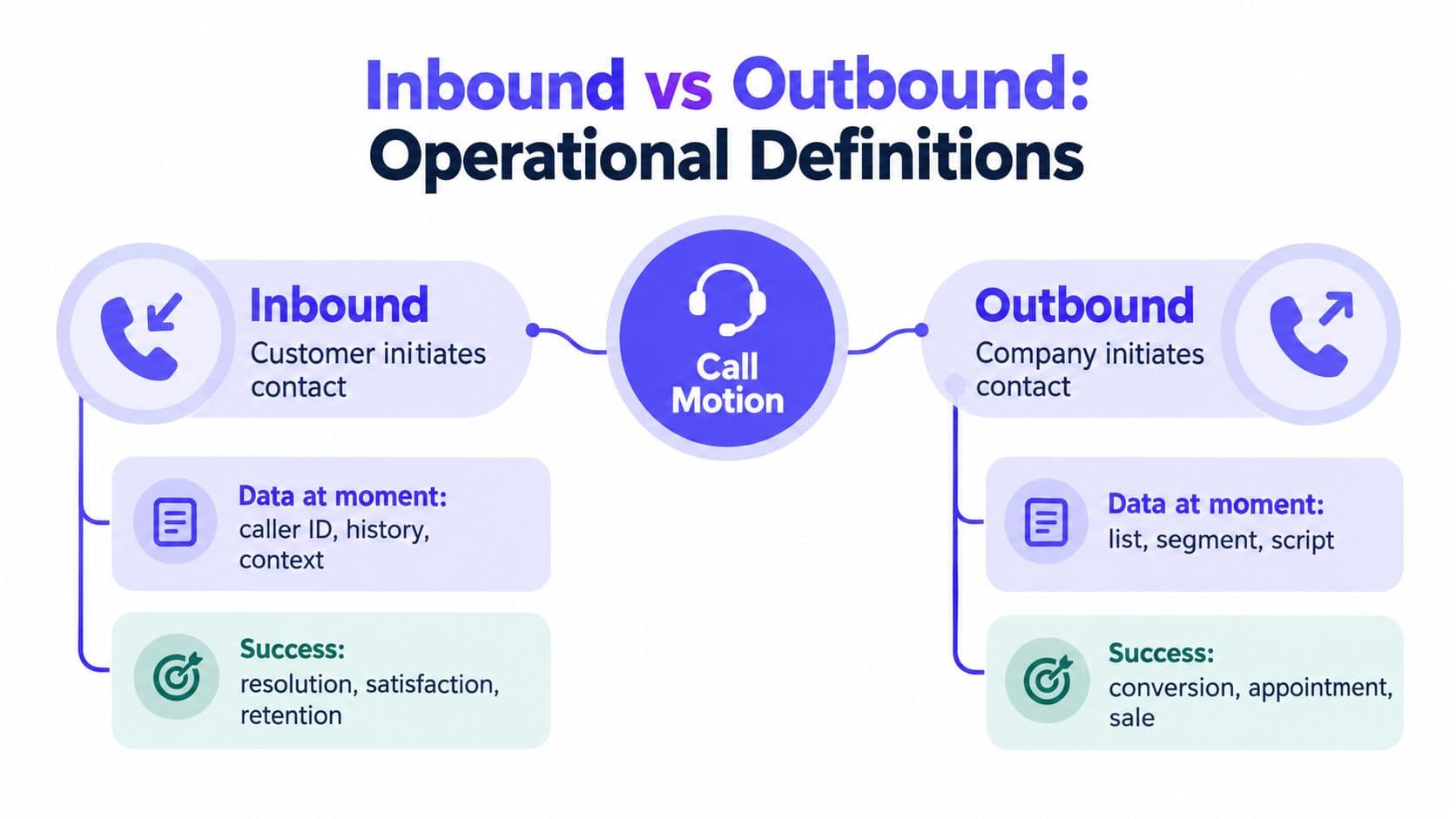
Inbound calls are customer-initiated conversations. Outbound calls are business-initiated conversations. Direction defines the motion, not whether the agent eventually sells something.
An incoming quote request is inbound sales. A call your team places to confirm a requested appointment is outbound service. Classifying both correctly prevents reporting errors and helps managers assign the right operating controls.
Define the work at the moment of contact
For an inbound conversation, configure the agent's workspace around caller identity, interaction history, and the reason for calling. IVR selections can provide an initial clue, but agents should confirm the actual need rather than treating a menu choice as a complete diagnosis.
For outbound work, the starting record is different. Agents need the contact's segment, the campaign purpose, prior attempts, the relevant script, and eligibility to contact that person. A lead list tells you whom you intended to reach; it doesn't establish what that person wants.
The distinction also changes how you define completion:
- Inbound completion: The caller's problem is resolved, the requested transaction is completed, or an accountable next step is agreed.
- Outbound completion: The conversation produces the campaign's intended outcome, such as qualification, an appointment, or a confirmed follow-up.
- Incomplete work: A transfer, voicemail, or unanswered attempt is an intermediate event, not automatically a successful customer outcome.
Separate direction from legal permission
Customer initiation changes the operational setting, but it doesn't erase governance responsibilities. The Congressional Research Service review of unwanted calls distinguishes the consumer-contact risks associated with proactive outreach and documents why records and controls matter.
Use explicit CRM fields for motion, purpose, disposition, and next owner. Don't force an agent to reconstruct these from free-text notes.
That vocabulary matters during handoffs. “Outbound callback for unresolved billing issue” gives the next agent a usable assignment. “Call customer” leaves the purpose, urgency, and expected outcome open to interpretation.
Side by Side Across Direction, Timing, Data, and Skills
The same agent can handle both motions, but the same workflow won't serve both well. Inbound callers need access to someone who can help. Outbound recipients need a credible reason to engage with an interruption.
Inbound and Outbound Operations Compared
| Dimension | Inbound Model | Outbound Model |
|---|---|---|
| Direction | Customer initiates contact | Business initiates contact |
| Timing | Staffing must accommodate arrival patterns and peaks | Campaign schedules must respect eligibility and calling windows |
| Available data | Caller identity, IVR selection, tickets, account history | Contact list, segment, campaign, prior attempts, consent record |
| Agent mindset | Diagnose, clarify, resolve | Establish relevance, qualify, agree on a next step |
| Scripting | Flexible diagnostic paths and escalation guidance | Structured opening, qualification, objections, and closing |
| Escalation | Transfer to a skilled agent with context | Route interested contacts to the appropriate specialist |
| Technology priority | Availability-aware routing and queue visibility | Dialer controls, campaign queues, and suppression checks |
Timing determines how managers allocate attention
Inbound managers should start with arrival patterns. If callers are waiting while agents perform discretionary prospecting, the shared staffing model needs correction. Campaign productivity doesn't compensate for customers being unable to reach support.
Outbound managers have more control over when eligible work enters an agent's queue. Use that control deliberately. Schedule campaigns around recipient time zones, available agents, and the capacity of the team that will receive qualified transfers.
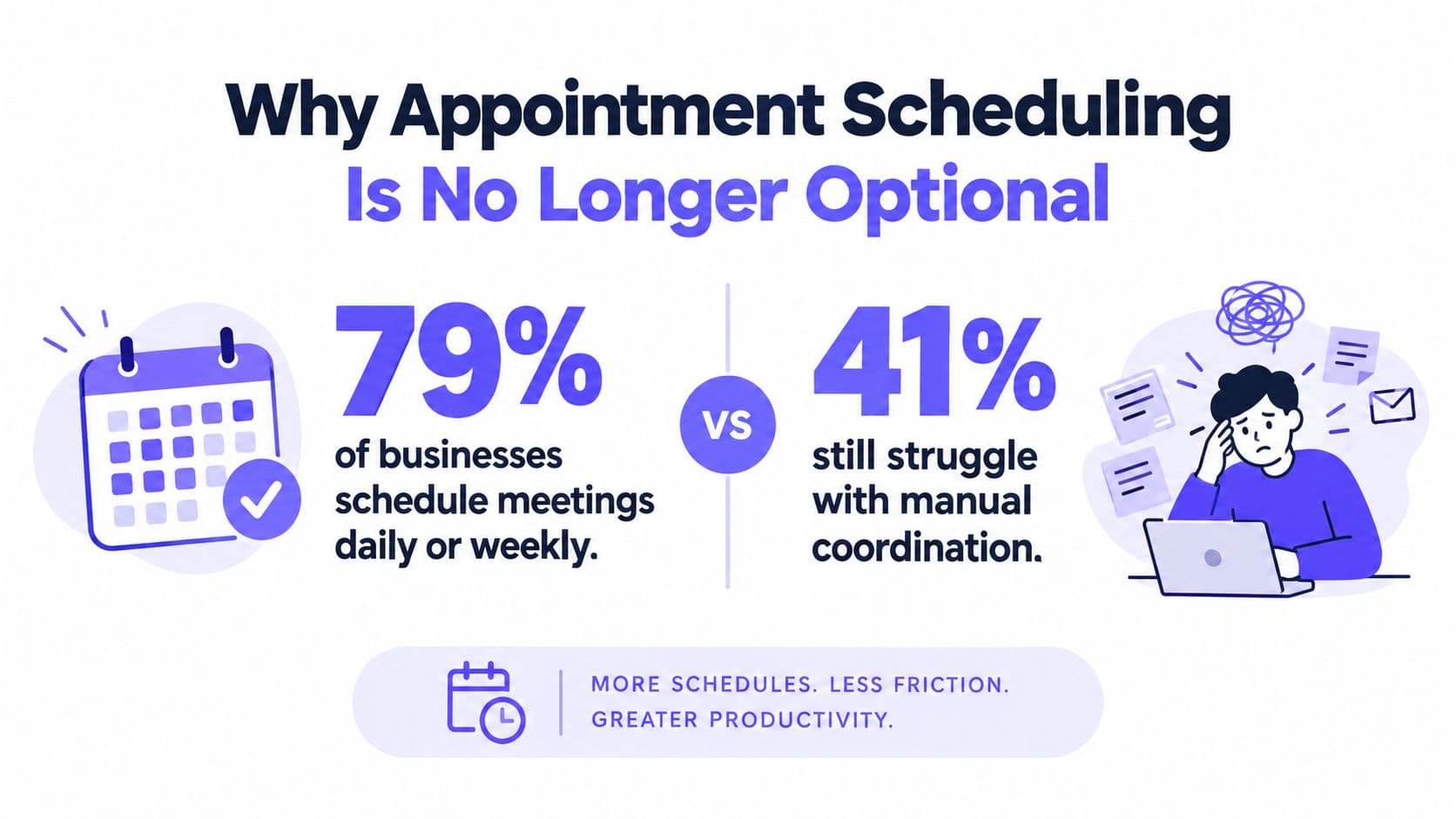
This distinction is especially important for home services. Booking agents shouldn't fill the calendar through territory outreach while incoming customers struggle to confirm existing appointments. Coordinate campaign plans with actual scheduling availability.
Scripts and skills need different depth
An inbound script should help agents investigate without trapping callers in unnecessary questions. Give agents decision paths for verification, troubleshooting, exceptions, and escalation. Require a useful transfer summary rather than making the customer repeat the problem.
An outbound script should earn permission to continue conversationally, establish relevance, and qualify the intended next step. Keep objection handling specific to the offer. Don't teach agents to defeat every refusal; teach them to distinguish uncertainty from a clear request to stop.
The regulatory distinction also affects workflow design. In the United Kingdom, the direct-marketing bulletin describing ICO responsibilities and Telephone Preference Service restrictions reinforces why outbound marketing needs permission-sensitive controls.
A shared phone number doesn't make the work identical. Train agents for the conversation they're entering, not just the software they're using.
When hiring, test diagnostic judgment for inbound roles and relevance-building for outbound roles. For blended positions, assess both separately. A strong service agent isn't automatically a strong prospector, and an effective appointment setter may need substantial product training before handling support escalations.
The KPIs That Actually Govern Each Motion
A dashboard that rewards calls completed across both motions encourages the wrong behavior. An inbound agent can close interactions without resolving anything. An outbound agent can make attempts without reaching qualified prospects.
Use separate scorecards, then connect them through customer-level outcomes.
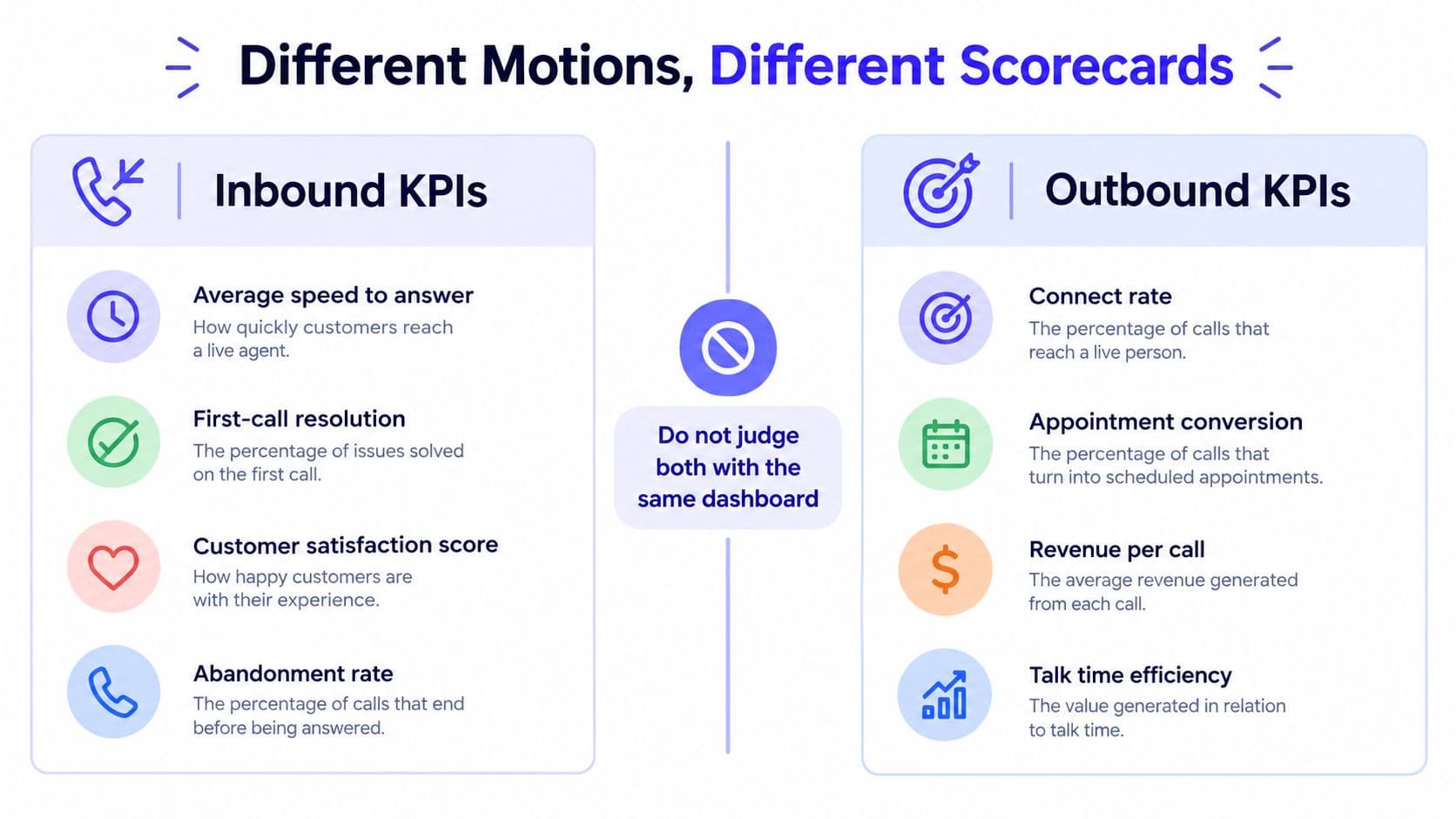
Inbound measures access and resolution
A widely used service-level benchmark is answering 80% of calls within 20 seconds, with typical abandonment benchmarks around 2% to 5%, as described in Capacity's call-center productivity guidance. Treat those as planning guardrails, not universal targets that override your customers' needs.
Track service level alongside average speed of answer, first-contact resolution, and abandonment. Define the abandonment denominator explicitly. Excluding short abandons changes the reported result, so managers shouldn't compare queues using inconsistent calculations.
Review performance by queue and time interval. Daily averages can conceal periods when callers couldn't reach a skilled agent. Also inspect repeat contacts: a short conversation isn't efficient if the customer must call again.
Outbound measures throughput and yield
The ICMI contact-center metrics guidance identifies outbound objectives including contact productivity, cost per contact, and time-of-day effectiveness. Build the reporting chain around:
- Live-contact rate: Live contacts divided by total dials.
- Contact-to-conversion rate: Desired outcomes divided by live contacts.
- Qualified outcomes per productive hour: Qualified outcomes divided by productive agent hours.
- Cost per contact: Define which staffing, platform, and campaign costs the calculation includes.
Low contact rate should trigger an investigation into list quality, timing, number reputation, and caller identification. Strong contact with weak conversion calls for a different diagnosis: qualification, offer relevance, script quality, or follow-up.
Keep units honest. Revenue per hour and appointments per hour aren't interchangeable; revenue reporting requires actual revenue in the numerator.
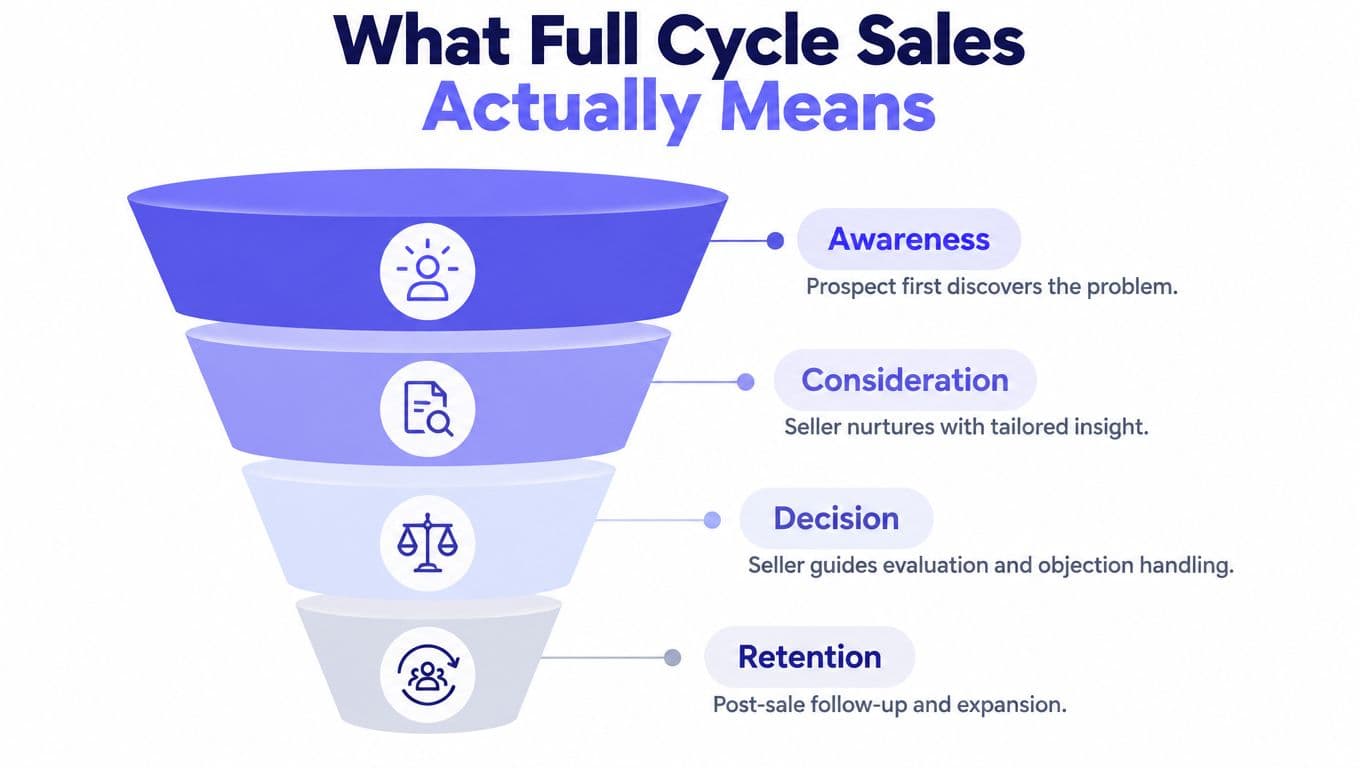
For teams managing full-cycle sales, connect activity to downstream opportunity progression. Preserve the originating motion and campaign so managers can distinguish productive outreach from activity that merely fills the dashboard.
Staffing, Scripts, and Tooling for Each Model
Buy capabilities against an operating problem, not a feature checklist. If callers can't reach the right agent, another outbound automation won't fix the queue. If reps spend their day dialing ineligible or irrelevant contacts, faster dialing won't fix the campaign. Our outbound sales software buyer's guide covers the data-readiness checks behind that, and the call center dialer software buyer's guide covers where the dialing engine ends and the routing layer begins.
Which queue a caller lands in is its own design problem, and our skills based call routing setup guide covers the taxonomy and fallback paths behind it.
For small teams, protect scheduled inbound coverage and assign outbound work to defined blocks. As demand grows, establish dedicated queue owners and campaign owners before adding more complex automation. Very large teams may need specialist systems, but they still need reliable synchronization of customer records.
Prioritize the inbound essentials
The inbound must-haves are availability-aware routing, skills-based queues, caller context, and visible escalation paths. IVR should identify intent or complete appropriate tasks, not create extra navigation for its own sake.
Use callback options where the operation can fulfill them reliably. Display relevant history before answer, with access controls appropriate to the information involved. The inbound call-routing buyer's guide is a useful starting point for evaluating routing requirements.
Distinguish essential capabilities from optional ones:
- Must have: Queue reporting, agent availability, contextual transfers, and accountable follow-up.
- Add when justified: More advanced IVR containment, specialized queue policies, and additional automation.
- Avoid: Routing rules so complicated that supervisors can't explain why a caller reached a particular team.
Equip outbound without removing judgment
Outbound teams need lead queueing, reliable dispositions, pre-contact compliance checks, and automatic activity logging. Add a power dialer when manual progression between eligible records is the bottleneck.
Local-presence caller ID and voicemail drop are capabilities to evaluate, not substitutes for trustworthy identification or permission. Prerecorded voicemail workflows deserve the same scrutiny as other automated outreach. Test scheduling handoffs so agents don't book meetings that receiving teams can't service.
A unified workspace is one option alongside specialist dialers, routing systems, and CRMs. GrowOutly consolidates outbound dialing, inbound routing, messaging, CRM records, compliance checks, and scheduling, allowing teams to keep these workflows together rather than assembling separate tools.
The platform view below illustrates that calling-workspace approach.
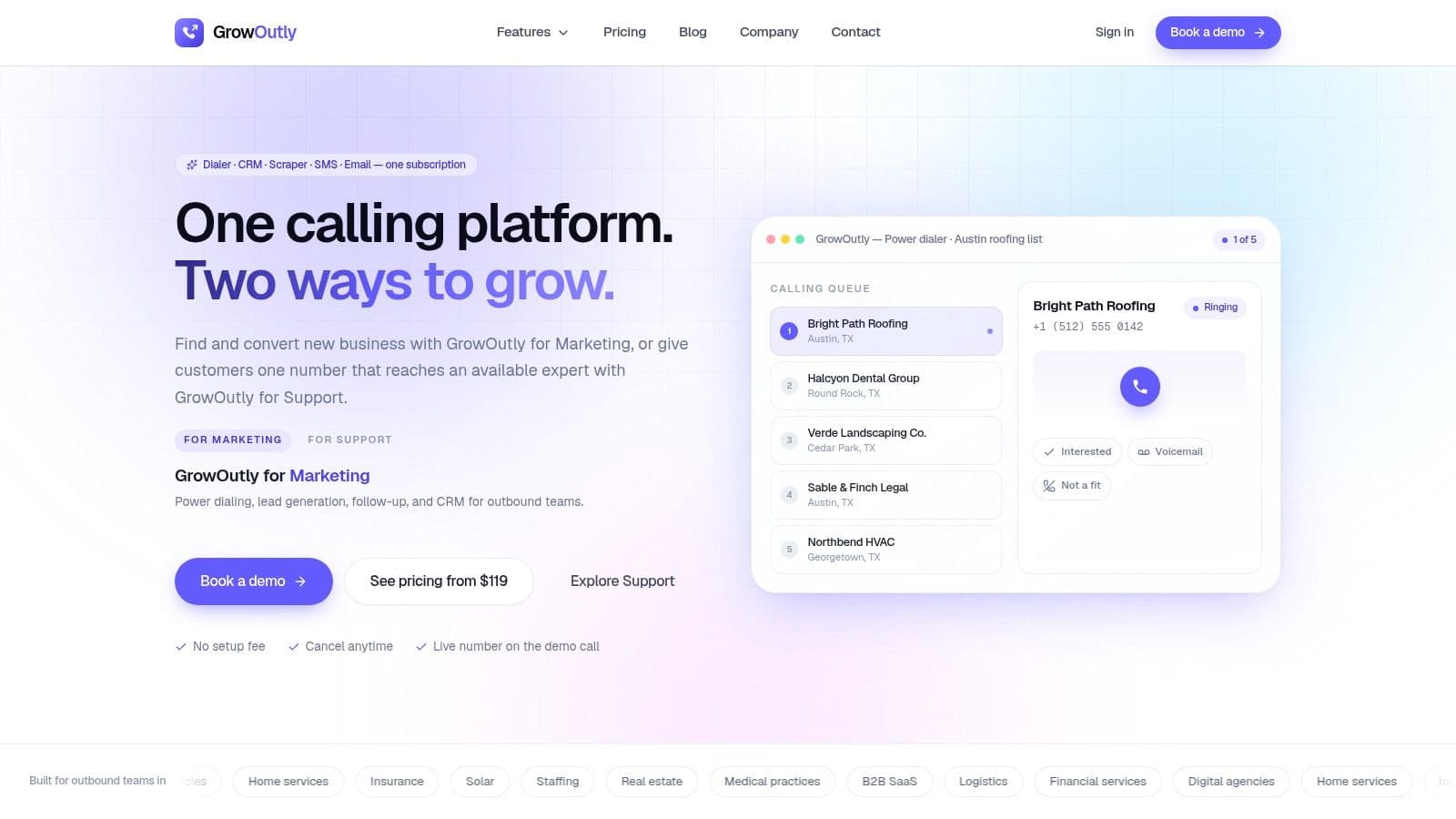
Before committing, test an unresolved support call, a restricted outbound attempt, and a qualified appointment handoff. Verify what agents see, what supervisors can audit, and what happens when the expected agent isn't available.
Buy the system your team can govern. A consolidated workspace simplifies some handoffs; a specialist stack can suit complex requirements if your team can maintain the integrations.
Using Inbound Signals to Power Smarter Outbound
An inbound conversation can tell your team what matters to the customer, how urgent it is, and what needs to happen next. That only works if the call and the record live in one place, which is the write-back loop power dialer CRM describes. Use that information to make follow-up relevant. Don't turn every service interaction into campaign enrollment.
Capture the signal before deciding whether outreach is appropriate.
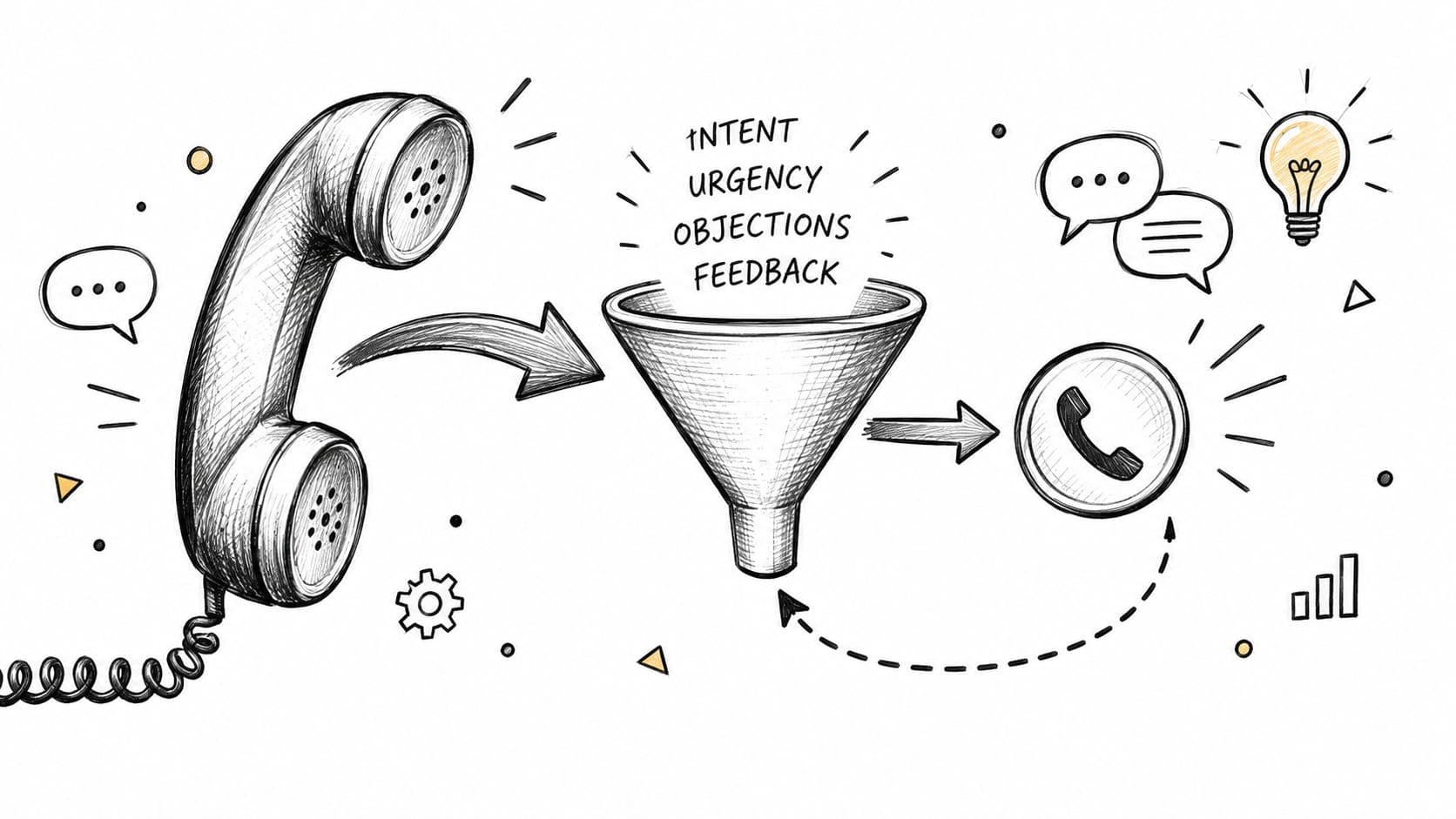
Route signals to the right action
A requested service callback should go to the resolution owner. An explicit sales inquiry can go to a qualified specialist with the customer's question attached. A renewal window or unfinished quote warrants an eligibility review, not automatic enrollment in a promotional sequence.
A complaint should first produce corrective action. A do-not-call request should produce suppression, not a retention campaign designed to overcome the objection.
- Capture intent: Record the customer's actual request rather than an agent's optimistic interpretation.
- Assign responsibility: Give the receiving team a named owner and a clear outcome.
- Check eligibility: Evaluate the purpose, channel, automation method, consent scope, and applicable restrictions.
- Preserve context: Include unresolved issues and promises already made.
The FCC's unwanted-communications enforcement guidance states that non-emergency autodialed or prerecorded calls to mobile phones generally require prior express consent, while telemarketing robocalls require prior express written consent. Texts generally fall within the TCPA calling framework, so automated promotional SMS needs corresponding consent controls.
Judge the handoff by what happens afterward
Don't credit the integration merely because support created a sales task. Check whether the follow-up addressed the original request, whether the customer had to repeat information, and whether unresolved service work remained open.
Track time from the inbound signal to the appropriate follow-up, resolution after transfer, repeat contacts, and consent-related exceptions. These measures tell managers whether connected workflows help customers rather than merely expand campaign lists.
Use the accompanying video as a discussion prompt when reviewing your team's follow-up process.
Trust boundary: A relevant reason to contact someone and legal permission to contact them are different requirements. Your workflow needs both.
The strongest connected model makes the next conversation more useful. If the customer experiences it as an unrelated interruption, the handoff failed even if the agent reached them.
SMS Outreach Keywords and Opt-In Mechanics That Stay Compliant
Keywords make SMS enrollment easier to operate, but a keyword alone doesn't establish compliant consent. The surrounding disclosure, the recipient's action, and the retained record matter.
The FCC's consumer guidance on unwanted robocalls and texts explains that recipients can revoke consent at any time and in any reasonable manner, including replying STOP. Don't limit recognition to an exact keyword when a recipient clearly asks you to stop.
Configure enrollment and support keywords
Use this working vocabulary when designing your messaging flow:
| Keyword purpose | Suggested keywords | Workflow response |
|---|---|---|
| Opt-in | JOIN, SIGN UP, YES, START | Present or confirm the applicable enrollment disclosure and retain the response |
| Opt-out | STOP, UNSUBSCRIBE, CANCEL, END, QUIT | Suppress the applicable outreach and log the request |
| Support | HELP | Identify the sender and provide a usable support route |
Before enrollment, identify the business, explain the message purpose and expected frequency, disclose potential messaging rates, and provide access to terms. Don't hide promotional enrollment inside an unrelated service request.
Use a confirmation step where practical to verify that the recipient intended to enroll. Double opt-in is a useful operational safeguard, not a substitute for the written consent required for covered telemarketing automation.
Make revocation work beyond the SMS inbox
Retain the consent source, disclosure version, scope, and revocation history. Your TCPA compliance checklist should translate those records into operational tests, not just a policy document.
A recipient who writes “please don't contact me again” shouldn't need to learn your preferred command. Route ambiguous requests for review and stop the affected automation while the team resolves them.
Synchronize restrictions across voice, SMS, and email according to the request's scope. A broad objection to marketing shouldn't leave another campaign free to contact the same person, while a channel-specific request should be recorded accurately.
Finally, test suppression against scheduled messages and queued calls. Logging an opt-out is insufficient if an already scheduled campaign can still execute.
Matching the Model to Your Team and a Best-Practices Wrap-Up
Choose the operating model your team can execute consistently. A small business doesn't need enterprise-level specialization, but it does need clear responsibility. A growing operation shouldn't rely on agents remembering which queue, script, or restriction applies.
Outbound-heavy B2B agencies and services firms should prioritize targeting, contact eligibility, qualified-conversation reporting, and dependable sales handoffs. Home services and local trade businesses should connect territory outreach with real appointment availability and protected coverage for existing customers.
Support-heavy teams should fix access and resolution before adding campaigns. Insurance and solar organizations planning high-volume outreach should make compliance readiness a launch condition. Staffing and recruitment teams should classify candidate communication by purpose rather than borrowing a generic sales cadence.
Match complexity to operating maturity
For a small blended team, use defined coverage blocks, a common customer record, and a supervisor who owns exceptions. For a growing team, establish separate motion owners and documented handoffs. For a large operation, evaluate specialized systems against integration reliability, audit access, and operational support requirements.
If your compliance posture is weak, don't accelerate dialing. Repair consent records, suppression logic, and review procedures first.
Consumer resistance deserves attention: the FTC reported more than 2.6 million Do Not Call complaints and approximately 258 million active registrations in fiscal year 2025 in its National Do Not Call Registry Data Book. Those complaints are unverified consumer reports, not a measured illegal-call or fraud rate.
Keep the operating checklist short
- Gate outreach: Check eligibility before calls and messages enter execution.
- Capture consent: Preserve purpose, scope, and withdrawal history.
- Maintain lists: Remove duplicates, stale records, and restricted contacts.
- Separate KPIs: Manage queue responsiveness independently from campaign yield.
- Handle SMS requests: Recognize keywords and plain-language objections.
- Plan capacity continuously: Review coverage, routing failures, and receiving-team availability.
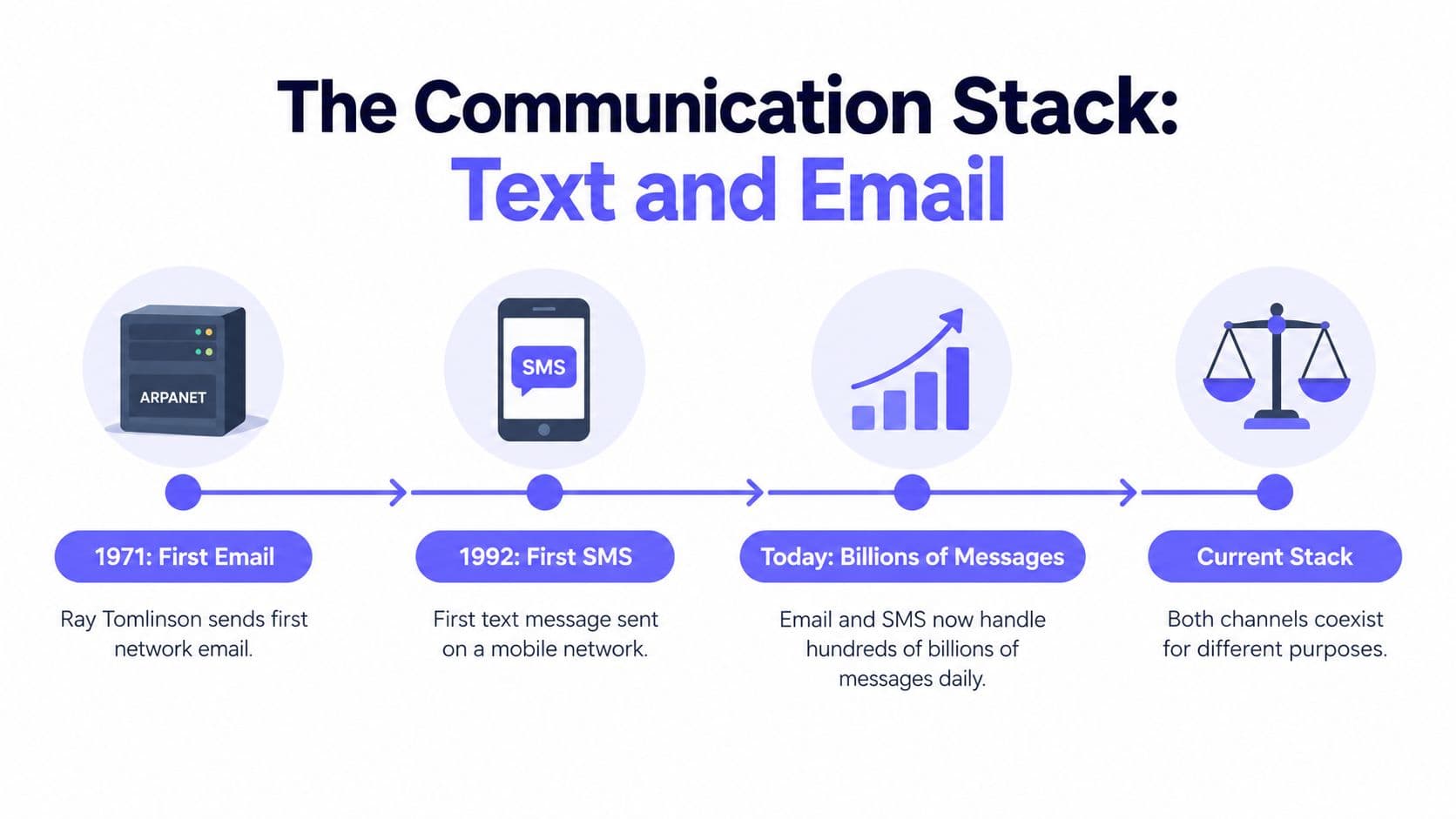
Choosing which channel carries each follow-up is a related call, and our guide to text or email covers that decision by intent and audience.
The recommendation isn't “do everything.” Run the primary motion well, connect the relevant customer signals, and expand only when your staffing and controls can support the next workflow.
GrowOutly offers outbound dialing, inbound routing, messaging, CRM records, compliance checks, and scheduling in a single workspace. Visit GrowOutly to evaluate how your team could connect inbound context to outbound follow-up, and test a support handoff, a consent-restricted contact, and an appointment-booking workflow before choosing your setup.